July 4 Weekend Aurora Watch Update: Tonight's Live Window for Austin, Houston, and Los Angeles
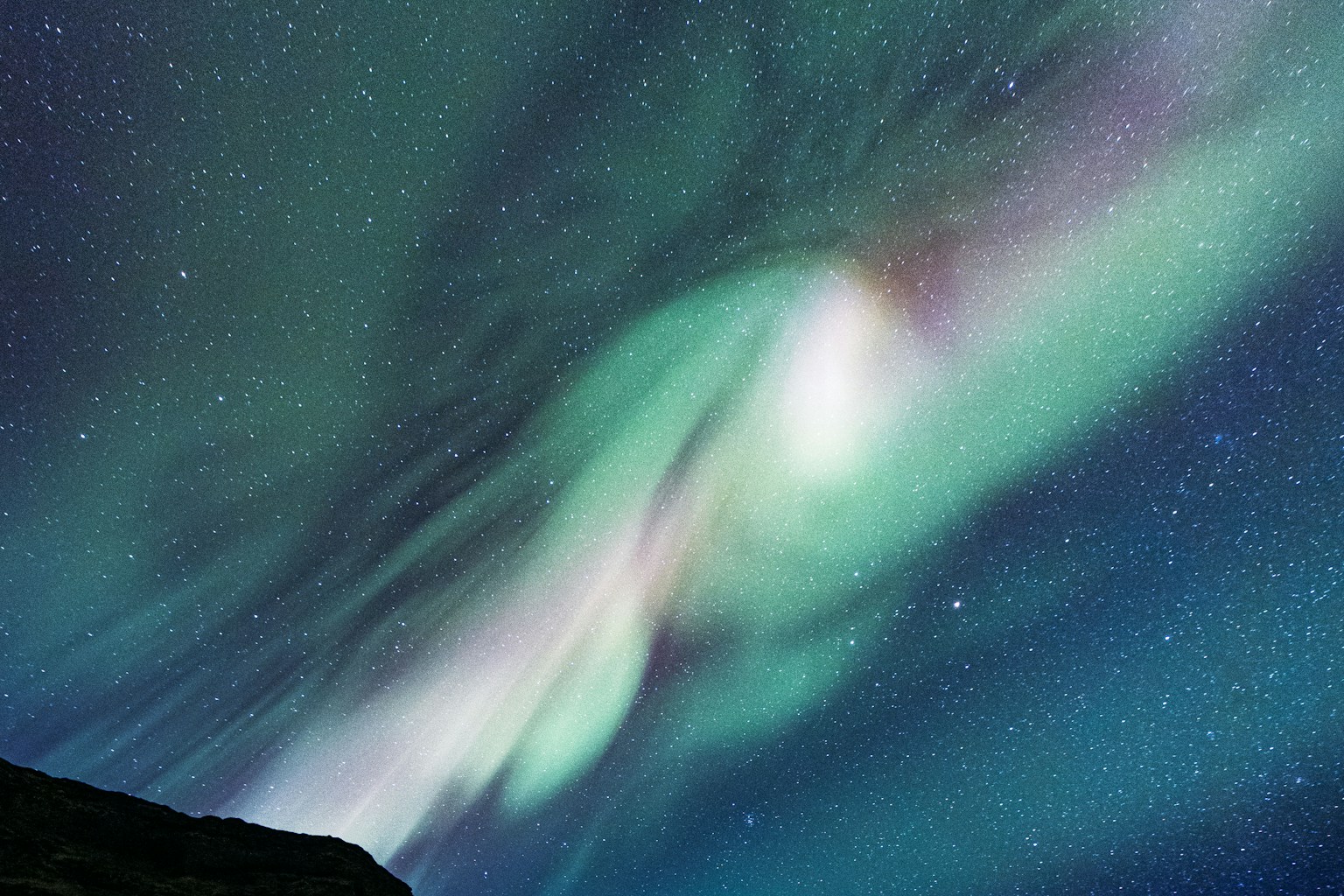
Update — July 3, 2026, 15:48 UTC / 10:48 a.m. CDT / 8:48 a.m. PDT: NOAA's latest 3-Day Forecast moved the most useful remaining U.S. window to 00:00-03:00 UTC on July 4. That translates to 7:00-10:00 p.m. CDT in Austin and Houston and 5:00-8:00 p.m. PDT in Los Angeles. The forecast got more urgent than the July 1 version, but it still does not line up cleanly with full darkness in any of the three launch cities.
NOAA's July 4 weekend aurora watch is still real. The practical story changed.
On Friday, July 3, 2026 at 12:30 UTC, NOAA's Space Weather Prediction Center said the greatest expected three-hour Kp block for July 3-July 5 is 5.67, or G2 (Moderate). The headline number matters, but the useful change for Cosmic Match readers is the timing: the strongest remaining U.S. window is now the 00:00-03:00 UTC block on July 4, which lands on Friday evening, July 3 in the United States.
That is why this post needed a same-day update. The forecast is no longer mainly a Friday morning miss for Austin, Houston, and Los Angeles. It is now a live Friday evening watch that still comes with awkward local lighting.
SpaceWeather added another layer of caution on July 3: the first CME hit Earth's magnetic field at 1200 UTC, but the impact was not strong and did not produce an immediate geomagnetic storm. NOAA still says G2-class storms are possible in the hours ahead, and another CME may graze Earth late on July 4. So the right posture is still the same one we use for all fast-moving space-weather stories: monitor, do not guarantee.
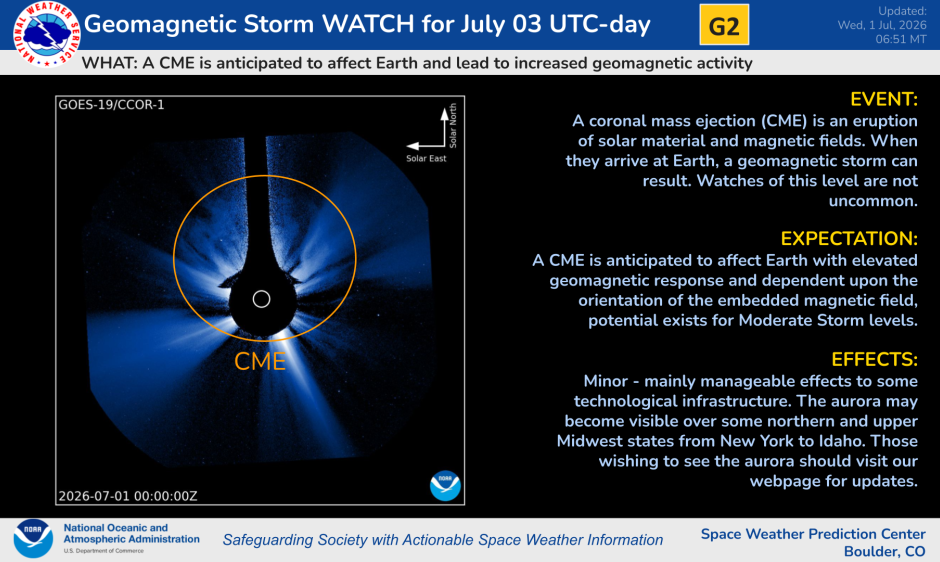
The July 3 watch is still official. The same-day update is about where the strongest remaining block now sits on the clock for U.S. readers.
What Changed Since the July 1 Version
The original July 1 version of this article focused on a worse setup: the strongest official block then landed at 12:00-15:00 UTC on July 3, which mapped to daylight in Texas and dawn/daylight in Los Angeles.
NOAA's July 3, 2026 12:30 UTC forecast still includes that earlier block, but it also places another G2 block at 00:00-03:00 UTC on July 4. For U.S. readers, that second block is the one that matters now.
NOAA's 15:05 UTC Geophysical Alert Message tightened the same takeaway in plain language: space weather for the next 24 hours is predicted to be moderate, and geomagnetic storms reaching the G2 level are likely.
This is the cleanest way to frame the change:
- Official NOAA fact: the strongest expected Kp in the current forecast is still 5.67 (G2).
- Official NOAA fact: there is now a second G2 block at 00:00-03:00 UTC on July 4.
- Cosmic Match local inference: that shift makes Friday evening, July 3 the live window to watch in Austin, Houston, and Los Angeles, even though it still does not align neatly with full darkness.
If you want a lower-risk backup for the holiday weekend, our guide to where to stargaze this week in Austin, Houston, and Los Angeles is still the safer plan than building the whole night around aurora hopes.
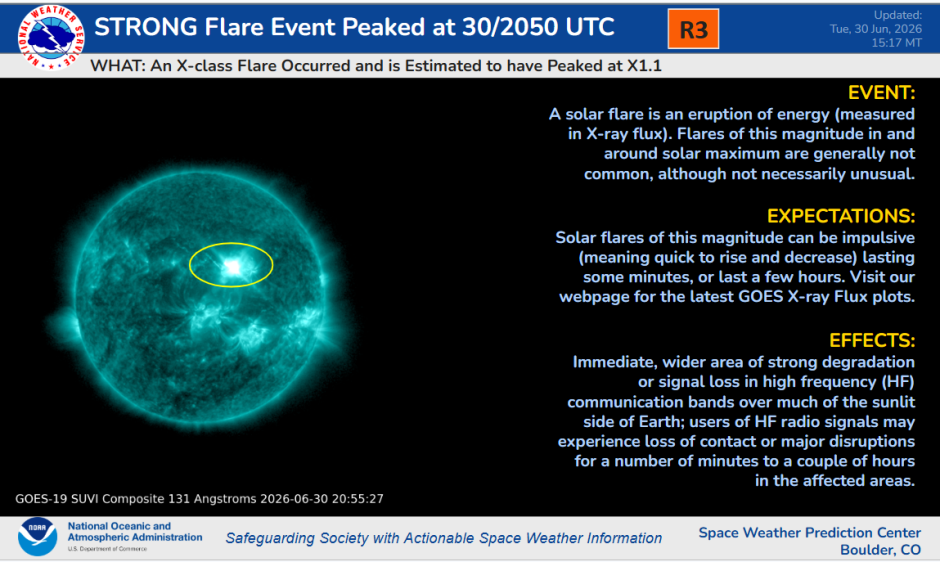
The watch still traces back to the June 30 flare and CME sequence, but the live timing shift is what changed the local reading on July 3.
Tonight's Remaining Practical Windows
Here are the forecast blocks that matter most for the night of Friday, July 3 local time:
| NOAA block | Austin / Houston | Los Angeles | Practical read |
|---|---|---|---|
| 00:00-03:00 UTC on July 4 | 7:00-10:00 p.m. CDT on July 3 | 5:00-8:00 p.m. PDT on July 3 | Strongest official block at G2, but it starts before sunset in all three cities. |
| 03:00-06:00 UTC on July 4 | 10:00 p.m.-1:00 a.m. CDT | 8:00-11:00 p.m. PDT | Darker local skies, but the forecast steps down to G1. |
| 06:00-09:00 UTC on July 4 | 1:00-4:00 a.m. CDT | 11:00 p.m.-2:00 a.m. PDT | Darker still, but the official forecast drops below storm level. |
This is why the update is more urgent than convenient.
Using Time and Date's July 3 tables, sunset is about 8:36 p.m. in Austin, 8:25 p.m. in Houston, and 8:08 p.m. in Los Angeles. Civil twilight runs later than that. So even though NOAA's strongest remaining block now reaches local evening, it still arrives too early to count as a clean dark-sky setup.
That does not make the update meaningless. It just changes the question from "Is this basically a daytime miss?" to "Does the storm stay elevated long enough into darker hours to give local watchers a marginal chance?"
Why Tonight Is Still Not a Promise
This is the beginner point that matters most: a G2 forecast is a storm-intensity forecast, not a city-by-city visibility promise.
On NOAA's own Space Weather Scales page, G2 is the level where aurora has been seen as low as New York and Idaho under favorable conditions. Austin, Houston, and Los Angeles sit well south of that benchmark, so the local read depends on more than the raw Kp number:
- whether the CME-driven disturbance actually strengthens the way NOAA expects
- whether elevated activity lasts into darker local hours
- whether your local horizon and sky transparency are good enough to capitalize on a marginal event
SpaceWeather's July 3 note is useful here because it keeps the article honest. The first CME already hit at 1200 UTC and did not trigger an immediate storm. That does not cancel NOAA's forecast, but it is a reminder that space-weather timing can wobble even after impact begins.
If you are new to aurora forecasting, the right mindset is: tonight is worth watching more than it was on July 1, but it is still not a clean local aurora call for Texas or Southern California.
If you want an easier first astronomy outing that works even when the lights do not cooperate, find local stargazers on Cosmic Match and plan around a normal observing night instead of an all-or-nothing aurora chase.
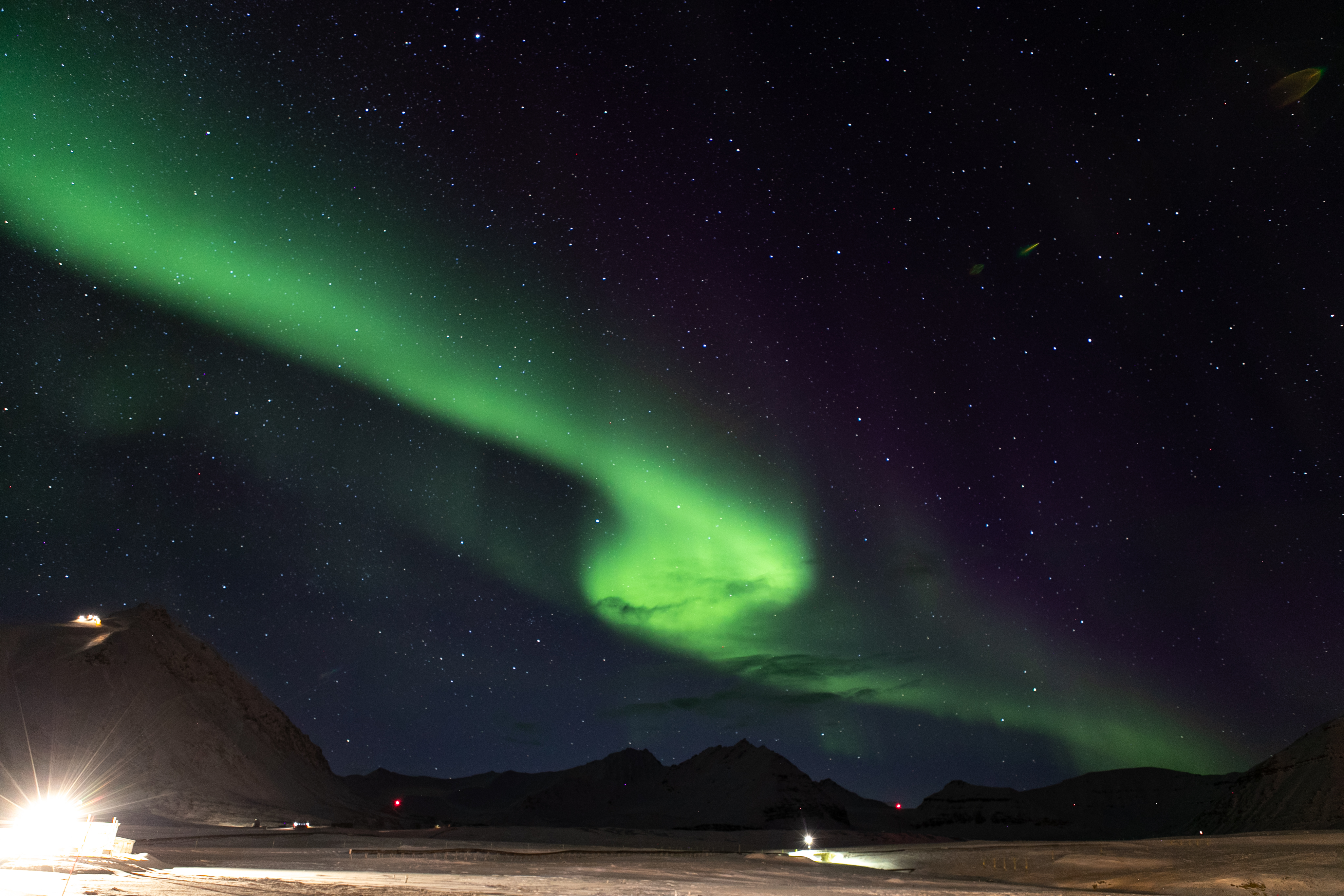
Most dramatic aurora photos come from higher latitudes with cleaner darkness than Austin, Houston, or Los Angeles will have tonight. Use them as context, not as proof of what your own sky will do.
The Honest City-by-City Read for Friday Night
Austin
Austin's useful remaining window is now the 7:00-10:00 p.m. CDT block on Friday, July 3, because that is when NOAA places the strongest official G2 period. The catch is timing. Sunset is about 8:36 p.m., so the strongest block begins in daylight and only reaches deeper twilight late in the window.
After that, the forecast slips to G1 from 10:00 p.m. to 1:00 a.m. CDT, when the sky is darker but the official storm strength is lower.
The honest Austin read is: this is finally a real same-evening watch window, but still not a strong local aurora bet. If you are already heading west of the city for dark skies, it is worth keeping an eye on the northern horizon. It is not worth promising yourself a show.
If you would rather spend the night with people who will appreciate the space-weather story either way, you can meet local space lovers in Austin.
Houston
Houston gets the same official timing as Austin: 7:00-10:00 p.m. CDT at G2, then 10:00 p.m.-1:00 a.m. CDT at G1.
The local problem is also similar, with one extra practical downside: humidity and haze often make low-contrast horizon events even harder to catch around Houston. Sunset is about 8:25 p.m., so a meaningful piece of the strongest block still happens before the sky is properly dark.
That makes Houston a watch-if-convenient situation, not a rearrange-your-night-around-it situation. If the disturbance overperforms or lingers, the conversation improves. If it behaves exactly like the forecast, the lighting problem never fully goes away.
If you want a safer holiday-weekend plan, find Houston stargazers on Cosmic Match and treat any aurora check as a bonus rather than the entire event.
Los Angeles
Los Angeles now gets the earliest version of the strongest block: 5:00-8:00 p.m. PDT on Friday, July 3. That sounds useful until you compare it with the sky. Sunset is about 8:08 p.m., so most of the official G2 window is still daylight or bright twilight.
The darker local period comes immediately after, from 8:00-11:00 p.m. PDT, but NOAA lowers the forecast to G1 there.
So Los Angeles now has a cleaner same-day urgency story than the July 1 version, but not a cleaner darkness alignment story. If you check, think of it as a twilight-to-early-night monitor window, not as a guaranteed Southern California aurora event.
If you want to keep the night social even if the forecast fades, browse the Los Angeles astronomy community.
How To Handle Tonight Without Overcommitting
If you want to play the update smart, keep the plan simple:
- Re-check NOAA's 3-Day Forecast and Alerts / Watches pages before your local evening begins.
- Pay more attention to whether elevated activity holds into darker hours than to whether one table cell says G2.
- Treat reports from farther north as useful context, not automatic proof that your own city is next.
- Keep a backup astronomy plan that still works if the aurora never becomes locally visible.
That last point matters. Cosmic Match readers do not need every interesting sky alert to turn into an all-or-nothing chase. Sometimes the smarter move is to watch the forecast, learn how the timing works, and spend the night with people who already care about the same sky stories. You can join the Cosmic Match community and build a better default observing plan for the rest of the weekend.
Bottom Line
The useful update is simple: Friday evening, July 3, 2026 is now the live window to monitor, because NOAA's strongest remaining block shifted to 00:00-03:00 UTC on July 4.
That is a real forecast improvement over the July 1 version. It is not the same thing as a clean aurora setup for Austin, Houston, or Los Angeles. In all three cities, the strongest block still begins before true darkness, and the darker hours come after NOAA steps the storm level down.
So the correct posture tonight is still the same one that keeps readers honest: watch it, learn from it, and do not guarantee it.