Moon and Venus After Sunset on July 17: A Beginner Twilight Guide
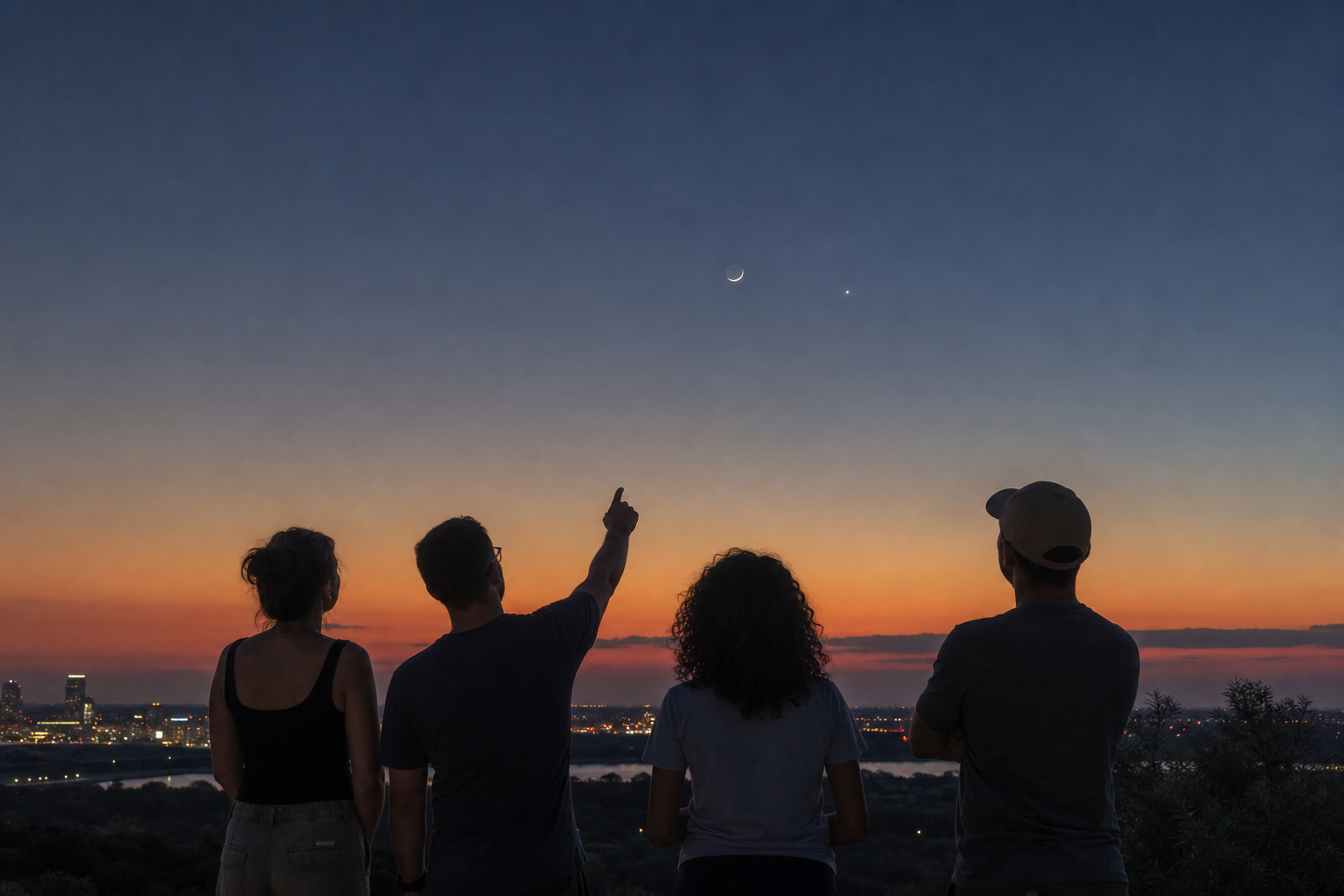
On Friday, July 17, give yourself one small job after sunset: find an open view to the west. A slim, three-day-old crescent Moon will be sharing the evening sky with Venus, the brilliant planet that is hard to mistake for anything else once the sky begins to dim. You do not need a telescope, a memorized star chart, or a late-night drive. A clear horizon and a little patience are the whole plan.
The pair is a genuine close approach, separated by about 2°01′. That is roughly the width of two fingertips held at arm’s length. It is a lovely scale for the naked eye and binoculars, although it is too wide to expect both objects in a typical telescope view. The best part is the timing: this is a twilight sight, so it is an easy first skywatch for people who prefer a social evening to an all-nighter.
Your simple July 17 plan
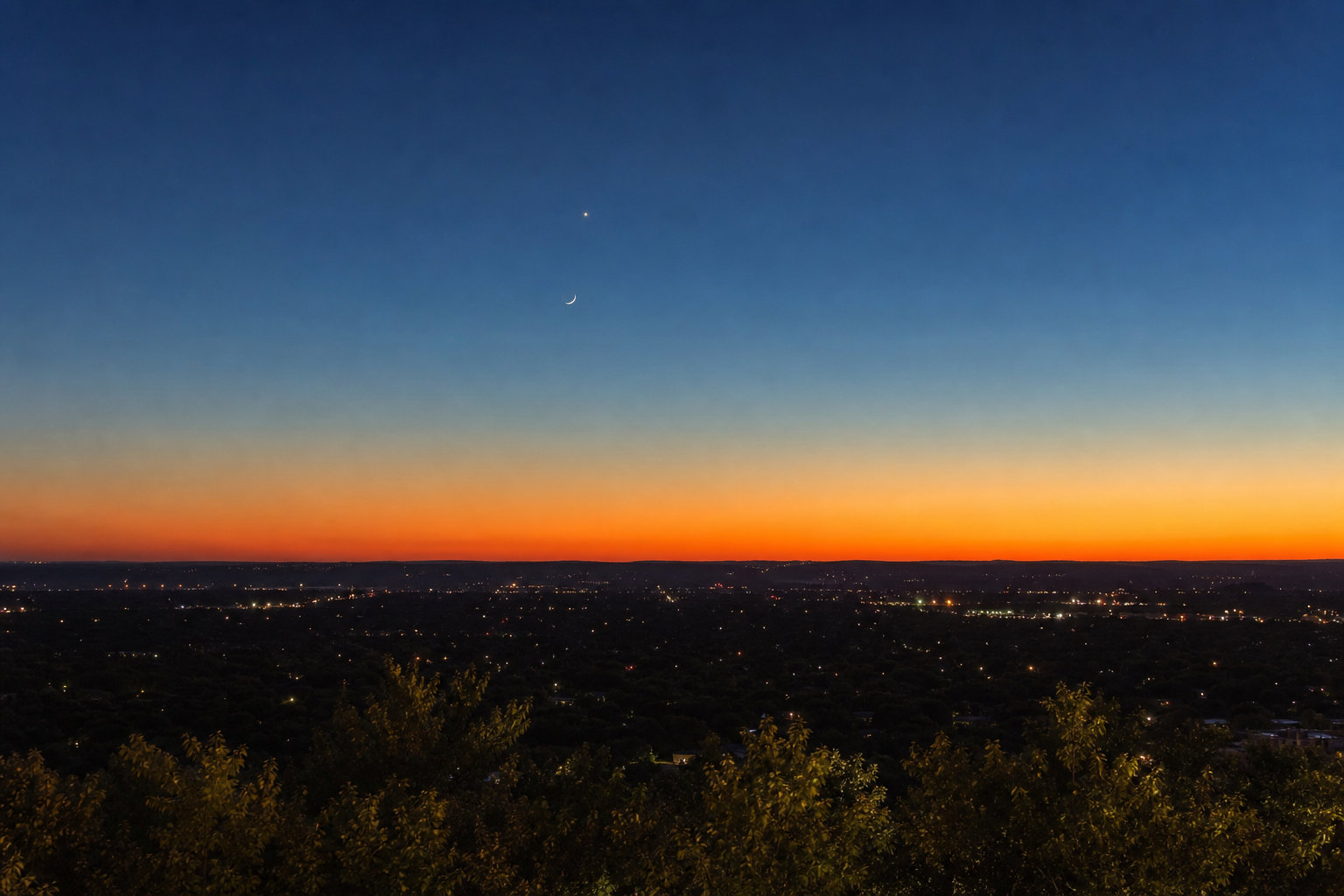
Pick a place with an unobstructed western view: a park edge, hilltop, waterfront path, balcony above nearby roofs, or even a parking area with a wide horizon. Arrive just before local sunset, settle in, and begin looking 25 to 35 minutes after sunset. The sky should still be blue enough to feel friendly, while Venus starts to pop.
Look low in the west first. Venus will be the intensely bright, steady point. Once you find it, scan nearby for the delicate crescent Moon. A hand held at arm’s length helps you judge the spacing: the two will be close, but not touching. If the Moon feels unexpectedly faint at first, give your eyes five more minutes and try again. Twilight changes quickly.
For a practical city window, plan a flexible 20-minute watch rather than chasing a single exact minute:
- Austin: start looking around 8:55–9:15 p.m. CDT from a west-facing spot. Hills, trees, and apartment blocks matter more than a few minutes on the clock.
- Houston: try roughly 8:40–9:00 p.m. CDT. A flat western horizon is especially helpful; check cloud cover before you leave.
- Los Angeles: look around 8:25–8:45 p.m. PDT. Coastal haze can soften the low sky, so an elevated inland overlook may improve the view.
Those windows are starting points, not guarantees. Check your local forecast on the afternoon of July 17, and do not wait for darkness: Venus and the Moon will both sink toward the horizon as the evening goes on. In-The-Sky.org’s current ephemeris for nearby San Antonio places the pair about 26° high around 8:50 p.m. CDT and confirms that both are naked-eye targets. Your local horizon will make the final call.
What to bring — and what to skip
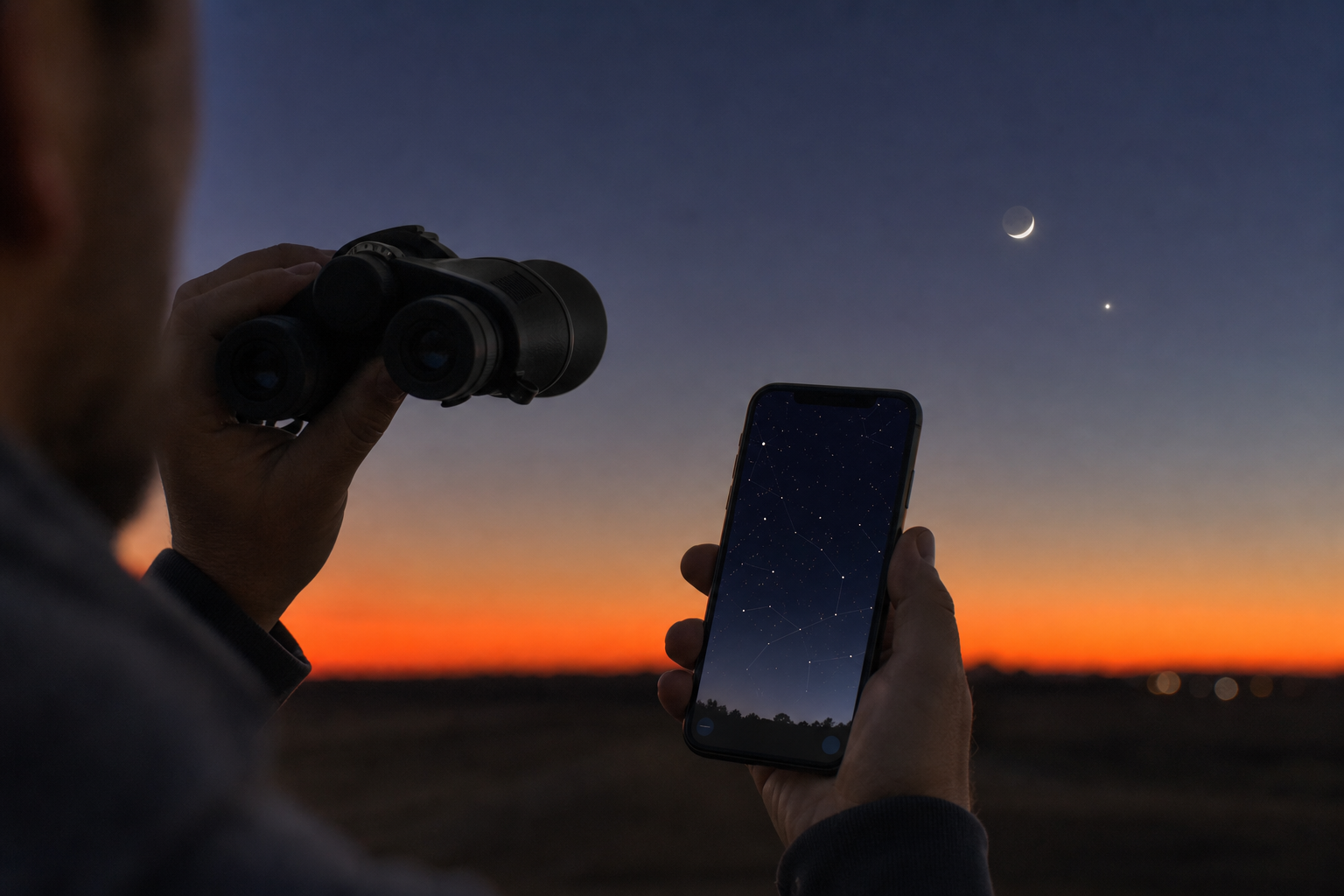
The no-equipment version is completely valid. Bring a water bottle, a light layer, and a friend who will enjoy the tiny victory of finding Venus first. Binoculars can make the Moon’s crescent more satisfying, but do not point them anywhere near the Sun; wait until after sunset and use them only on the already-safe evening sky.
A phone sky-map app is useful as a backup, not a test. Set the screen dim, glance once to confirm west, and then put it away. Your eyes will do a better job adapting when they are not negotiating a bright display. If you are coming from a bright restaurant patio or a well-lit sidewalk, step a little farther from direct lights and wait a few minutes.
Make it an easy shared outing
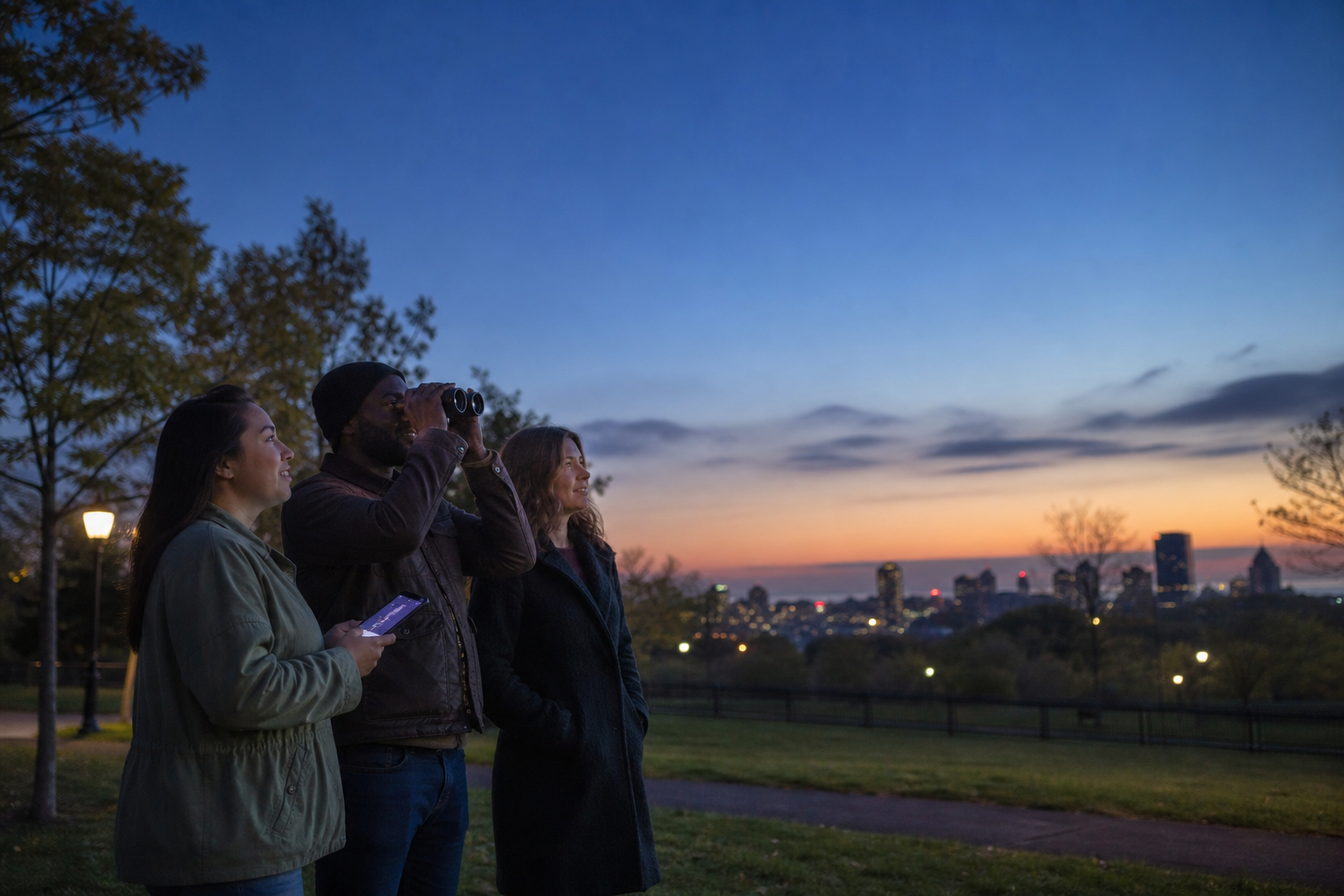
This conjunction is tailor-made for a low-pressure invitation: “Want to meet somewhere with a clear western view for 20 minutes after sunset?” There is no gear barrier and no need for anyone to sound like an expert. One person can watch for Venus, another can find the Moon, and everyone gets a good excuse to linger through the last color in the sky.
If you are new to finding people who want to do this kind of thing, Cosmic Match is built for shared sky plans. You can join the astronomy community at Cosmic Match and start a conversation with a simple July 17 prompt: Where is your favorite west-facing sunset spot? For a follow-up outing, use our guide to finding the Summer Triangle from a city balcony. It is another no-telescope target that rewards a little looking up.
The goal is not to produce the perfect photo or identify every star. It is to notice something real together. Venus will look bright enough to be almost unreal; the young Moon will look like it has been drawn in with a fine silver pen. Both are simply sunlight, seen from two very different neighbors in our solar system.
A few helpful expectations
Do not confuse closeness in the sky with closeness in space. The Moon is our nearby companion, while Venus is vastly farther away; their apparent pairing is a line-of-sight effect from Earth. That is exactly what makes conjunctions fun: familiar objects briefly share a piece of the sky.
Clouds are the main spoiler. A thin bank low in the west can hide the pair even when the rest of the sky is clear. If that happens, do not assume you missed it—wait a few minutes for a gap and try a second location with a cleaner horizon if it is safely nearby. Skip the hunt if storms are approaching or visibility is poor. There will be more sky evenings.
One last look west
Set a reminder for July 17, check the forecast that afternoon, and keep your plan comfortably simple. Find west. Start about half an hour after sunset. Spot Venus. Then look nearby for the slender Moon.
If you see the pair, share the moment with someone who gets why two bright points above a city horizon can rearrange an ordinary Friday. And if you are looking for future observing company, explore Cosmic Match and make your next “look west” plan together.
Source: In-The-Sky.org’s July 17 conjunction ephemeris, checked July 17, 2026; event calculations use JPL DE440.