How to Find the Summer Triangle From a City Balcony

How to Find the Summer Triangle From a City Balcony
If your sky is more apartment glow than dark-sky drama, the Summer Triangle is still one of the easiest wins you can get in July. By the second week of the month, Vega, Deneb, and Altair are bright enough to cut through a lot of city light pollution, which makes this pattern a good first target for balcony observers who do not own a telescope and do not want a complicated setup.
That does not mean a city balcony turns into a dark-sky site. It does not. You probably will not see the Milky Way, and the smaller constellations around the Triangle may stay washed out. But the Triangle itself is different: it is large, bright, and forgiving. If you can give your eyes a few minutes, face the right part of the sky, and keep nearby glare under control, you can learn it in one short session and use it as a reference point for the rest of summer.
Why the second week of July works
The Summer Triangle is a seasonal pattern, not a one-night-only event, but early July is a particularly friendly learning window. In July evenings across the Northern Hemisphere, the Triangle stands in the eastern sky after dusk and climbs higher as the night goes on. Around July 7 to July 8, 2026, the Moon is at third quarter, which helps because the first half of the evening is darker than it would be near full moon. For a beginner on a balcony, that means less fighting against glare before midnight.
If you already read our earlier Summer Triangle guide for mid-June, think of this post as the simpler city version. The June piece was about learning the pattern before the solstice and using it as a launch point for deeper observing. This one is about the low-friction version: no gear, no highway drive, no pretending your balcony is a mountain.
The three stars you are looking for
The Summer Triangle is an asterism, which just means a recognizable pattern rather than an official constellation. Its three corners are:
- Vega, in Lyra, usually the easiest one to notice first.
- Deneb, in Cygnus, farther from the city skyline and often part of a larger cross shape once your eyes adjust.
- Altair, in Aquila, lower and often the last corner beginners feel sure about.
The good news is that these are all bright stars. The better news is that the Triangle is huge. First-timers often expect a tight little shape, then miss it because they are staring too narrowly. Relax your gaze and let the pattern span a big section of sky.
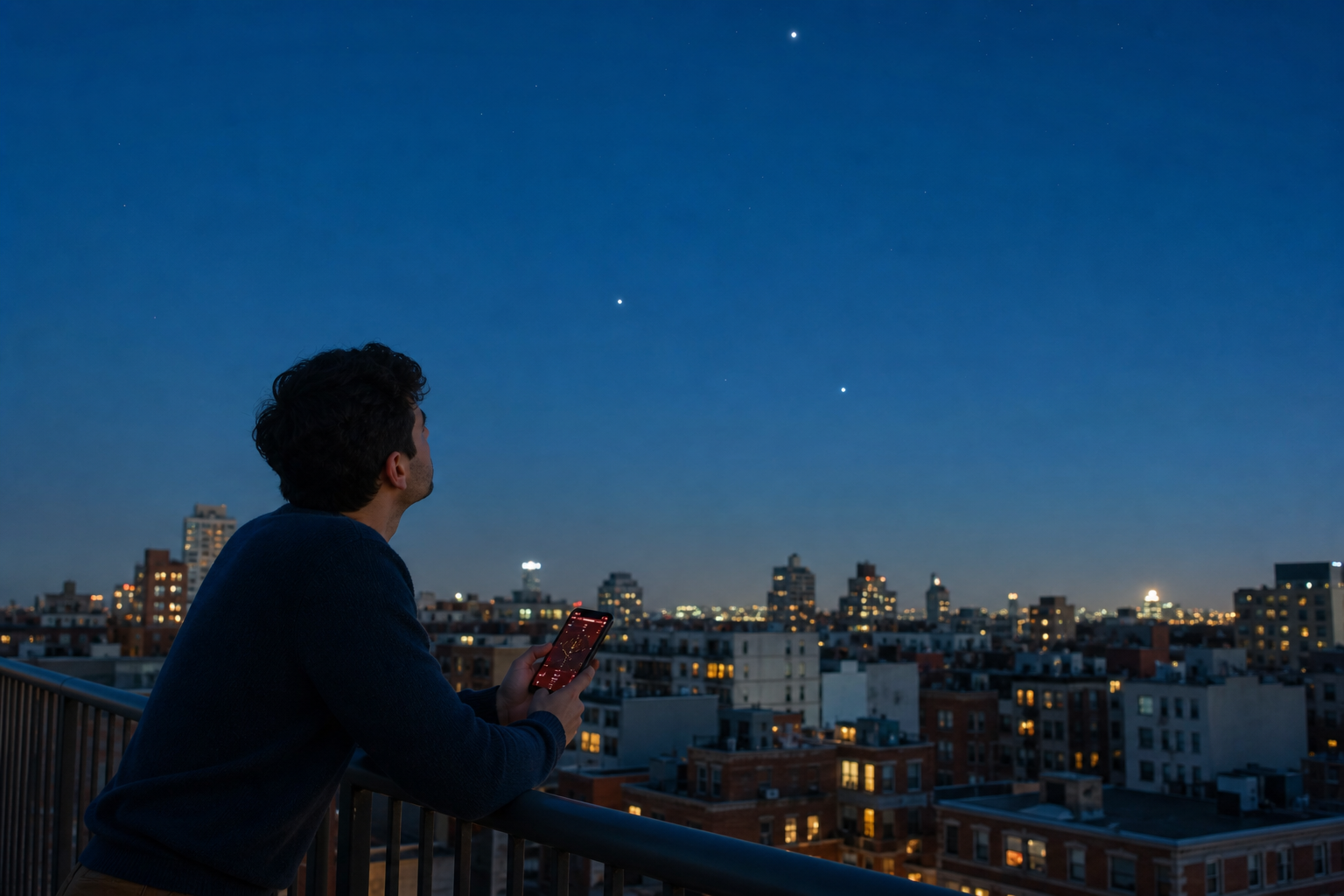
Step 1: Start after twilight, not at sunset
The easiest mistake is going outside too early, deciding the sky is washed out, and quitting after two minutes. Wait until twilight is mostly gone. On a July balcony, that usually means starting well after sunset, when the western glow is no longer dominating your vision.
You do not need perfect darkness. You do need patience. Give yourself ten calm minutes without bouncing between the sky and a bright screen.
Step 2: Face the eastern half of the sky
In July, the Summer Triangle shows up in the east to east-southeast during the evening. If your balcony only faces west, this guide may not be the right fit for that location. If you face east, northeast, or southeast, you have a real shot.
This is where a phone can help, but only if you use it carefully. A star app or compass app is useful for orientation, especially if buildings chop the sky into awkward slices. The trick is to use it briefly, dim the screen as far as it will go, and then look back up. If you keep blasting your eyes with a bright display, you make the sky harder to read.
Step 3: Find Vega first
Vega is the anchor. It is bright, blue-white, and usually the first corner that feels obvious. Once you are looking in roughly the correct direction, pick the brightest star that seems comfortably above the skyline rather than low in the haze.
If you are not sure, stay with that one star for a moment. Do not immediately hunt all three. Confirm the first point, then build the pattern outward from it.
Step 4: Stretch wide for Deneb and Altair
From Vega, look broadly rather than tightly. Deneb sits off to one side and Altair to the other, making a large, easy-to-remember shape. Deneb is tied to Cygnus the Swan, and once your eyes settle you may start to sense Cygnus as a long cross. Altair belongs to Aquila the Eagle, lower and a little more exposed to city murk.
If Altair feels harder to lock down, that is normal. Lower stars usually suffer more from haze, building glow, and bad sightlines.

What city light pollution changes, honestly
This is the part beginner guides often sugarcoat. The Summer Triangle is city-friendly, but the region around it is not equally city-friendly.
From a balcony in Austin, Houston, or Los Angeles, you may see the three bright corner stars without much trouble. You may also start to notice the line of Cygnus on a better night. What you probably will not get is the richer dark-sky context that makes the Milky Way lane, Delphinus, Sagitta, or fainter deep-sky targets pop immediately.
That is not failure. It is just a different kind of session. A balcony night is excellent for pattern learning, repetition, and confidence. A darker-site night is where the neighborhood around the Triangle starts to come alive.
If you want a practical next step beyond the balcony, our Austin stargazing guide is a useful city-to-darker-sky bridge. If you want another no-gear beginner read, How to Try Free Public Telescope Observing in Los Angeles shows the same low-friction approach in a public setting.
A simple 15-minute balcony session
If you tend to overplan and then skip the sky entirely, use this:
- Wait until twilight is mostly over.
- Turn off or block the nearest balcony light.
- Open a star app for 15 seconds only to confirm east and Vega.
- Put the phone away and stare high, not low.
- Lock in Vega, then trace to Deneb and Altair.
- Spend two extra minutes seeing whether Cygnus begins to appear.
That is enough for night one. Do not force it into a marathon.
How to make it social without making it awkward
The Summer Triangle is a good community pattern because it gives everyone the same job: find one bright star and connect the shape together. You do not need everyone to know constellations already. You do not need a telescope to create a shared skywatching moment. You just need a clear enough patch of eastern sky and a short window when people are actually willing to step outside.
This is exactly the kind of prompt that works well for Cosmic Match members: "Clear sky tonight. Want to spend 20 minutes finding Vega, Deneb, and Altair from a balcony or rooftop?" It is specific enough to feel real and simple enough that a beginner can say yes without worrying about gear or experience.
If you want more people around you who treat a clear night like a plan, join the Cosmic Match astronomy community and meet others who are into skywatching, astrophotography, launches, and casual observing sessions. If you want one more seasonal follow-up after you learn the Triangle, our earlier Summer Triangle guide adds the deeper-sky context and nearby targets.

The best outcome for this guide
The best outcome is not memorizing every star in one night. It is getting one repeatable success from a place you already have access to.
If you can step onto a city balcony on a July evening and reliably pick out Vega, Deneb, and Altair, you have done something useful. You have built a reference point. The next night gets easier. The next constellation gets less intimidating. And when you finally do get to a darker site, the sky feels less random because you already know where to begin.
That is the real value of the Summer Triangle from the city: not perfection, just orientation.
Sources and further reading
- NASA: What Are Asterisms?
- NASA Skywatching FAQ
- EarthSky: See 3 small constellations near the Summer Triangle
- EarthSky: Altair and Aquila the Eagle
- Time and Date: Moon Phases 2026
Ready for a dark-sky next step?
The Summer Triangle is a great city target. Around the July new Moon, take the next step with our beginner Milky Way phone and tripod plan for a dark-site session.
A quick twilight warm-up
For an easy July skywatch before the Summer Triangle takes over, see our Moon and Venus after-sunset guide. It is a no-telescope way to practice finding your western horizon.
Planning your August sky calendar? Our August 12 eclipse visibility guide for Austin, Houston, and Los Angeles explains why this eclipse is a shared remote experience locally—and how to enjoy it safely.
Watching on the bright-Moon July 30–31 peak instead? Our Southern Delta Aquariids and Alpha Capricornids bright-Moon guide sets realistic expectations and gives you an easy no-telescope plan.