LHS 1140 b’s Helium Signal: What Astronomers Found—and What They Did Not

A subtle change in the light of a distant red star has given astronomers something unusually valuable: evidence consistent with an atmosphere around a rocky planet in its star’s temperate zone. The planet is LHS 1140 b, about 48 light-years away. The evidence is an escaping-helium signal seen during a 2024 transit — not a photograph of clouds, not a readout of the surface, and not evidence of life. That distinction is the story.
The team saw helium in 2024 and did not see it in a follow-up observation the next year. That makes the result exciting and deliberately unfinished: it points to an atmosphere worth testing again, while making variability and repeat observations central to the next step.
 An artist’s visualization of LHS 1140 b and a faint escaping upper atmosphere. It is not a measurement of the planet’s surface or clouds.
The short version
The study team reports evidence for a helium-dominated upper atmosphere around LHS 1140 b. Helium is exceptionally light, so atoms high in an atmosphere can escape to space. During a transit — when the planet crosses its star from our viewpoint — that extended gas can leave a particular fingerprint in the starlight.
That is different from directly measuring a planet’s surface air. The signal tells researchers about gas high above the planet, and it is consistent with the presence of an atmosphere. It does not yet establish whether the planet has oceans, which gases dominate nearer the surface, or whether its conditions are suitable for life.
The researchers describe this as the first atmosphere evidence for a rocky planet in a stellar habitable zone. That “first” is the team’s framing, and it is appropriately specific: it is not a first detection of any exoplanet atmosphere, nor a confirmation that this world is an Earth twin.
How a helium signal can show up from 48 light-years away
Astronomers do not resolve LHS 1140 b as a tiny disk. They wait for it to transit its small red-dwarf star and split the star’s light into a spectrum. If the planet has a sufficiently extended upper atmosphere, a very small extra amount of light is absorbed at wavelengths associated with helium.
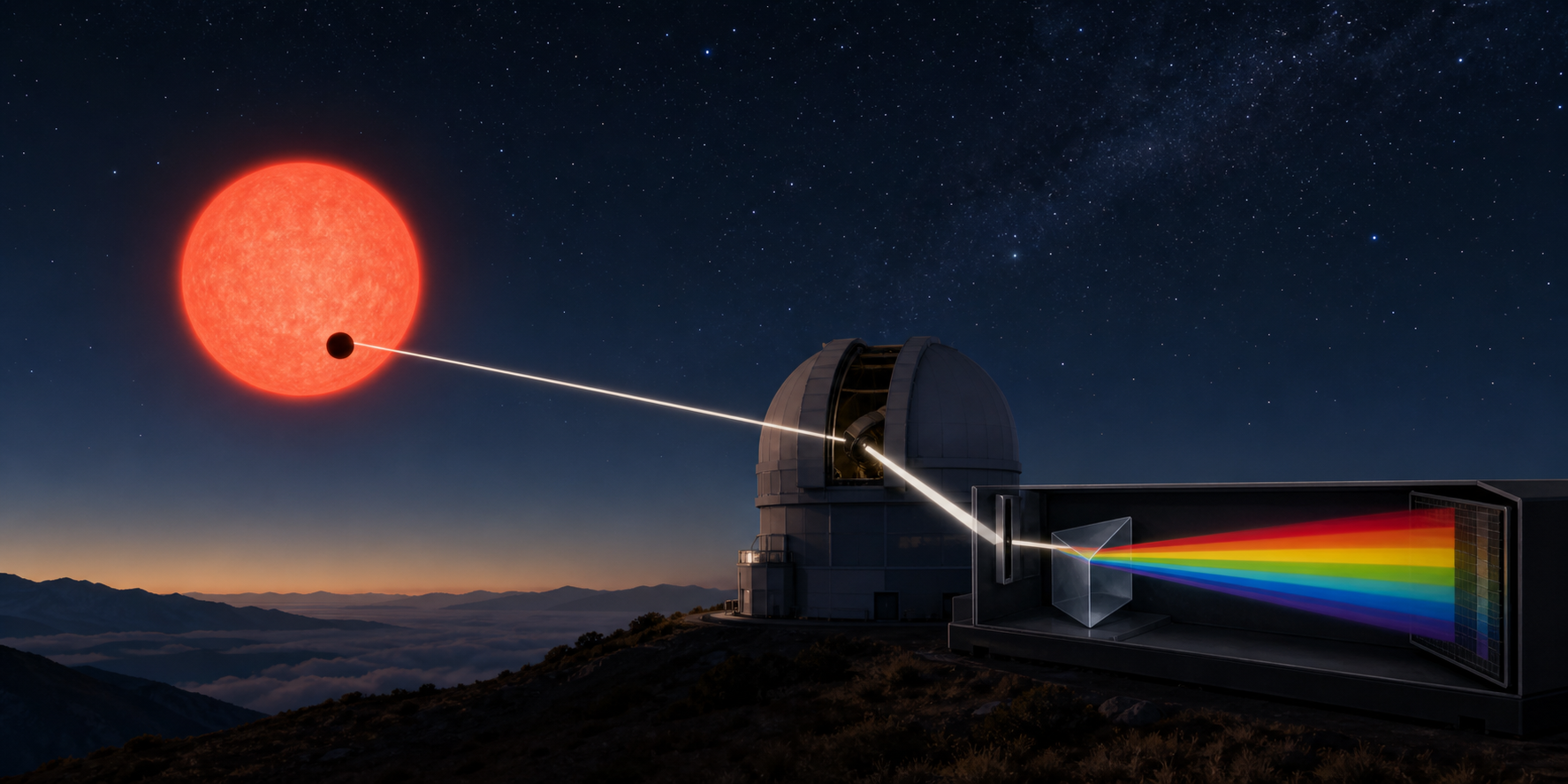 Transit spectroscopy looks for subtle changes in starlight while a planet crosses in front of its star.
Helium is a useful tracer because an escaping cloud can reach far above the planet, creating a larger target than the rocky world itself. As Harvard’s summary explains, the team used the Magellan/Clay telescope at Las Campanas Observatory in Chile and a spectrograph to observe a rare, tightly timed opportunity involving two planets in the system.
The key result came from the 2024 epoch. The helium feature was detected then. In the following-year observation, it was not detected. Rather than erasing the first result, that contrast is part of what scientists now need to explain: the escape rate may vary, observing conditions and geometry matter, and repeat measurements are the way to test the interpretation.
What “escaping helium” does — and does not — mean
“Escaping” sounds like an atmosphere disappearing overnight. It is not that simple. Upper atmospheres can lose light gases over long timescales, especially under stellar radiation. The observation is a snapshot of a process, not a verdict on the planet’s whole history.
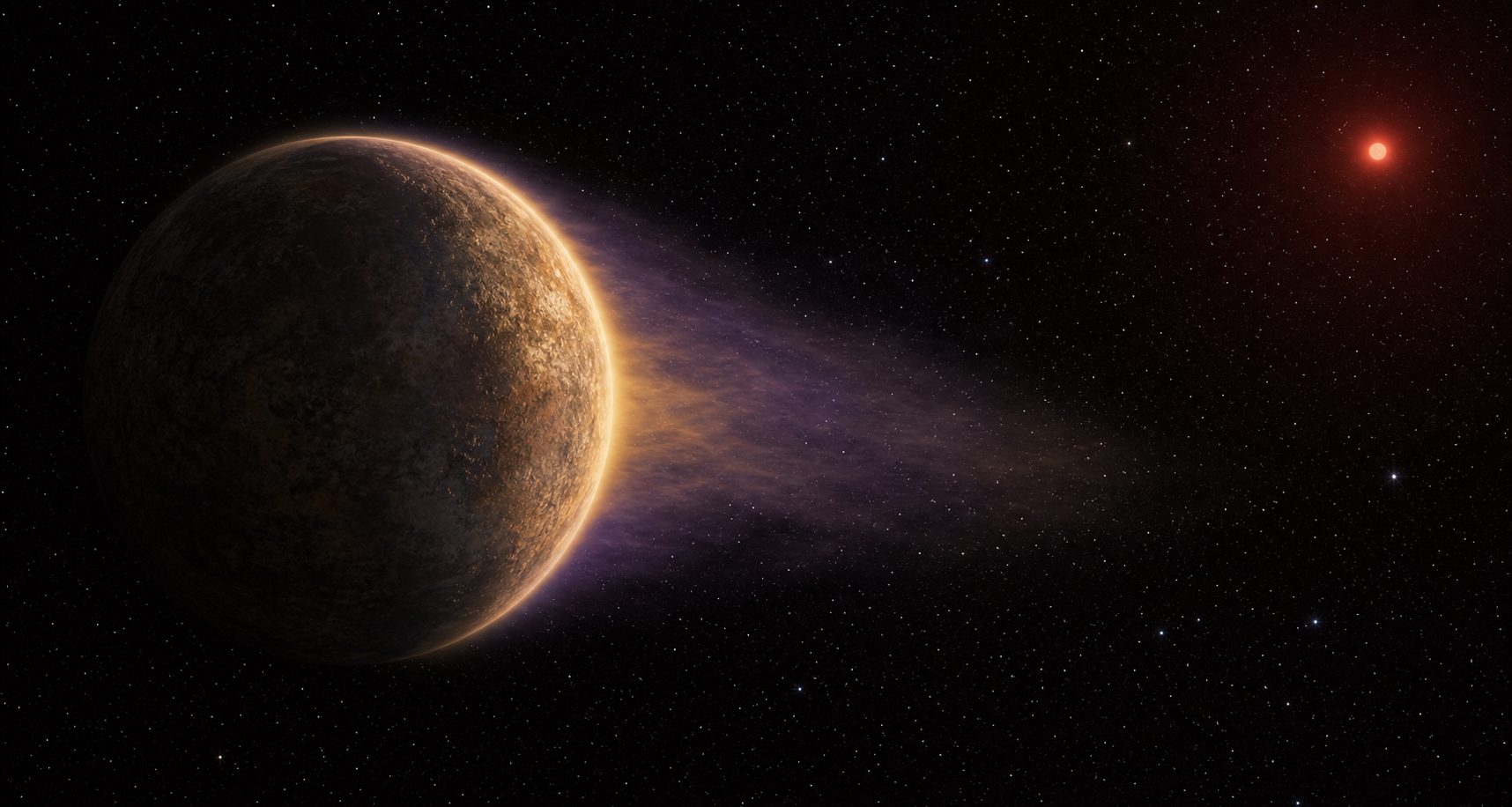 A stylized view of helium escaping from an upper atmosphere; the measurement is a spectral signature, not a visible plume.
It also does not mean that LHS 1140 b has a breathable atmosphere. Helium is not a biosignature. A model discussed alongside the work explores possible planet and atmosphere histories, including a helium-rich scenario and possibilities involving substantial water. Those are hypotheses constrained by the new evidence, not direct detections of water, oxygen, or a surface environment.
This is why the careful wording matters. A rocky world in a habitable zone is a compelling place to investigate, but a habitable zone only describes where temperatures could allow liquid water under suitable atmospheric conditions. It does not confirm water, a stable surface climate, habitability, or inhabitants.
Why the non-detection is scientifically useful
A one-night signal is a starting line. The 2025 non-detection raises a real question: was the helium escape variable, or is there another explanation for why the signal changed? More transits are needed to tell.
That uncertainty is not a flaw to smooth over for a headline. It is how astronomical inference gets stronger. Independent observations, repeated transit measurements, and work at complementary wavelengths can narrow the possibilities. The study’s result makes LHS 1140 b a much more interesting target for that work; it does not finish the job.
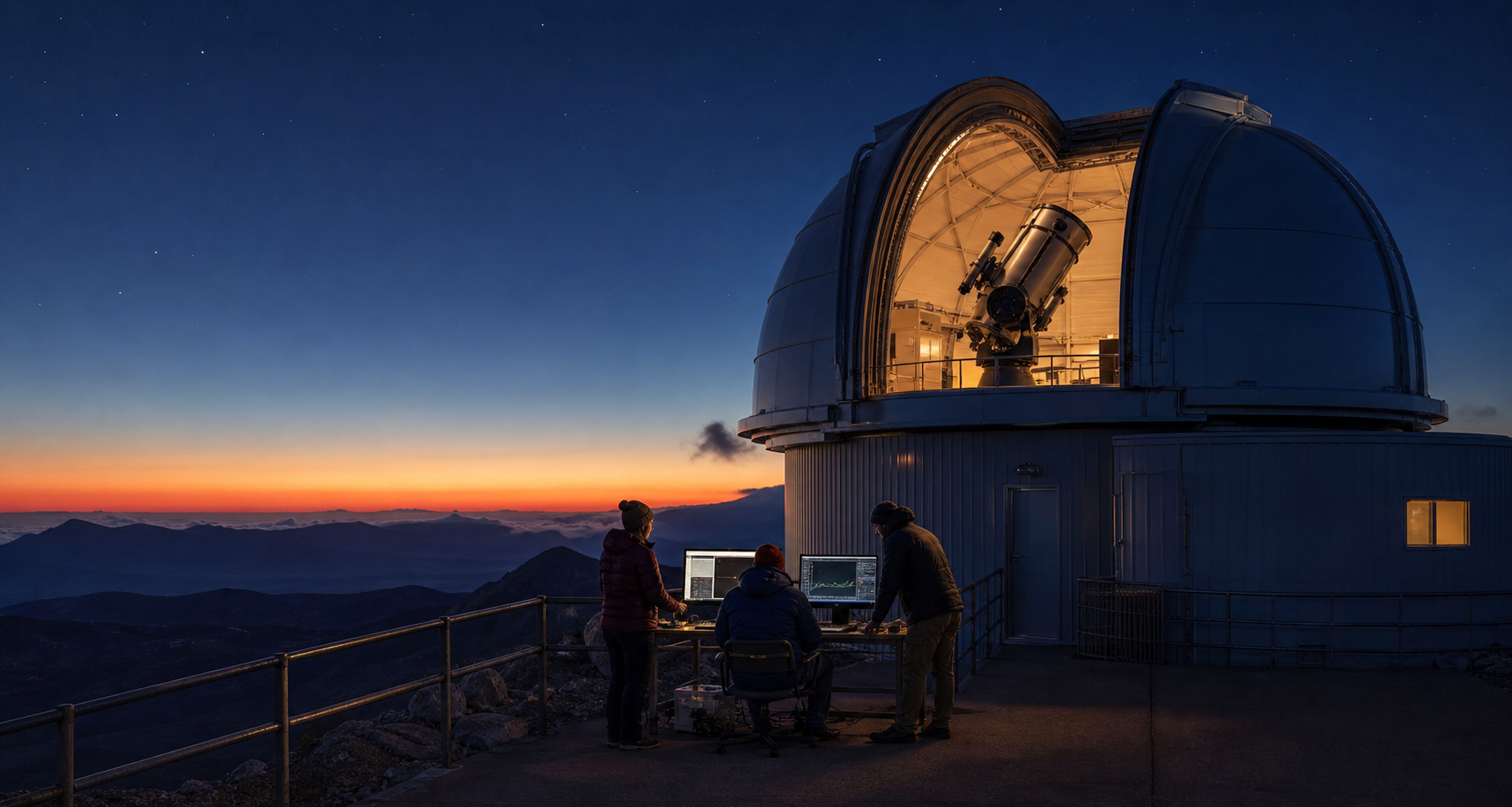 Follow-up observations are the practical next step for testing a variable upper-atmosphere signal.
A good way to read the next headline
When you see an exoplanet headline, try three questions: What was actually measured? What is inferred from it? What would need to happen next to confirm the inference? Here, the measurement is a helium spectral feature in 2024. The inference is evidence consistent with an atmosphere. The next step is more observations, especially because the following-year observation did not repeat the detection.
That habit makes space news more rewarding. It is also a great conversation starter with people who enjoy asking the second question, not just sharing the first headline. If that sounds like your kind of crowd, join the Cosmic Match space community or sign up to meet local astronomy enthusiasts.
For another approachable example of how astronomy turns a small signal into a bigger question, read our guide to why Saturn can look like a star before dawn. The methods are different, but the instinct is the same: let the observation set the boundaries of the claim.