AstroRad on Artemis I: What the Radiation Vest Results Actually Show
Artemis I did not fly through a solar-particle storm, so the widely repeated AstroRad results—61.8% and 40.2%—are not direct measurements of radiation blocked in space. They are modeled effective-dose reductions for two historical severe solar-particle events, after researchers first checked their simulation against real detector readings collected during Orion’s transit through the inner Van Allen belt. That distinction is the whole story, and it is a promising one for future crews.
The Matroshka AstroRad Radiation Experiment (MARE) rode inside NASA’s uncrewed Orion capsule for its 25.5-day lunar mission in late 2022. It paired a real deep-space flight dataset with a carefully constrained model of a danger astronauts may one day need to shelter from quickly: a solar-particle event.
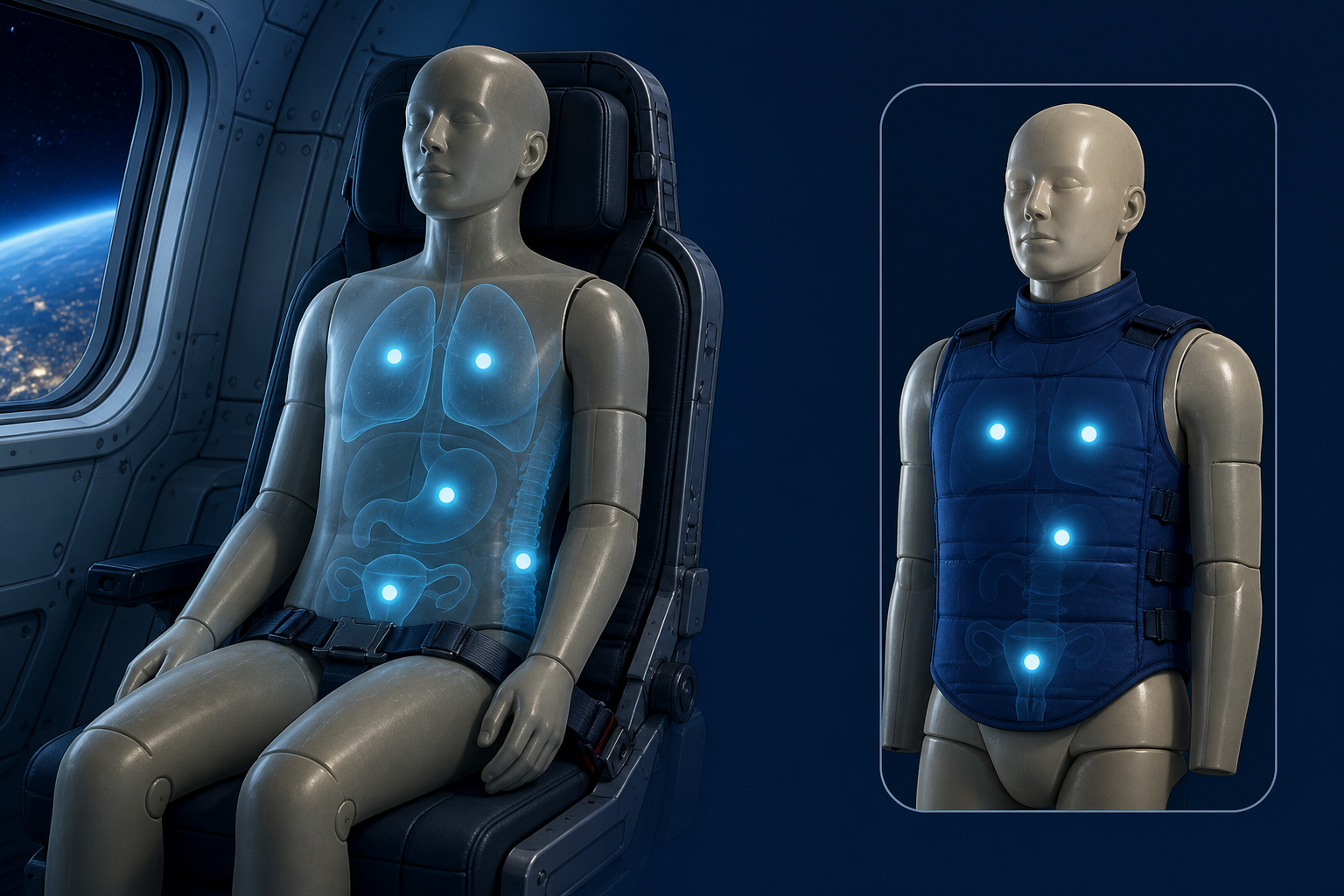
Illustration: a conceptual rendering of the MARE-style phantom-and-detector setup; it is not a flight photograph.
What was AstroRad testing on Artemis I?
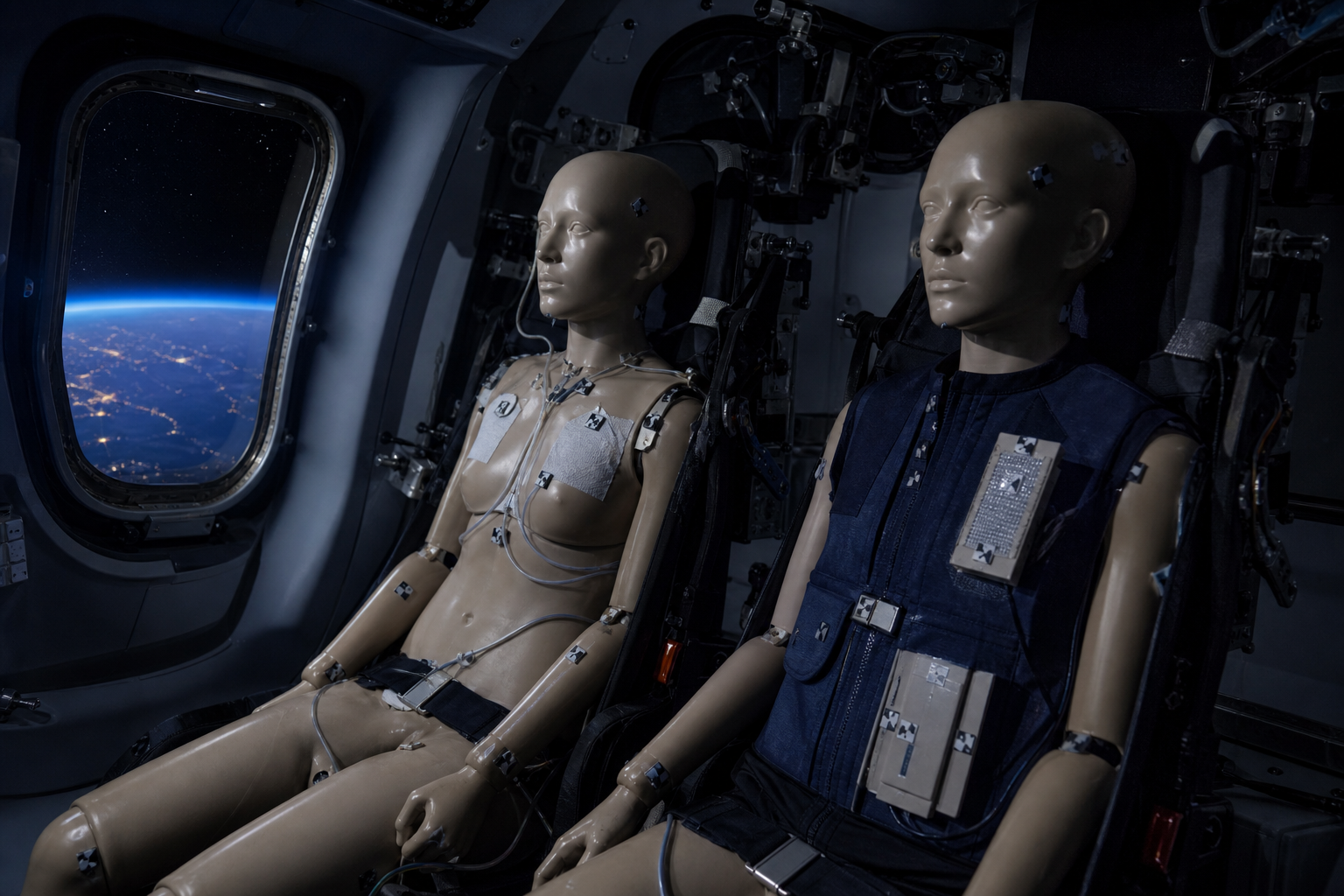
MARE used two nearly identical adult-female torso phantoms: Helga, unshielded, and Zohar, wearing a prototype AstroRad vest. Their material makeup imitates bones, soft tissue and organs; a 3-centimeter internal grid and many dosimeters let researchers map radiation near sensitive regions. NASA says female-form phantoms were selected because women generally have greater sensitivity to space-radiation effects, while the vest is designed to protect people of any sex.
This was not a “put on a vest and ignore radiation” experiment. The selective-shielding concept aims to place mass over particular radiosensitive organs and tissue rather than make a whole-body suit that would be difficult to wear during a mission. The MARE team included detectors from DLR and NASA, including instruments on the phantoms and inside organs such as the lungs, stomach, uterus and spine.
For a useful primer on where Artemis I actually traveled, see NASA’s Artemis I mission reference. Orion went beyond the Moon and back, giving radiation researchers a genuinely deep-space environment to study—not a terrestrial stand-in.
Did Artemis I measure a solar storm? No.
No major solar-particle event occurred during the mission. That means MARE cannot report that AstroRad directly reduced dose during a real solar storm. It did, however, record the radiation environment that Orion encountered, including a pass through the inner Van Allen belt.
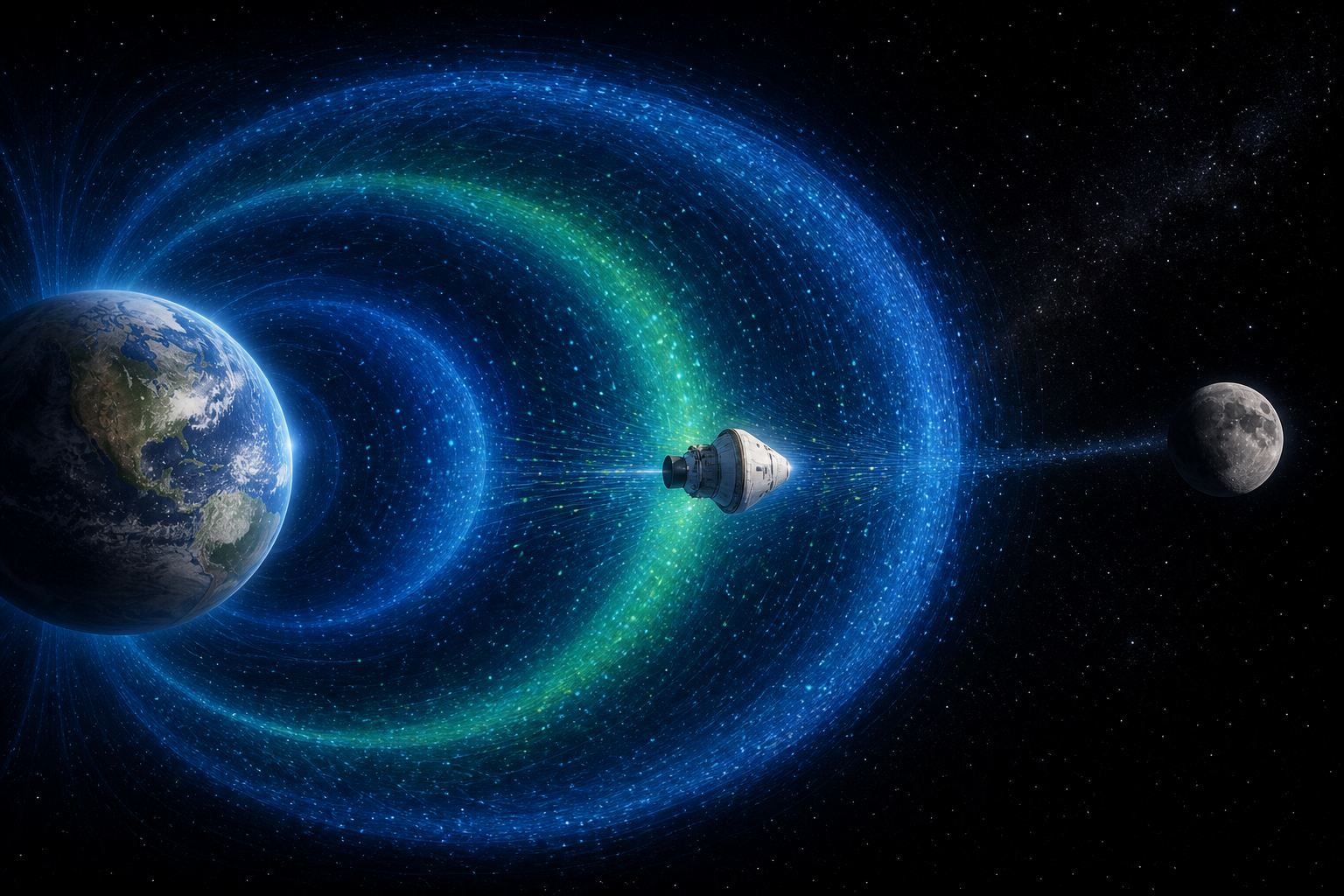
Illustration: an artistic visualization of Orion’s radiation-environment transit, not a scale map of the mission.
Why is that still useful? The inner-belt exposure gave the team detector data with which to test their Monte Carlo radiation-transport model. In the 2024 International Astronautical Congress technical record, the modeled and measured doses agreed to within reported average differences of -2.2 ± 12.5% for 16 DLR M-42 measurements and -3.1 ± 14.9% for 18 NASA Crew Active Dosimeter measurements. That is a validation check—not proof that every future solar storm will behave the same way.
What do the 61.8% and 40.2% results actually mean?
Once the model was checked against the inner-belt measurements, the researchers simulated solar energetic protons using spectra from two historic events. For an AstroRad wearer near Orion seats 3 and 4, they estimated effective dose would fall:
- from 233.6 to 89.4 mSv for an August 1972-like event: a 61.8% modeled reduction;
- from 249.9 to 149.4 mSv for an October 1989-like event: a 40.2% modeled reduction.
Those are effective-dose estimates under specific conditions: historical event spectra, a particular spacecraft geometry, and the stated seat vicinity. They are neither ordinary Artemis I mission dose readings nor a universal promise of protection in any storm. Particle energy, the direction of the event, spacecraft shielding, body position and exactly where a crew member shelters all matter.
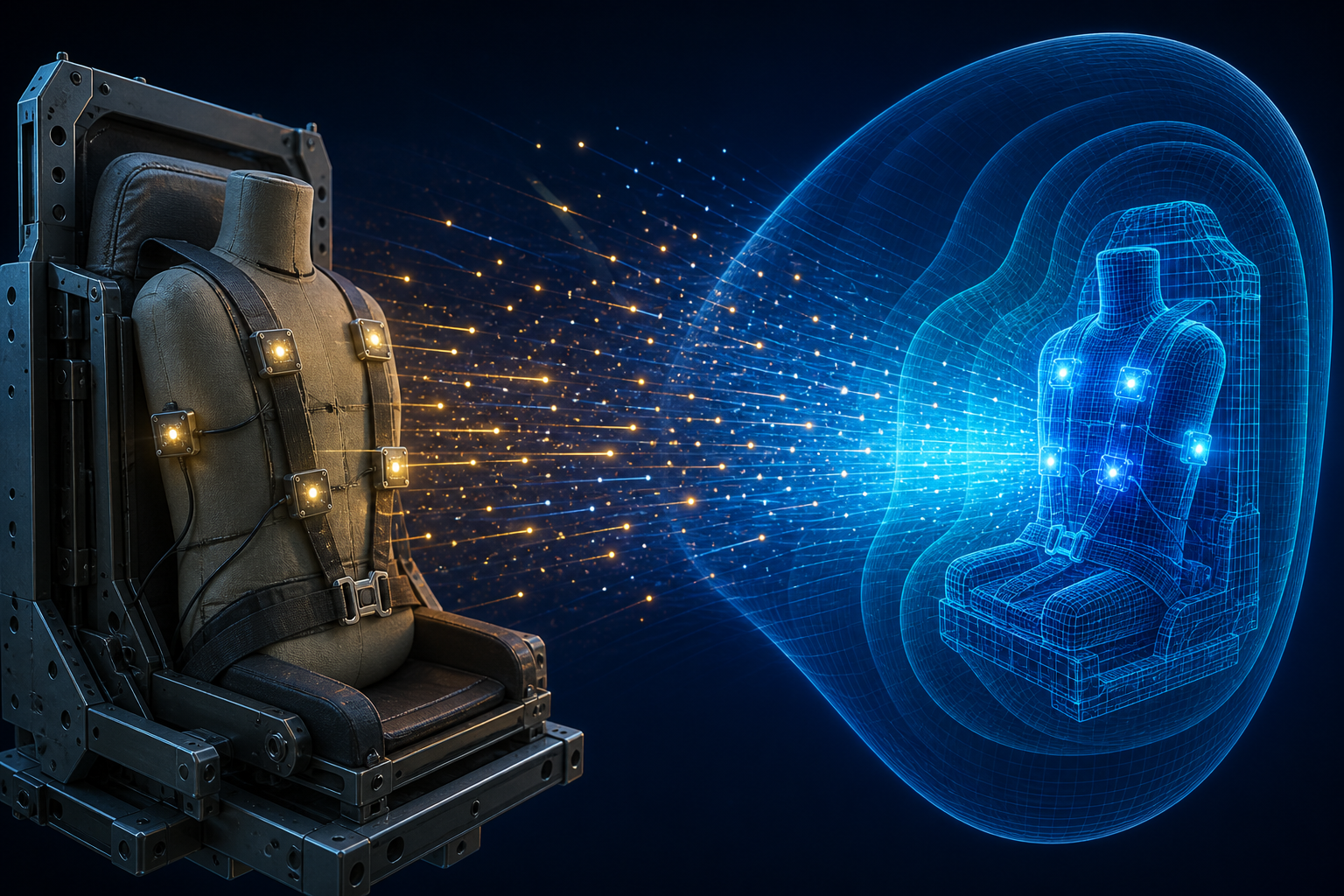
Illustration: the key sequence was measured detector data first, then model validation, then simulated storm cases.
Why does “modeled effective dose” matter?
Effective dose is a radiation-protection quantity that weights doses to different tissues by their relative sensitivity. It helps compare potential health risk; it is not a single detector’s raw reading. Using it here allows researchers to ask a practical mission question: under a defined severe-event scenario, how much could selective shielding change the estimated biologically relevant burden?
That is also why “AstroRad blocked 61.8% of Artemis I radiation” is inaccurate. Artemis I supplied the flight measurements used to test the model. The 61.8% figure came afterward from a simulated August 1972-type solar event, while 40.2% came from a simulated October 1989-type event.
Why this matters for future crews
For people following Artemis from Houston—where several MARE contributors are affiliated with NASA Johnson Space Center—the experiment is a reminder that crew safety is built from layers: mission timing, space-weather monitoring, spacecraft shelter, operations and personal protection. A vest, even a promising one, is one layer rather than a force field.
The most encouraging result is the method: fly instrumented phantoms in the real environment, compare the model to the detectors, state the uncertainty, then use the model carefully for scenarios that did not occur. That is the kind of transparent, incremental engineering worth following alongside mission milestones such as NASA’s upcoming human-exploration work.
If you enjoy digging into the science behind the headlines with people who share the curiosity, join the Cosmic Match space community free. Bring the question that sent you down a rabbit hole; someone else may have the paper open already.
Sources and publication status
The primary flight/model account currently available is the 2024 International Astronautical Congress technical record, “First Data-Based Evaluation of the Radiation Protection Capabilities of the AstroRad Vest as Flown Onboard Artemis I.” NASA’s MARE reference provides the mission and phantom context.
The related Science Advances record, “First evaluation of wearable radiation protection for human deep space exploration, as flown on Artemis I,” is listed by Crossref as a journal article dated August 14, 2026 at the time of this publication. This explainer therefore treats the technical record as the published basis for the quoted modeled results and does not characterize the journal article as already published.
FAQ
Did AstroRad experience a real solar storm on Artemis I?
No. Artemis I had no major solar-particle event. The flight supplied detector data during its real radiation-environment transit; severe-event results were then modeled.
Are the 61.8% and 40.2% numbers measured results?
No. They are modeled effective-dose reductions for August 1972-like and October 1989-like solar-particle-event spectra, for stated Orion seat locations after validation against belt-transit detector data.
What did the phantoms measure?
Helga and Zohar carried many active dosimeters, including locations near internal organs. Zohar wore the prototype vest; Helga did not, enabling a controlled comparison framework.
Does this mean future astronauts will be safe from radiation?
It is evidence for one potential protective layer, not a guarantee. Mission operations, shelter design, space weather and the event’s properties remain essential parts of radiation safety.