Did Comets Seed Life on Earth? A New Study Narrows One HCN Pathway
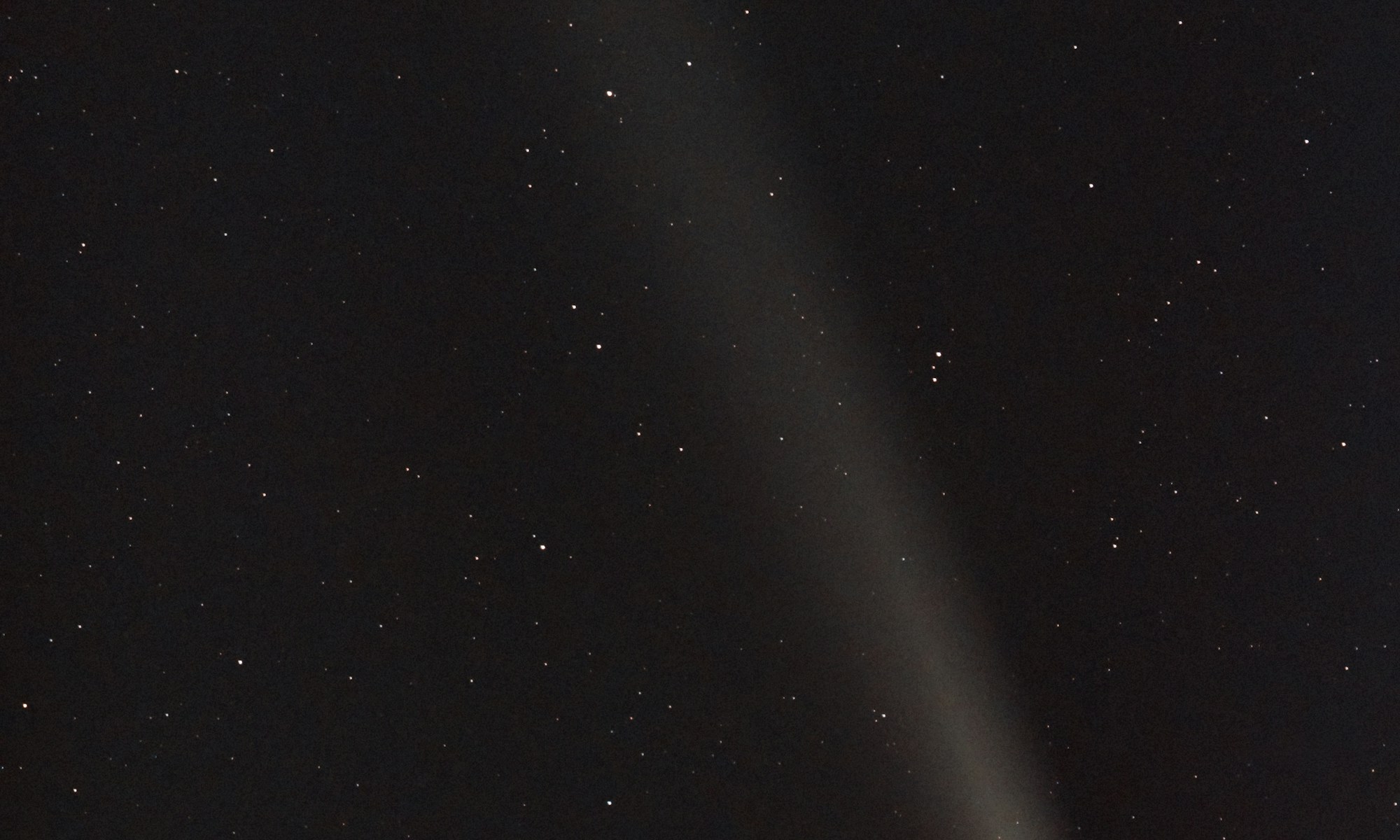
A new simulation study does not show that comets contributed nothing to early Earth. It asks a much narrower question: could an incoming comet deliver intact hydrogen cyanide (HCN) at a high enough local concentration to help power prebiotic chemistry? The answer from this model is: only under an exceptionally lucky set of conditions. That makes this one proposed comet-to-chemistry pathway unlikely—not every possible cometary contribution to water, organic material, or Earth’s long chemical story.
HCN is a small molecule with one carbon, one hydrogen, and one nitrogen. It matters in origin-of-life experiments because, at useful concentrations, its energetic carbon–nitrogen bond can help form ingredients such as sugars, nucleobases, lipids, and nucleotides. The new paper in Scientific Reports models whether a comet could carry that material through an impact and leave it concentrated enough to matter.
What did the study actually rule out?
It constrained a specific delivery route: a comet hitting early Earth and leaving intact HCN in a concentrated, usable patch on exposed land. That is a much tighter claim than “comets did not seed life.”
The researchers combined models of short-period comet bombardment, atmospheric entry, impact survival, and early-Earth land area. Their threshold was at least 10 millimolar HCN—the scale used in relevant lab chemistry. Their simulations deliberately used favorable assumptions in several uncertain places, so the result is best read as a challenging upper-limit test for this pathway.
The headline number is easy to misread. The median number of qualifying impacts was zero. In other words, more than half of the simulated histories had none. Yet 46% of simulations did record at least one successful impact. Rare is not impossible. For only the simulations that had a success, the study estimated the most probable timing of the last one as 4.41 billion years ago, with a +0.11/−0.29 billion-year range.

Why would an HCN-carrying comet have such a hard time?
Think of the route as a cosmic obstacle course. First, a comet has to be large enough to survive atmospheric passage; the paper points to roughly 100 meters as the lower size scale for survival. Then it must arrive slowly enough and at a shallow enough angle that the impact does not destroy most of its cargo. Those three requirements—size, speed, and angle—overlap in a very small slice of possibilities.
HCN is a useful test case precisely because it is relatively tough compared with many more complex prebiotic molecules. If even HCN struggles to survive and stay concentrated, that raises a difficult question for more fragile molecules. But it is still an inference about modeled survival, not a direct observation of every ancient impact.
A global calculation also looks unfavorable. The paper estimates the total intact HCN delivery, spread through one modern ocean, would be about 0.75 micromolar at most—far below the concentrations considered useful in the experiments. The proposed way around that is a local land impact, where a comet’s own ice might initially create a much richer mixture. Early Earth, however, likely offered limited exposed land.
For a different kind of comet story—one observed rather than reconstructed from early-Earth models—see our guide to how Euclid found a new comet.

What happens after a rare “successful” impact?
Surviving the collision is not the finish line. The models describe impact pressures of roughly 10–100 gigapascals—a violent event that fractures, deforms, and melts local rock while disrupting water and ice around the crater. Groundwater, rain, and runoff could then dilute the surviving HCN on a timescale of days to weeks. HCN can also react with water to form formamide, though the study argues dilution is likely the faster practical problem.
That timing matters. Prebiotic chemistry would need to get productive while the mixture remained concentrated. The paper uses a deliberately simplified, illustrative calculation for this next step; it does not simulate life appearing in a crater. Its point is that a very rare delivery event plus a short chemical window is a demanding combination.
This is exactly where scientific restraint helps. A comet impact can be destructive, but impacts can also create heat, fresh minerals, hydrothermal settings, and new chemistry. The study did not model all of that chemistry, all comet compounds, or every possible source of Earth’s prebiotic inventory. Asteroids, atmospheric chemistry, volcanic settings, hydrothermal systems, and metal-bound cyanide reservoirs remain part of the broader conversation.
Does this mean comets had no role in Earth’s origin story?
No. It means the cleanest version of one idea—an intact cometary HCN delivery event that leaves a high-concentration local reservoir—looks exceptionally improbable in these simulations. Comets contain many compounds. They could have contributed material in ways this model does not test, and any contribution would have interacted with a changing planet over a huge span of time.
That distinction is also what makes the result interesting. Instead of ending the origins-of-life question, it narrows a candidate mechanism and directs attention to the chemical settings that might have done more of the work. Science often advances this way: not with a single cosmic “yes” or “no,” but with sharper boundaries around what needs explaining.

You do not need a lab—or a telescope—to join the wonder behind questions like this. Share your favorite space question and meet people who enjoy following the evidence at Cosmic Match’s astronomy community. If a new discovery has you weighing what is confirmed versus what is still a hypothesis, our explainer on Rubin’s dwarf-planet candidate is a good next read.
Sources and a note on scope
- Anslow et al., “Cometary impacts an unlikely pathway towards the origins of life on Earth” (Scientific Reports, 2026)
- University of Cambridge news release
- Science News coverage
- Independent expert reactions collected by Science Media Centre Spain
FAQ
Did the new study prove that comets did not seed life on Earth?
No. It modeled whether intact HCN could be delivered by a comet impact at a high enough local concentration for a particular prebiotic pathway. It does not test every compound, every impact effect, or every possible cometary contribution.
Why is hydrogen cyanide important in origin-of-life chemistry?
In laboratory work, concentrated HCN can participate in reaction networks that produce several important molecular building blocks. The unresolved question is how early Earth could have accumulated a suitable concentrated reservoir.
Could one lucky comet impact still have worked?
The model does not rule that out. Forty-six percent of its simulations had at least one qualifying impact, but the median number was zero, and any surviving HCN still faced rapid dilution in the modeled crater environment.
Where else might early Earth’s prebiotic ingredients have come from?
Scientists investigate several possibilities, including atmospheric chemistry, volcanic or hydrothermal environments, asteroids, and chemical concentration processes on Earth. This paper narrows one cometary HCN scenario rather than choosing a single winner.