NASA Just Locked In UVEX: What the $590 Million Milestone Means
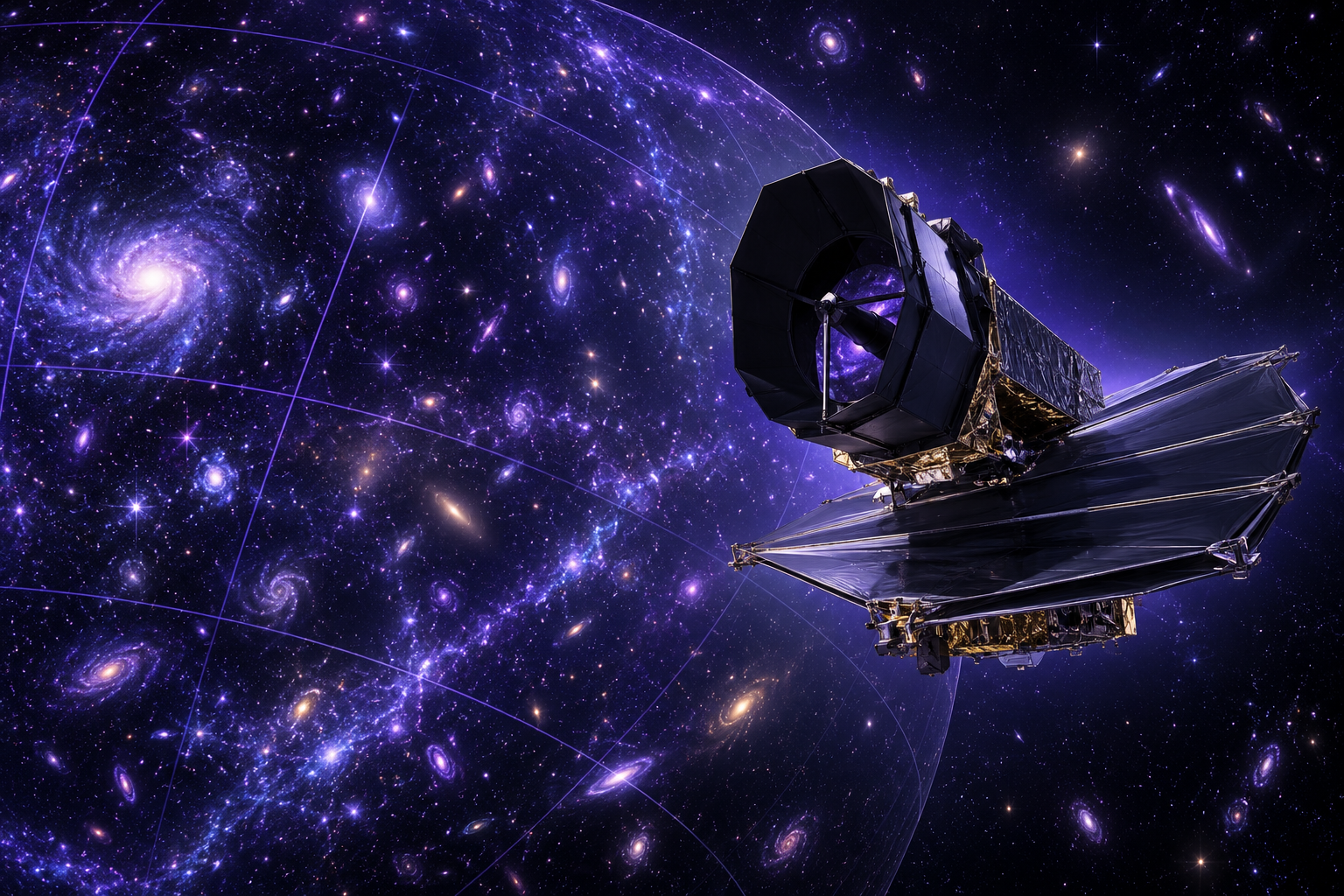
NASA has cleared UVEX—the UltraViolet EXplorer space telescope—through KDP-C, a NASA decision milestone that locks in the mission’s technical baseline and program plan. In plain English: the Caltech-led mission now has the agency’s formal commitment to move into the build phase, with a $590 million total lifecycle cost and a commitment to launch by January 2031. It has not launched, and construction is not finished—but this is a major moment for a mission designed to make the first deep ultraviolet all-sky maps.

For people who follow space news without keeping a spreadsheet of NASA acronyms, KDP-C is the useful signal: UVEX has crossed a serious review gate and can proceed with much more certainty than a mission concept or an early study. NASA announced the decision on October 27, 2026; NASA’s UVEX update is the primary source for the milestone.
What changed when NASA approved UVEX at KDP-C?
KDP-C stands for Key Decision Point C. It is a technical and programmatic confirmation: NASA has reviewed the mission’s design, schedule, risk posture, and cost baseline, then authorized it to move forward into implementation. Think of it less as “the telescope is done” and more as “the plan to build and operate it is now formally set.”
That distinction matters. NASA’s commitment is to launch by January 2031—not on a particular day or in a newly announced month-long launch window. And the $590 million figure is not just the price of hardware on a workbench; it is UVEX’s committed total lifecycle cost.
UVEX was selected in 2024 as a Medium-Class Explorer mission. It is not a flagship observatory and it is not a replacement for Roman, Webb, or Hubble. Explorer missions are built around focused questions and carefully bounded cost and scope. That focus is part of why KDP-C is worth watching: a specific science mission now has a credible route from drawing board to observatory.
If you enjoyed seeing how a different NASA mission is still working through its earlier confirmation steps, our guide to NASA’s PRIMA mission and Phase B is a useful comparison. Milestones have names, but they do not all mean the same thing.
Why is ultraviolet light worth sending a telescope to space for?
Ultraviolet light is largely blocked by Earth’s atmosphere. That is wonderful for life on the ground and inconvenient for astronomers: many hot, energetic processes leave important clues in ultraviolet wavelengths that a backyard telescope cannot collect from the surface.
UVEX will map that sky deeply and broadly, building a resource researchers can use to study how galaxies evolve and where stars are forming. Caltech’s mission overview describes the goal as the first deep ultraviolet all-sky maps—a way to see a layer of the universe that is mostly invisible from the ground.
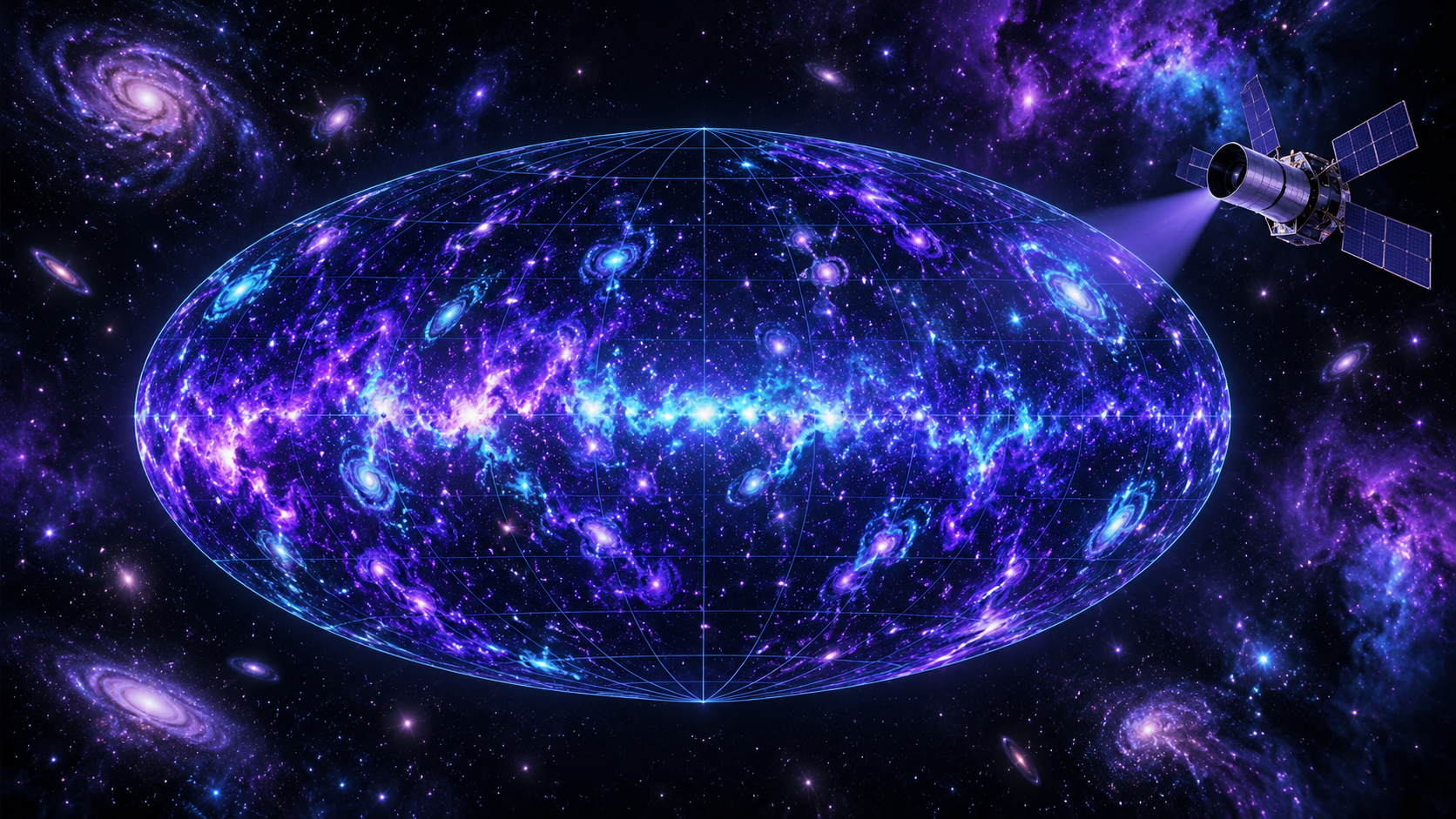
An all-sky map is not a single glamour shot. It is a shared reference: a coherent survey that lets scientists compare distant objects across huge stretches of sky, find changes over time, and choose promising targets for more detailed instruments. That collaborative handoff is one of the quietly exciting parts of astronomy. A broad survey helps many future questions get asked better.
For a recent reminder that major astronomy facilities often work as an international network rather than a solo act, see how CTAO-North’s completed four-telescope array combines views of the high-energy sky.
How could UVEX respond to gravitational-wave events?
UVEX is also designed for rapid pointing toward ultraviolet counterparts of gravitational-wave events, including events involving merging neutron stars. Gravitational-wave observatories register ripples in spacetime; telescopes then look for light from the same region to learn more about what made the signal.
The careful wording is important. UVEX will be able to follow up promising alerts; that does not promise that every event will have a detectable ultraviolet counterpart. The value is speed and coverage: when an alert arrives, the mission can turn its ultraviolet eye toward the location and add one more kind of evidence to the picture.
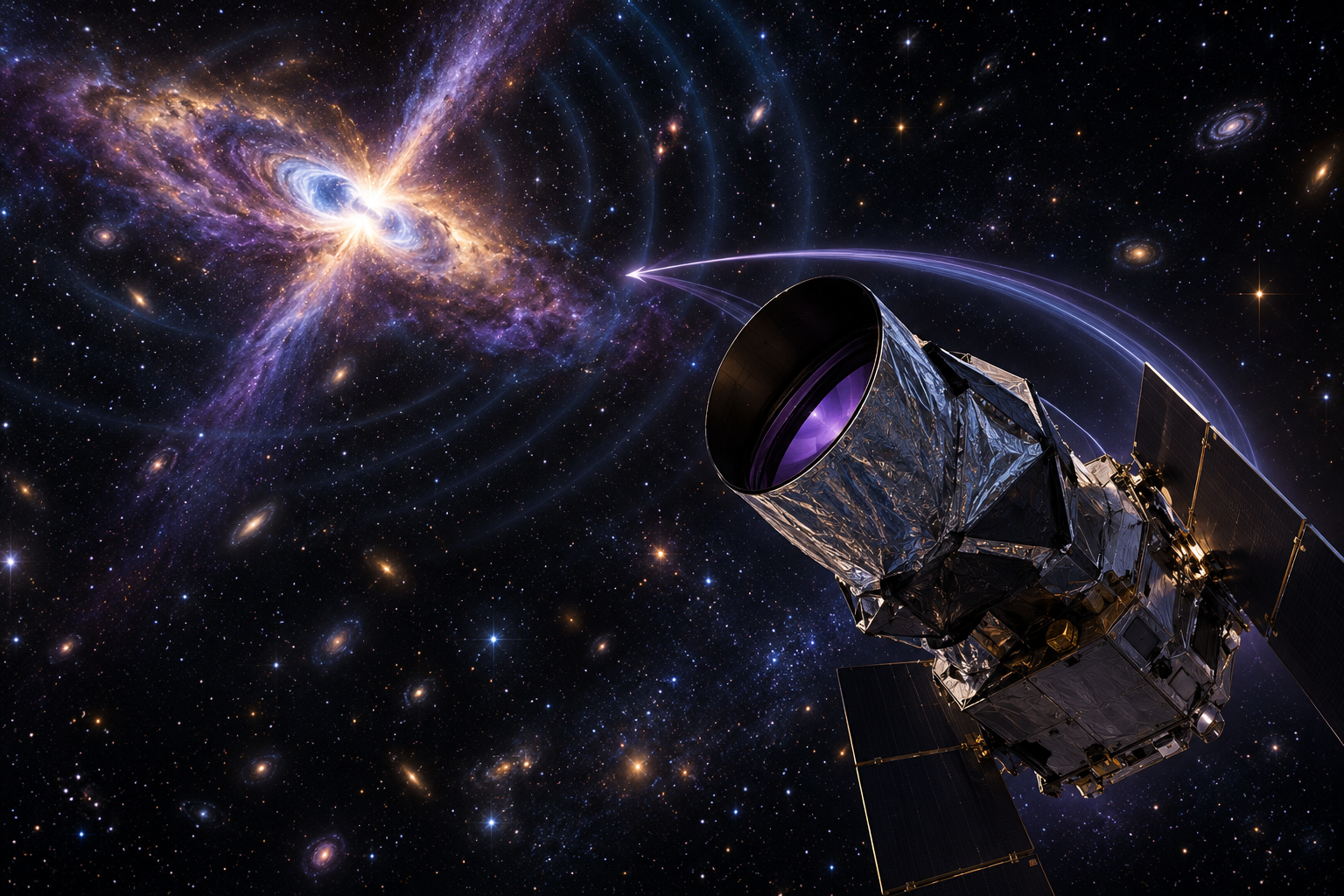
This is the spirit of multimessenger astronomy: use different signals—light, gravitational waves, particles—to turn one cosmic event into a fuller story. UVEX would make ultraviolet observations a more responsive part of that team.
The agency’s broader exploration work has the same practical habit of testing one dependency before the next. Our look at NASA’s Human Landing System roadmap shows why a milestone should be read as a real advance without being mistaken for the finish line.
Who is leading UVEX, and why does Pasadena matter?
Caltech in Pasadena leads the UVEX mission, with Fiona Harrison as principal investigator. That makes this a real Southern California space-science story, even though no local public event was announced alongside KDP-C. The work also involves NASA and partner institutions, including the Space Sciences Laboratory at UC Berkeley, whose mission-management context traces the ultraviolet expertise behind the project.

For Cosmic Match readers in Los Angeles, it is a good reminder that “space news” is made by people nearby as well as by rockets far away. Mission milestones can feel abstract until you picture the scientists, engineers, managers, and students turning years of work into a telescope that can ask new questions of the sky.
Want a place to swap the news that makes you look up? Join the Cosmic Match space community free and find people who get why a KDP acronym can be worth celebrating.
FAQ
What is NASA UVEX?
UVEX, short for UltraViolet EXplorer, is a NASA Medium-Class Explorer mission led by Caltech. It is planned to create deep ultraviolet maps of the whole sky and rapidly follow up selected gravitational-wave alerts.
What does KDP-C mean for UVEX?
KDP-C is NASA’s Key Decision Point C, where the agency confirms a mission’s technical and programmatic baseline and authorizes implementation. It means UVEX can proceed into its build phase; it does not mean the telescope has launched or finished construction.
When will UVEX launch?
NASA has committed to launch UVEX by January 2031. NASA has not announced a specific launch date or a month-long launch window.
Is $590 million the construction cost of UVEX?
No. The $590 million is the mission’s committed total lifecycle cost, rather than a price tag only for building the telescope.