Four Giant Telescopes, One International Team: What CTAO-North Completed
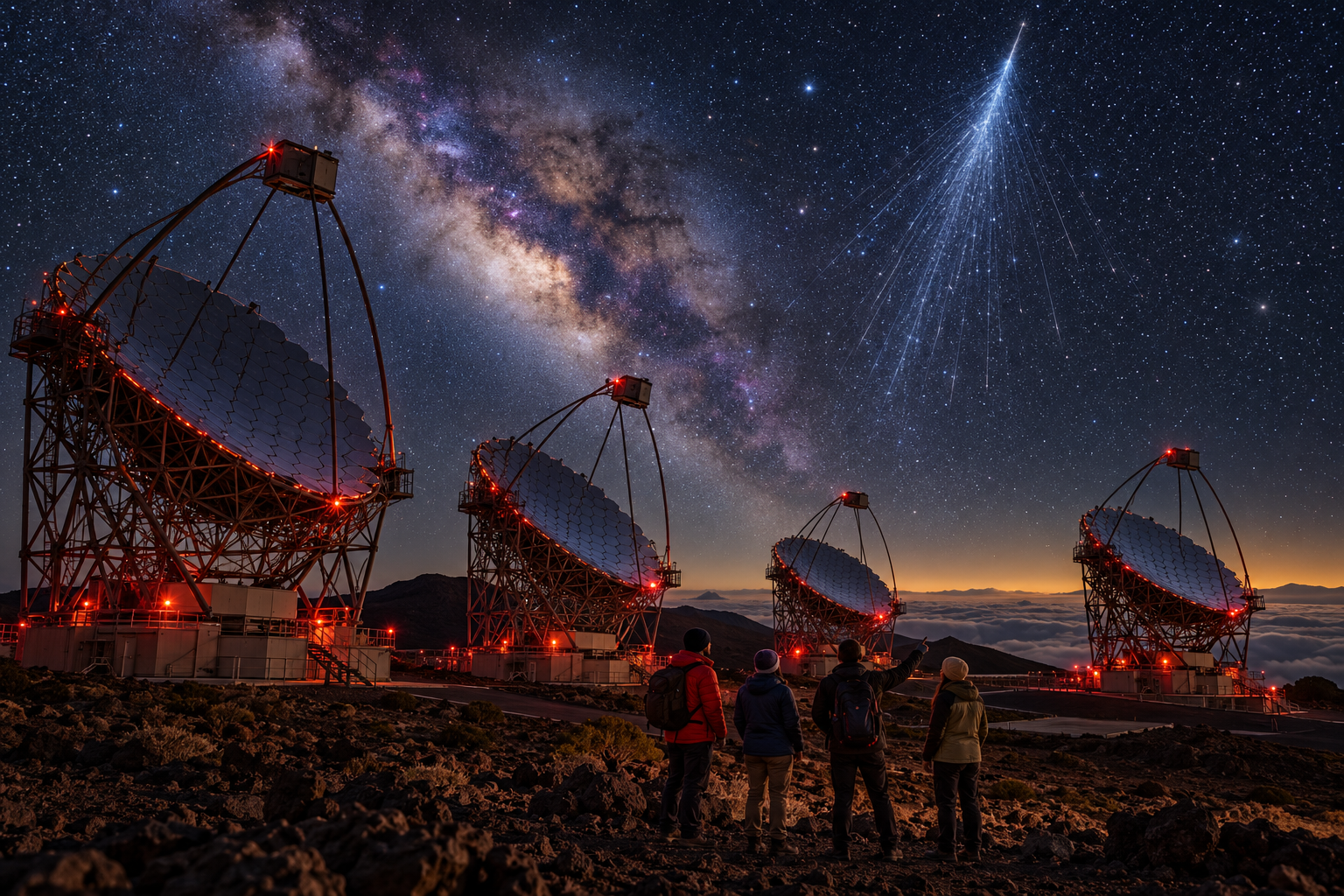
The Cherenkov Telescope Array Observatory has just completed a major piece of its northern site: four giant, synchronized gamma-ray telescopes now stand together on La Palma in Spain’s Canary Islands. The milestone is exciting because it gives astronomers four views of the same fleeting flash in Earth’s atmosphere—but it is not the same thing as routine science operations. The array still has commissioning and integration work ahead.
If you love the thought of the universe’s most extreme objects leaving clues in our sky, this is a beautiful moment to follow. You do not need a telescope to appreciate it: the new instruments are built to investigate cosmic explosions, black holes, pulsars, and perhaps dark matter through the highest-energy light we can detect from the ground.
What did CTAO-North complete?
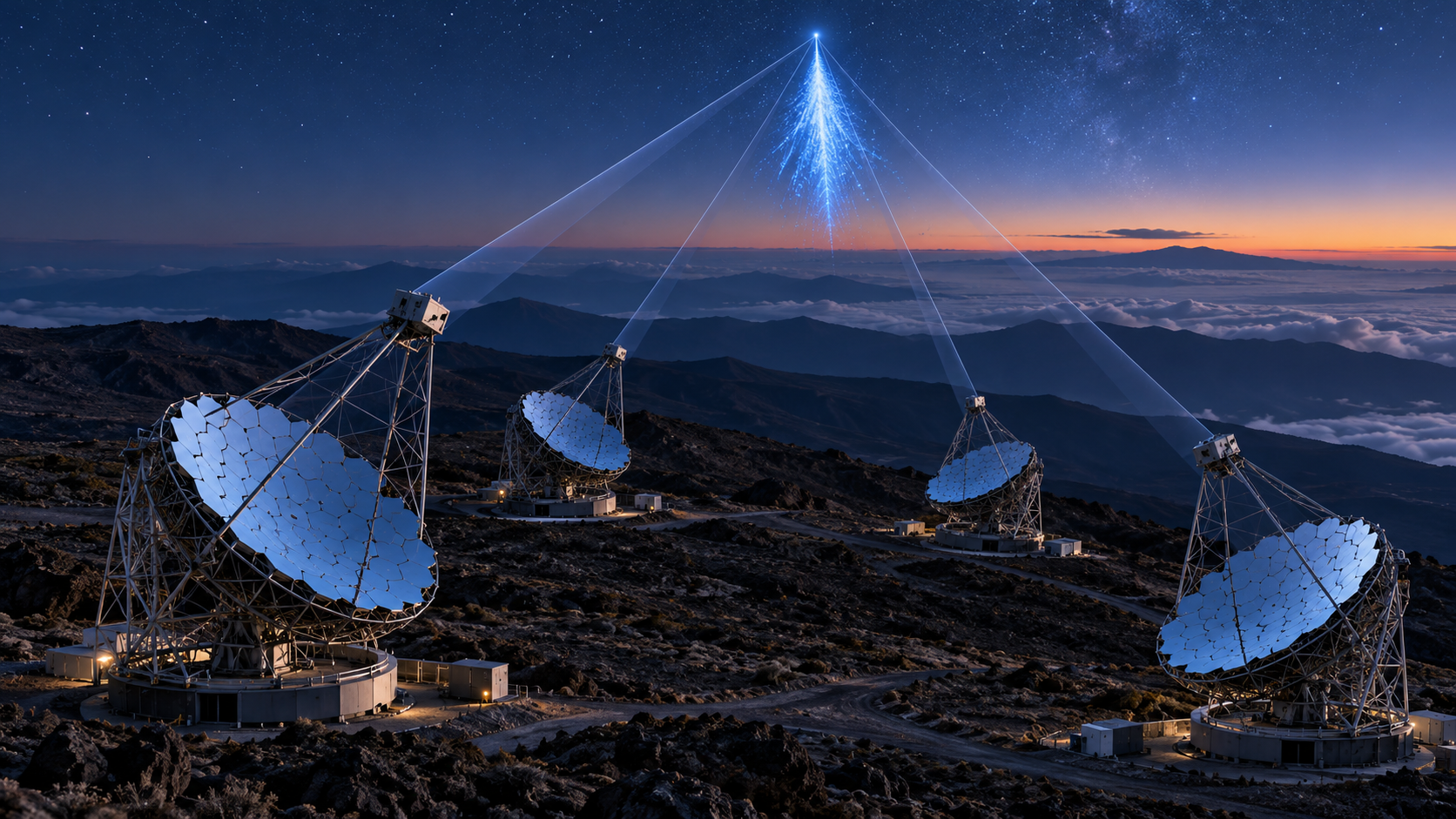
At the Observatorio del Roque de los Muchachos on La Palma, CTAO-North inaugurated its Large-Sized Telescope (LST) sub-array on October 15. The lineup combines the pioneering LST-1 with LST-2, LST-3, and LST-4: four 23-meter reflectors equipped with ultra-fast cameras.
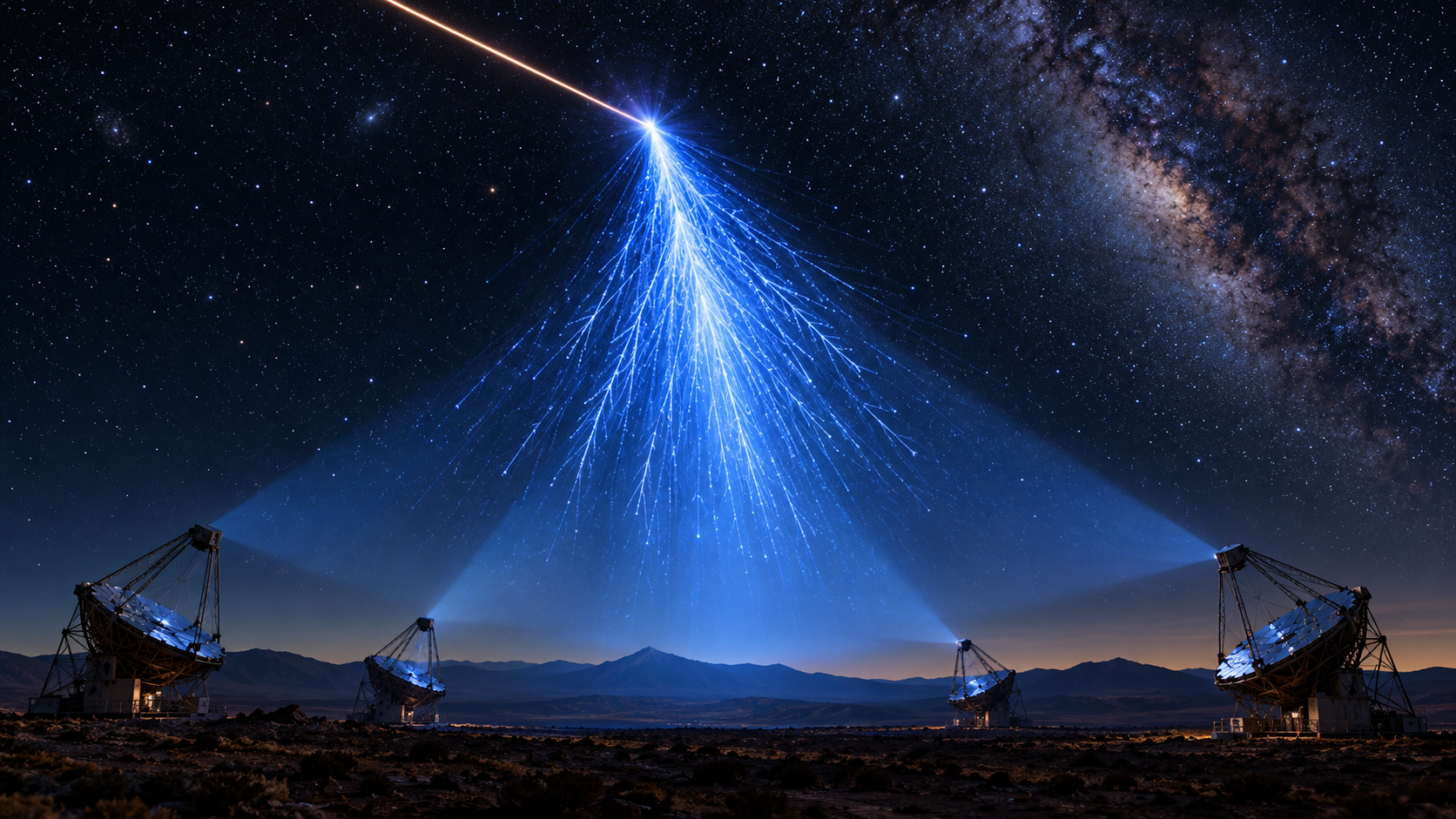
These are not ordinary optical telescopes that take long exposures of a galaxy. They are built to catch an extraordinarily brief, faint blue flash caused when a high-energy gamma ray hits Earth’s upper atmosphere. CTAO and Italy’s National Institute for Astrophysics (INAF) place the LSTs’ sweet spot at roughly 20 GeV to several TeV—an energy range that helps connect the gamma-ray sky seen from space with even more energetic phenomena measured from the ground.
The ceremony celebrates real hardware and a real collaboration: a completed four-telescope sub-array assembled by an international team. It does not mean the entire observatory has switched on for routine operations. Commissioning and integration are the essential next steps that turn four finished instruments into a coordinated scientific facility.
How can four telescopes outperform one?
Imagine trying to locate a distant firework from a single phone microphone. You might know something happened, but it is hard to pin down exactly where or how big it was. Add microphones at several locations and compare what each heard, and the picture becomes much sharper.
That is the basic advantage of stereoscopic observation. Each LST sees the same atmospheric particle shower from a slightly different angle. Combining those snapshots lets researchers reconstruct the incoming gamma ray more reliably: where it came from, how much energy it carried, and how it differs from background events caused by cosmic rays.
INAF says the four-dish network improves sensitivity, angular resolution, and energy reconstruction over a single telescope. For rapidly changing sources—such as gamma-ray bursts, novae, and active galaxies powered by supermassive black holes—those gains matter. A short-lived signal can vanish while an observer is still deciding where to look.
What will CTAO-North look for in the extreme universe?
Gamma rays are messengers from some of nature’s most violent environments. The LST sub-array can help study pulsars, relativistic jets from active galaxies, gamma-ray bursts, and other transient events. CTAO also points to questions about the origin of cosmic rays and the nature of dark matter.
The lower-energy reach is especially valuable. High-energy gamma rays are gradually absorbed as they travel across the universe, so capturing the lower-energy end of the signal can open a longer view back through cosmic time. CTAO says its low threshold could help it observe bright gamma-ray bursts at redshifts around 4—roughly 12 billion years of look-back time.
For a broader sense of how astronomers build a picture from multiple kinds of light, explore our guide to how IceCube listens for high-energy neutrinos and our explainer on what JWST found in WASP-17 b’s atmosphere. Different messengers, same big idea: the universe is richer when we learn to detect more than one kind of signal.
Why the international team matters
The four telescopes are a reminder that frontier astronomy is a community project. CTAO describes a collaboration spanning more than ten countries and hundreds of scientists and engineers; INAF and INFN are among the institutions that helped make the LST sub-array possible. One site on La Palma is now part of a much larger worldwide effort to understand the deep, dark, and extreme universe.
That spirit is worth carrying into amateur astronomy, too. You do not need a 23-meter mirror to share a skywatch. A local observing plan, a pair of binoculars, or a good science conversation can be the beginning of your own cosmic team. Join the Cosmic Match astronomy community to meet people who get excited about a clear forecast, a new discovery, or a late-night livestream. If you are new to the hobby, create your free Cosmic Match profile and find a welcoming place to start.
The important distinction: completed array, not finished mission
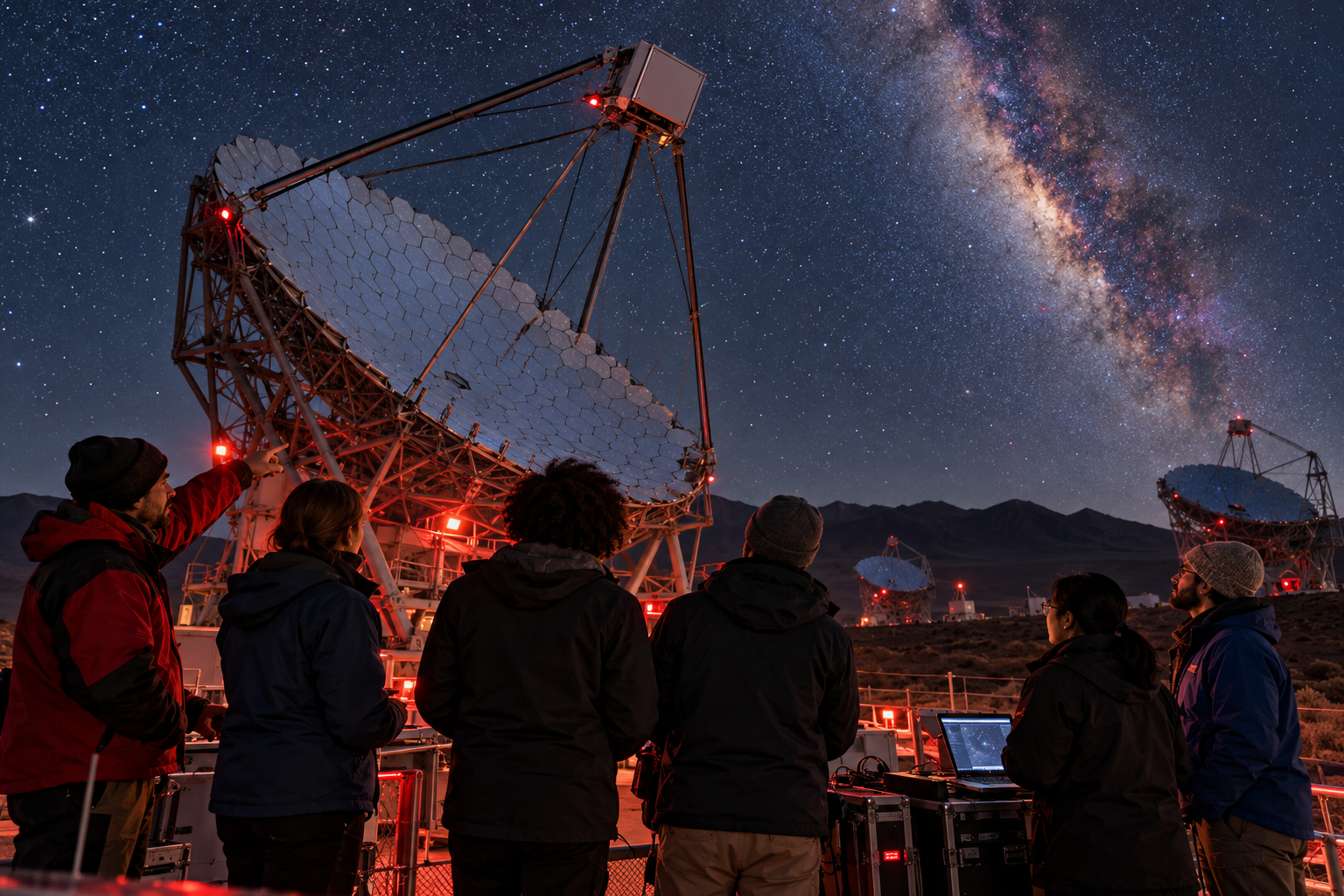
It is tempting to treat an inauguration as a finish line. Here, it is better understood as a powerful handoff: the physical four-telescope sub-array is complete, and the work of bringing it into full scientific operation continues. That distinction respects the engineering still underway and makes the achievement more impressive, not less.
The next time you hear that a telescope “sees” a gamma ray, picture what it really does: it catches a momentary atmospheric afterglow, compares that moment with its neighbors, and turns a whisper of blue light into a clue about a distant cosmic engine. Four instruments working together are far more than four times the story.
For the primary details, see CTAO’s LST sub-array inauguration announcement and INAF’s report on the CTAO-North LST network.
FAQ
Where is CTAO-North?
CTAO-North is located at the Observatorio del Roque de los Muchachos on La Palma in Spain’s Canary Islands.
Are the four CTAO-North telescopes already doing routine science?
Not yet. The four-telescope sub-array has been inaugurated, while commissioning and integration continue before full routine scientific operations.
Why do gamma-ray telescopes use Earth’s atmosphere?
Very-high-energy gamma rays create particle showers high in the atmosphere. LST cameras detect the shower’s extremely brief Cherenkov-light flash from the ground.
Can I see gamma rays with my own telescope?
No—gamma rays are invisible to the human eye and require specialized instruments. But you can follow the discoveries and share the wonder with fellow sky enthusiasts at Cosmic Match.