378 Days on Mars—Without Leaving Houston: Watch CHAPEA Mission 2 Come Home

NASA’s CHAPEA Mission 2 crew will exit its Houston Mars habitat on Saturday, October 31 at 2 p.m. CDT (3 p.m. Eastern) after 378 days of simulated Mars life. The egress ceremony will stream on NASA’s official YouTube feed. For a city built around human spaceflight, it is a rare chance to watch the human side of Mars preparation happen at home.
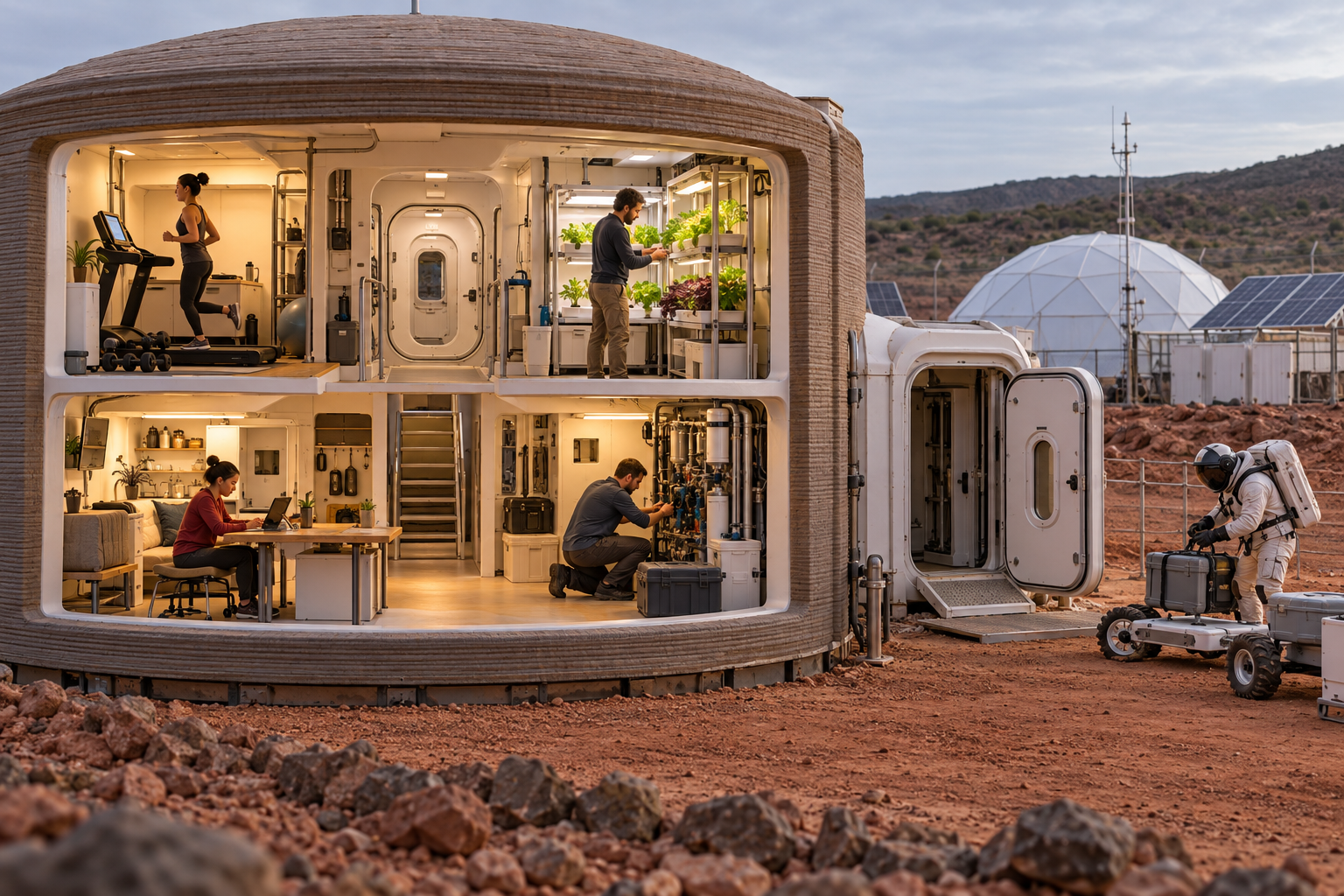
CHAPEA stands for Crew Health and Performance Exploration Analog. It is not a trip to Mars, and that distinction matters. The four-person crew has spent a year in an Earth-based simulation designed to help NASA learn what long-duration isolation, confinement, delayed communication, a resource-limited routine, and team dynamics can teach us before future crews go farther from Earth. NASA says the Mission 2 crew began the 378-day stay on October 19, 2025, inside the roughly 1,700-square-foot, 3D-printed Mars Dune Alpha habitat at Johnson Space Center.
Who is coming home from CHAPEA Mission 2?
The Mission 2 crew is Ross Elder, Ellen Ellis, Matthew Montgomery, and James Spicer. Their official roles are mission commander, medical officer, science officer, and flight engineer, respectively. They are research volunteers, not a television cast, and their work has been deliberately ordinary in the ways that matter: maintaining a home and workplace, carrying out science tasks, exercising, preparing food, managing limited resources, and continuing to cooperate on a demanding schedule.
NASA’s Mission 2 crew announcement explains why those roles and routines matter. A real Mars crew will not only need hardware that survives the journey. It will need people and systems that work together through distance, delay, repetition, and the occasional problem that cannot be solved by calling home immediately.

What did 378 days of simulated Mars isolation test?
A Mars analog cannot reproduce every part of another planet. Houston still has gravity, emergency support, and Earth just outside the facility. What CHAPEA can do is make some of the less cinematic challenges real enough to study: sustained isolation, confinement with the same small team, constrained supplies, a spaceflight-like diet, and communication delays intended to resemble the time a message might take between Earth and Mars.
NASA’s October 2026 mission update says the crew has grown crops, managed limited resources, navigated delayed communication, and completed suited simulated spacewalks. The program collects physical, behavioral-health, and performance data that can help NASA plan for future exploration.
The phrase “behavioral health” can sound clinical, but it points to something every group recognizes. How do you preserve focus when days feel repetitive? How do you make decisions when communication is delayed? How do you give one another room while sharing a compact workplace? A strong spacecraft is only part of a mission architecture. A strong crew culture is infrastructure, too.
Why is CHAPEA in Houston instead of Mars?
Because the hardest questions of a Mars mission are often human questions that can be investigated before launch. Johnson Space Center is NASA’s home for human spaceflight operations and research, making Houston a practical place to run a long, carefully monitored analog mission. The Mars Dune Alpha habitat lets teams observe the interaction of people, schedules, equipment, supplies, and living space over months rather than days.
That is also why CHAPEA is more compelling than a quick “Mars on Earth” headline. The value is not pretending that Texas is the Red Planet. The value is getting a year of useful evidence about how a crew adapts—and using that evidence to improve future habitat design, mission planning, and support systems.
If you like exploring Houston’s spaceflight story from the ground, our guide to a no-telescope stargazing picnic near Houston is a good counterpoint: one is a local night under the actual sky, the other is a local research mission helping prepare people to go beyond it.
How can you watch the CHAPEA Mission 2 egress live?
NASA Live lists the CHAPEA Mission 2 egress ceremony for Saturday, October 31 at 3 p.m. Eastern / 2 p.m. CDT from Johnson Space Center in Houston. NASA will stream it on YouTube; the agency’s NASA Live schedule is the best page to recheck if your plans change or you are looking for the replay afterward.
A simple watch-along plan:
- Open the official stream a few minutes early on Saturday.
- Invite one person who loves a big-picture space story and one person who is curious but new to it.
- Use the ceremony as a conversation starter: Which part of a 378-day shared mission would be hardest for you—routine, food, delayed messages, or the lack of privacy?
- If you watch afterward, share the official replay rather than reposting clips you do not own.
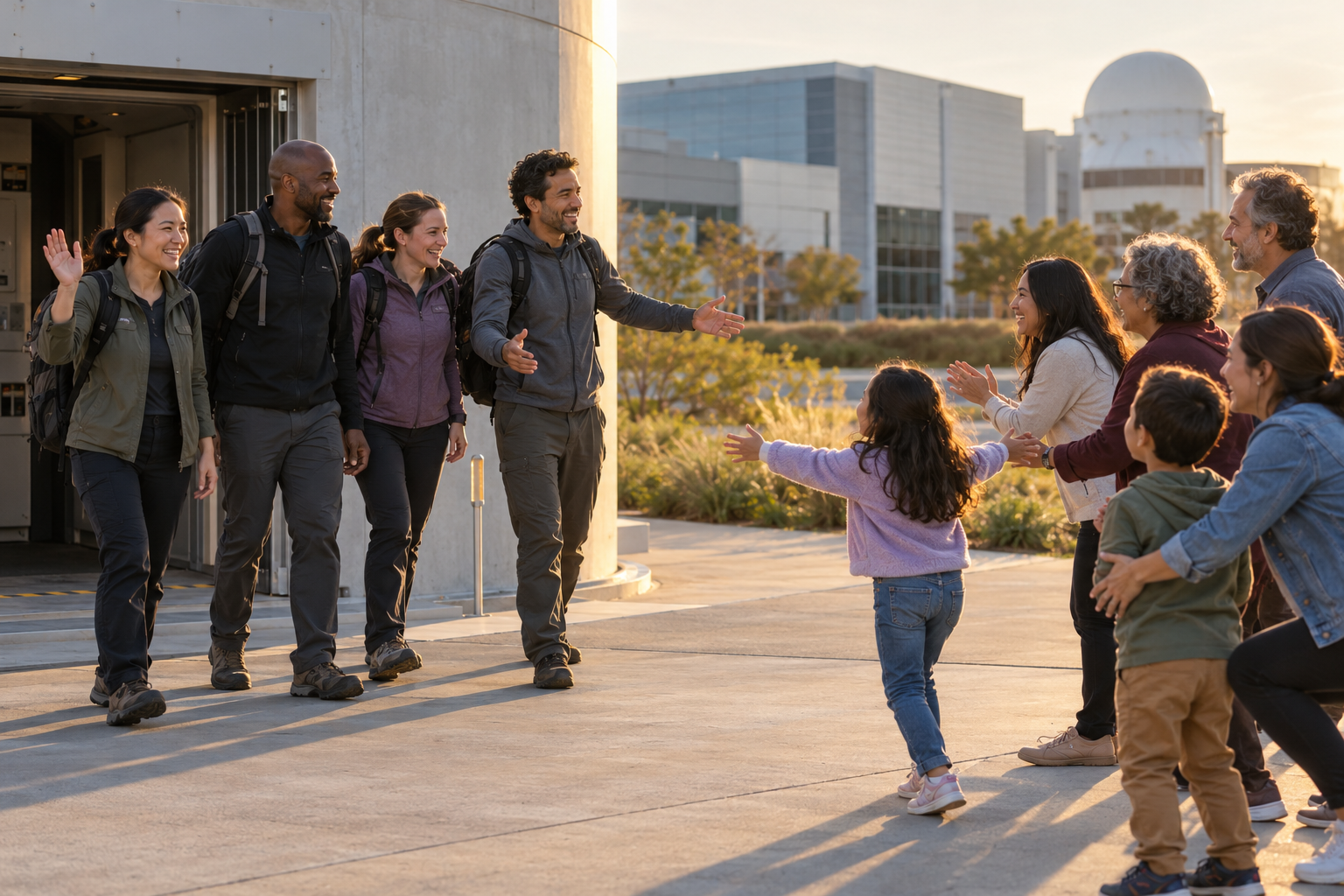
The egress itself will be a human moment: four people stepping back into ordinary, immediate life after communicating with their families through an imposed Mars-like delay. It is a reminder that exploration is not only launch footage and distant spacecraft. It is also people practicing patience, care, and teamwork in a very small shared world.
What happens after the CHAPEA crew exits?
The egress is a milestone, not the end of the science. NASA says the crew will begin two weeks of post-mission evaluations and debriefs; teams will then process health and performance information collected during the mission. The useful takeaway now is simple: year-long analog missions give future exploration plans a test bed for human realities that drawings and short demonstrations cannot capture.
For the Houston community, the timing is an invitation to pay attention to the place where that work is happening. You do not need technical training to care about how people live and work together during a long mission. Bring that curiosity to your next local observing plan, share it with a science-minded friend, or join the Cosmic Match space community to meet people who would happily talk Mars habitats over coffee or under a darkening sky. Houston skywatchers can also find nearby community on Cosmic Match.
FAQ
What time is the CHAPEA Mission 2 egress ceremony?
NASA lists the ceremony for Saturday, October 31, 2026, at 3 p.m. Eastern, which is 2 p.m. CDT in Houston. Recheck NASA Live on the day in case the schedule changes.
Where can I watch CHAPEA Mission 2 egress live?
NASA’s official YouTube stream is here. If you miss it, NASA Live and the YouTube link are the right places to look for an official replay.
Was the CHAPEA crew actually on Mars?
No. CHAPEA is an Earth-based Mars analog at NASA’s Johnson Space Center. Its purpose is to study crew health, performance, and operations during a long simulated Mars mission.
How long was CHAPEA Mission 2?
Mission 2 lasted 378 days, from October 19, 2025 to the planned October 31, 2026 egress.