Astronomers Found Two Debris Rings Around a Dead Star—Here’s What They Actually Saw
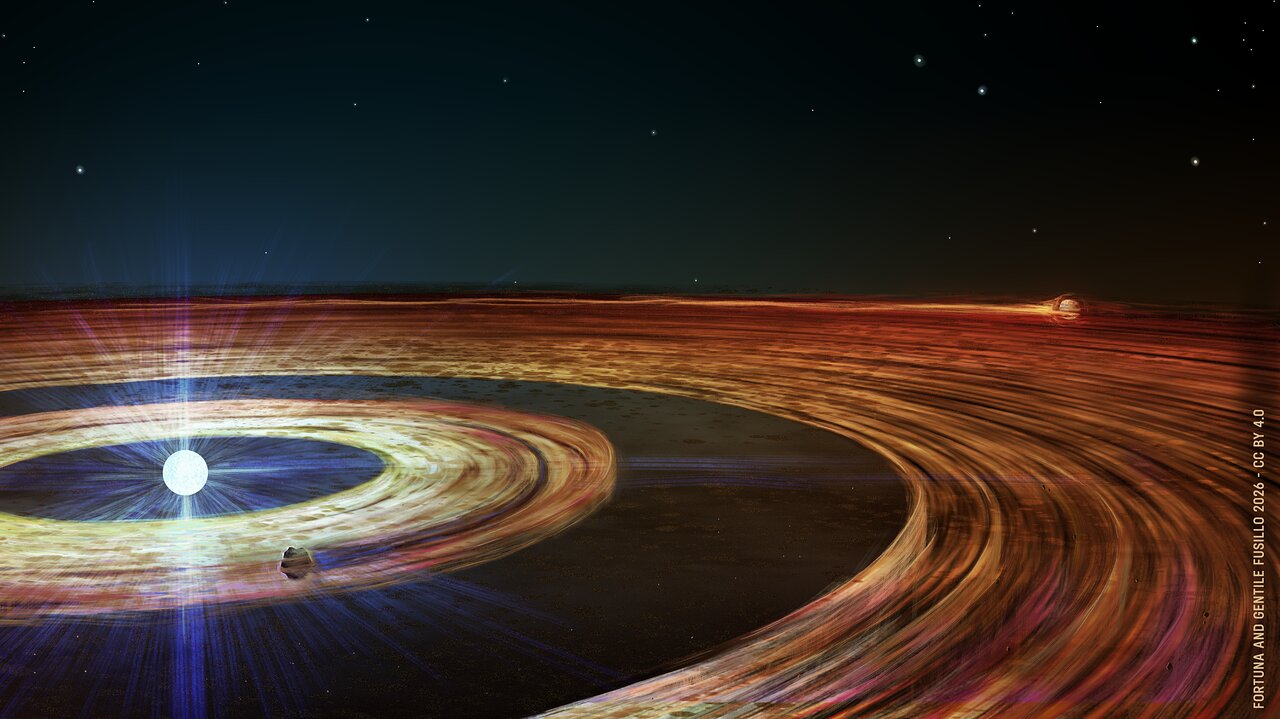
A new observation of the white dwarf J1328−1450 has given astronomers their first reported example of a stable double gaseous debris-disc system around a white dwarf: two separate rings of vaporized planetary material with a clear gap between them. The result comes from professional spectroscopy with ESO’s Very Large Telescope (VLT), not a photograph through an eyepiece—and the team’s proposed surviving bodies have not been directly imaged.\n\nThat distinction is the fun part. A small, strange-looking set of light signatures can reveal the structure and chemistry of a planetary system after its star has died. For anyone who loves a good “how do we know?” space story, this one is a cosmic crime scene with unusually good fingerprints.\n\n \n\nArtist’s impression of J1328−1450’s proposed double-disc system. This is a scientific visualization, not a direct image. Credit: ESO/L. Calçada, CC BY 3.0.\n\n## What did astronomers find around white dwarf J1328−1450?\n\nThey found two concentric rings of hot gas made from planetary debris, separated by a distinct gap. White dwarfs are the dense, burnt-out cores left after Sun-like stars exhaust their fuel and shed their outer layers. When that upheaval disturbs surviving rocky worlds, fragments can be pulled apart and vaporized into a disc close to the remnant star.\n\nGaseous debris discs around white dwarfs were already known. What is new here is the stable, two-ring layout. The study team reports that the system did not behave like one continuous flat disc; its light carries the signature of two separated components. That makes J1328−1450 a valuable laboratory for asking what planetary systems can look like after a star’s giant phase has rearranged everything.\n\nIt is also a useful reality check on the phrase “dead star.” The white dwarf itself is no longer fusing hydrogen like the Sun, but its neighborhood is still dynamically busy. Planetary material is moving, colliding, and leaving clues in light.\n\n## How can a spectrum reveal two rings that nobody photographed?\n\nThe VLT’s X-Shooter instrument spreads the system’s light into a spectrum—the same broad idea as a prism separating sunlight into colors, but measured with far more precision. Specific atoms and ions emit or absorb light at particular wavelengths. Gas orbiting toward us shifts those wavelengths slightly blueward; gas moving away shifts them redward.\n\nA single rotating gaseous disc often produces a pair of emission peaks: one from the approaching side and one from the receding side. For J1328−1450, the observations showed quadruple-peaked emission lines. The best explanation is two orbital rings, each supplying its own approaching-and-receding pair. The spacing and shapes of those features let researchers model the rings as separate structures.\n\n
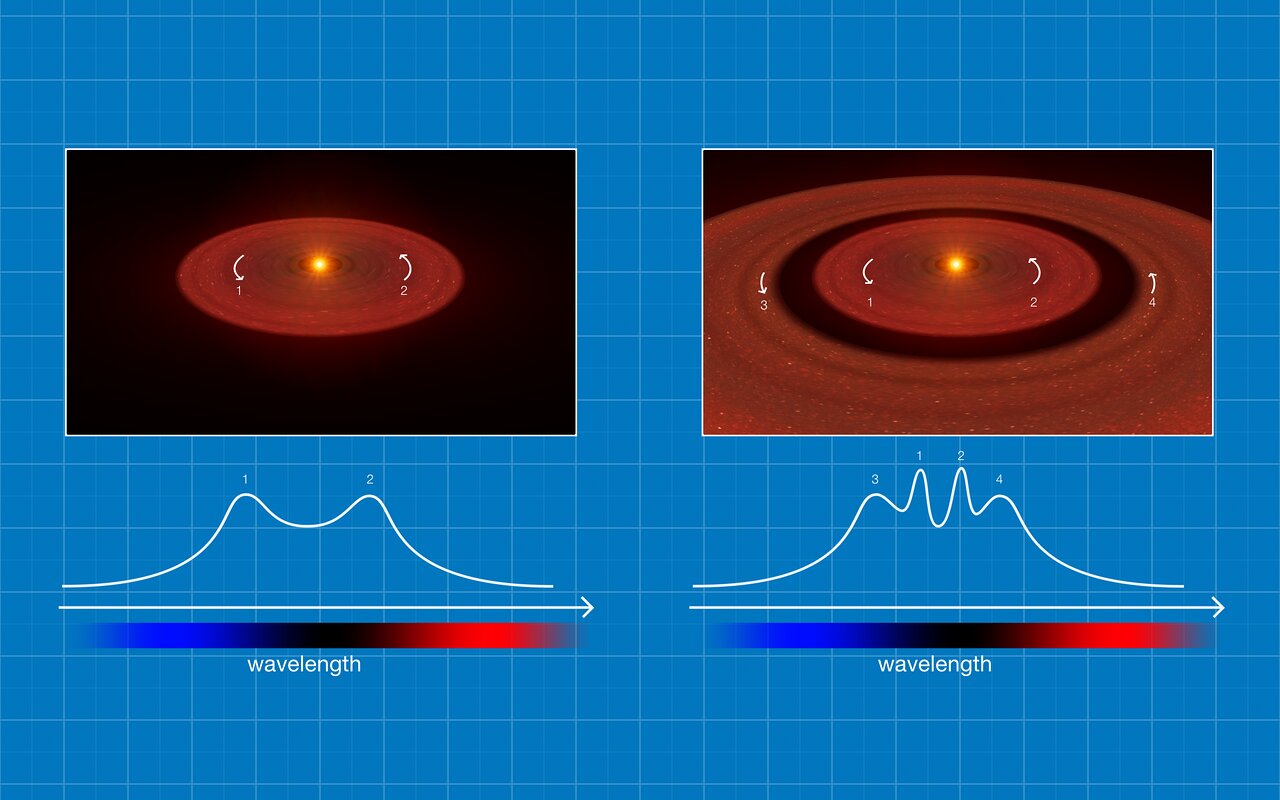 \n\nHow motion in a rotating disc changes an emission-line profile. In this case, two separated rings create the unusual multi-peaked pattern. Credit: ESO/L. Calçada, CC BY 3.0.\n\nThis is why the observation is not a direct picture of rings. It is an inference from the pattern of light, backed by physical models of orbital motion. That may sound indirect, but it is a powerful and standard way astronomy works. JWST’s map of WASP-17 b’s atmospheric edge is another good example: the telescope measured starlight filtered through a planet’s atmosphere rather than taking a conventional snapshot.\n\n## Why does magnesium matter in this white dwarf double debris disc?\n\nThe team did not only find two rings; it found a chemical difference between them. The inner ring is magnesium-rich, while the outer ring is magnesium-depleted. Calcium, oxygen, magnesium, and iron in the system point to rocky planetary material, but the mismatch between the rings is the interesting clue.\n\nOne interpretation is that two different parent bodies supplied the debris, with distinct compositions. Another is that the material came from different layers of a single differentiated body—the way a large rocky world can have chemically different crust, mantle, and core material. The observations support these possibilities; they do not yet choose decisively between them.\n\nThat careful language matters. Scientists can measure the gas chemistry in the rings. Connecting that chemistry to a particular destroyed world is a well-supported hypothesis, not a recovered rock sample. If you enjoy separating a measurement from the story built around it, this is exactly the kind of result worth following.\n\n## Did the team actually see two surviving planets?\n\nNo. The two surviving planetesimals are a proposed explanation for why the rings remain separated and stable, not directly imaged objects. In the team’s scenario, one body associated with the inner ring may be asteroid-scale—only a few kilometres across. The outer object might be much larger, potentially Pluto-sized or even Moon-sized depending on where it orbits and what it is made of.\n\nThose size ranges are deliberately uncertain. They come from models of the system’s dynamics, not a ruler laid across an image. The safe headline is: astronomers observed two gaseous rings and a gap; their modelling suggests surviving bodies could be sculpting that architecture.\n\n
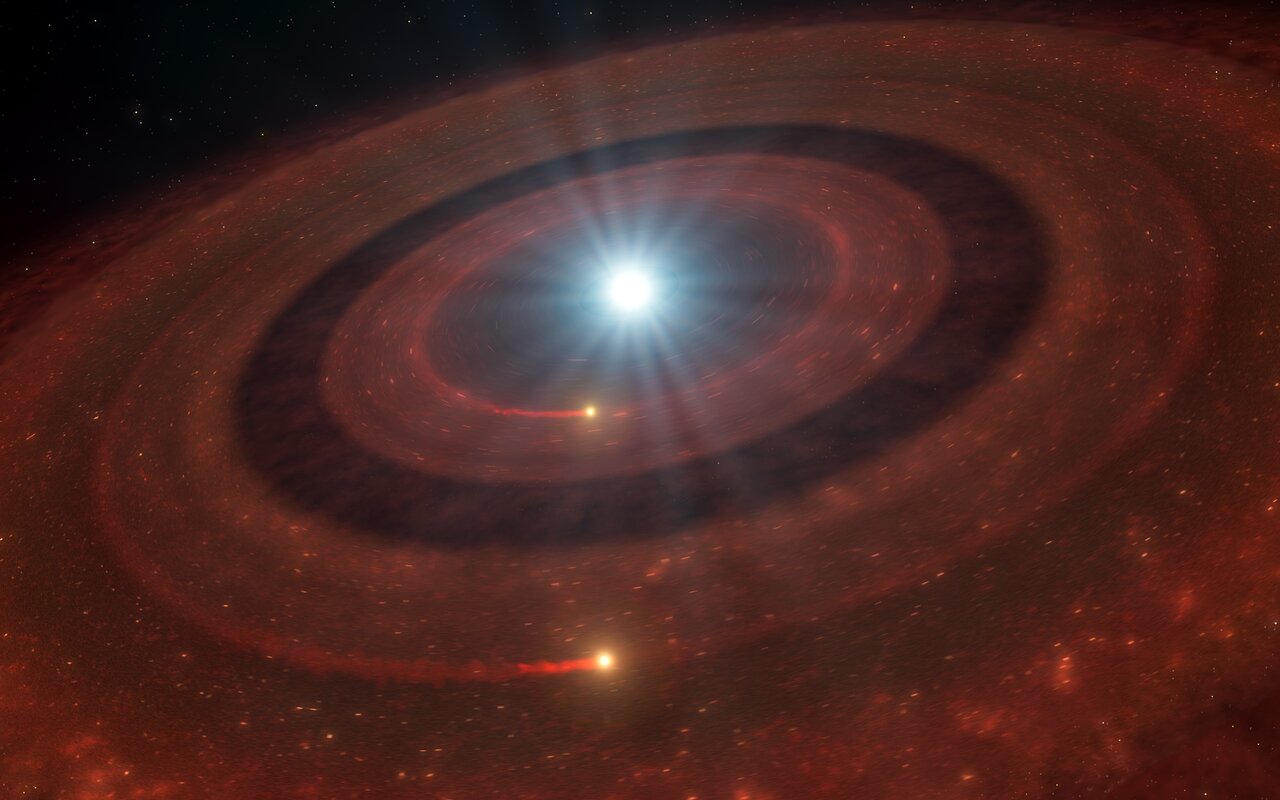 \n\nAnother ESO visualization of the system. The bright points represent the team’s proposed surviving bodies, not objects resolved by the VLT. Credit: ESO/L. Calçada, CC BY 3.0.\n\n## Why this dead-star system is a window into our Solar System’s future\n\nThe Sun will eventually become a white dwarf, though not for roughly five billion years. Earth’s exact fate during the Sun’s red-giant phase is still a separate question; J1328−1450 does not predict it. What this system does show is that the story need not end neatly when a Sun-like star dies. Outer rocky bodies can survive, interact, fragment, and leave behind dynamically complex debris.\n\nThe wider lesson is about patience with invisible evidence. From a distance, this system is a faint point of light. With spectroscopy, it becomes a record of velocity, chemistry, and gravitational structure. That same detective-work mindset is behind discoveries of distant small worlds—like Rubin’s still-unconfirmed dwarf-planet candidate—where evidence can be compelling without becoming certainty overnight.\n\nYou will not see J1328−1450’s rings with backyard binoculars or an amateur telescope in Austin, Houston, or Los Angeles. But you can absolutely share the question with people who get why a weird line in a spectrum is exciting. Join the conversation with fellow sky-curious people at Cosmic Match, and bring your best “wait, how can they tell?” question.\n\n## FAQ\n\n### Is J1328−1450’s double debris disc the first ever found?\n\nIt is the first reported stable double gaseous debris-disc system around a white dwarf. That is more precise than calling it the first double disc of any kind anywhere in space.\n\n### Can I see the two rings through my telescope?\n\nNo. The rings were detected with spectroscopy from ESO’s VLT and are far beyond the reach of amateur observing equipment.\n\n### What does a quadruple-peaked emission line mean?\n\nIt means the light from orbiting gas has several distinct Doppler-shifted components. In this case, modelling indicates two rotating rings, each with an approaching and receding side.\n\n### Were the possible planetesimals photographed?\n\nNo. The observed result is the two-ring gas structure. The possible asteroid-scale inner body and larger outer body are proposed from models that explain the gap and the rings’ stability.\n\nSources: ESO’s October 27, 2026 release; the Nature Astronomy study.
Another fresh debris-disk clue
For a newly reported look at dust around a young star, see Hubble’s visible-light detection of Beta Pictoris’s Cat’s Tail. It is a different kind of planetary-system aftermath: a vast dust feature whose composition and geometry are still being tested.