NASA’s $10B Moon Base Contract Is a Ceiling—Here’s What Was Actually Awarded

NASA’s Nov. 7 Moon Base announcement is easy to misread as one $10 billion spend. It is not. The clearest newly committed piece is a Blue Origin award to deliver the nuclear-powered PROMISE rover: $94 million at base, plus an additional $140 million option that depends on performance. The larger $10 billion figure is the ceiling for a 10-year CLPS 2 contract framework—a maximum amount that eight eligible companies may compete for through future task orders, not a check already written to each company.
For space fans, the useful story is not a single giant number. It is a map of different kinds of work: a science rover headed for the lunar south pole, a pool of potential cargo-lander providers, and transportation orders designed to move future Moon Base hardware between Earth, lunar orbit, and the surface.

Cover photo: NASA, shared on Unsplash under the Unsplash License.
What did NASA actually award for the Moon Base?
Start with PROMISE—short for Polar Rover for Observation, Mapping, and In-Situ Exploration. NASA says the six-wheeled, nuclear-powered rover is targeting a late-2028 launch and an 18-month mission at the Moon’s south pole. It is designed to work through long lunar nights and in permanently shadowed regions, where scientists think water ice may persist.
The rover’s drill is expected to sample regolith to about 1 meter (3 feet) below the surface. It will also carry spectrometers, cameras, temperature and radiation sensors, plus autonomy and radiation-tolerant computing demonstrations. That makes PROMISE a concrete science-and-site-selection mission—not a vague future concept.
NASA awarded Blue Origin a $94 million base contract to deliver PROMISE, with a $140 million option that is performance-dependent. The company plans to use its Mark 1 lander. That distinction matters: the option is possible future value, not committed spending today. NASA’s PROMISE mission overview is the primary place to follow the rover as its payload and landing plan develop.
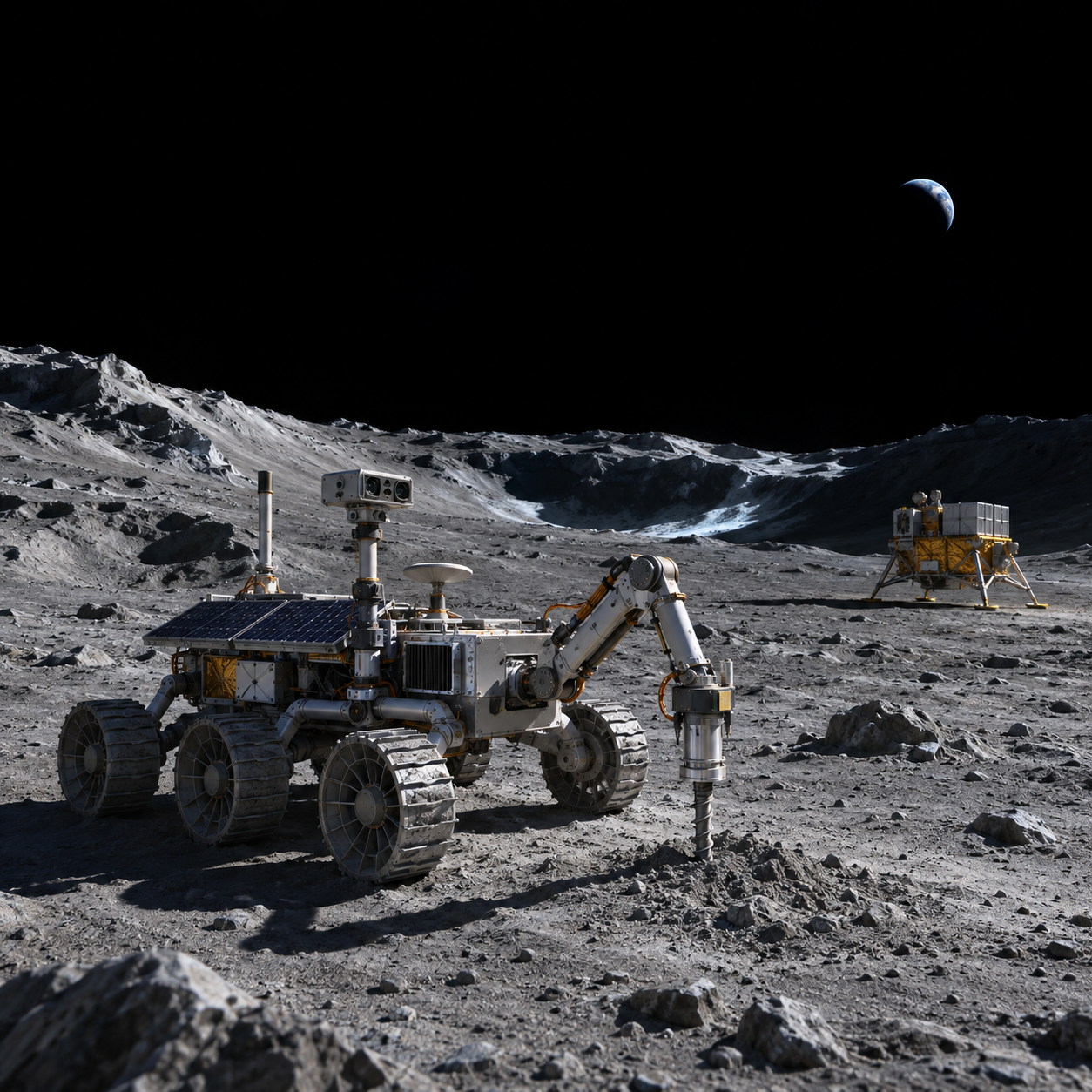
Illustration: a concept rendering of the kind of surface science operation PROMISE is intended to enable; not a mission photograph.
Is the $10 billion CLPS 2 figure money NASA has already spent?
No. NASA describes CLPS 2 as a 10-year, multiple-award, indefinite-delivery/indefinite-quantity contract with a combined maximum value of $10 billion. Think of it as a procurement ceiling and a qualified vendor pool: NASA can issue future delivery task orders within that structure, but the ceiling does not say that $10 billion is funded, committed, or evenly divided.
The eight companies now eligible to compete for future CLPS 2 lunar-delivery work are:
- Blue Origin
- Firefly Aerospace
- Intuitive Machines
- ispace-U.S.
- Lockheed Martin Space
- Northrop Grumman Space Systems
- SpaceX
- Voyager Technologies
Their job, if selected for a specific task order, would be to manage, build, and operate landers that take NASA science, technology, and infrastructure to the Moon. NASA also raised the existing CLPS 1.0 contract ceiling from $2.6 billion to $4.2 billion; that is another ceiling change, not a statement that those dollars have all been spent.
For Austin-area readers, one name has a local connection: Firefly Aerospace is based in Cedar Park. Its CLPS 2 selection gives it eligibility to compete for later missions; it does not announce a new Firefly delivery award in this release. If you want to swap launch chatter for a real-world space conversation, join the Cosmic Match space community and compare which lunar science questions you most want a rover to answer.
How do VADR task orders fit into the lunar transportation map?
A lander is only the last leg. NASA’s VADR (Venture-Class Acquisition of Dedicated and Rideshare) task orders cover the broader transportation problem: launch services, orbital-transfer vehicles, and getting cargo onto useful lunar trajectories.
NASA announced six VADR task orders worth approximately $1.3 billion combined. The agency named Arrow Science and Technology, Blue Origin, and Impulse Space for integration and transportation work, while explaining that missions may launch on Blue Origin’s New Glenn, Relativity Space’s Terran R, and SpaceX’s Falcon 9. In-space transportation spacecraft are expected from Blue Origin, Firefly Aerospace, Impulse Space, and Quantum Space.
That is a specific announced order total—unlike the CLPS 2 ceiling. It is still useful to separate it from the broader $5 billion maximum value of the 10-year VADR contract family. An orbital transfer vehicle is essentially the freight leg in space; a lunar lander handles the final descent.
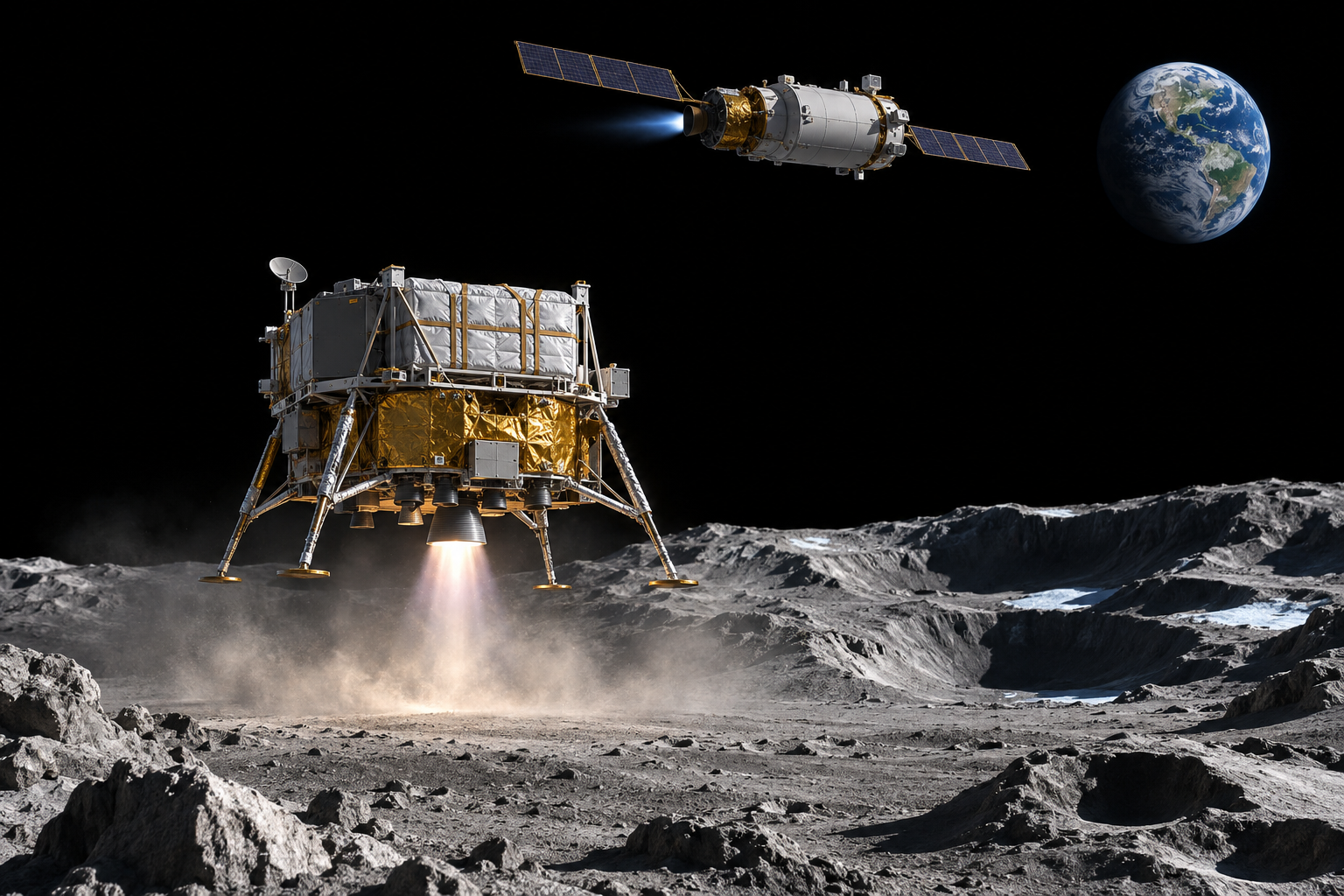
Illustration: lunar transportation involves distinct launch, orbital-transfer, and landing segments.
Los Angeles also appears naturally in this map: Impulse Space is headquartered in Redondo Beach. NASA’s release connects the company to the transportation awards, but it does not create a public local event to attend. The more interesting local takeaway is that work for a lunar south-pole campaign is spread across a national network of builders, operators, and science teams.
What comes next for the Moon Base?
The announcement also included early infrastructure steps. NASA intends to buy components for a Mini-Communications and Solar Tower, or miniCAST: Honeybee Robotics for energy storage, Redwire for power generation, and Yank Technologies for wireless power transfer. NASA says this first effort involves components rather than a major integrated system, with a separate solicitation for fully integrated power systems anticipated in early 2027.
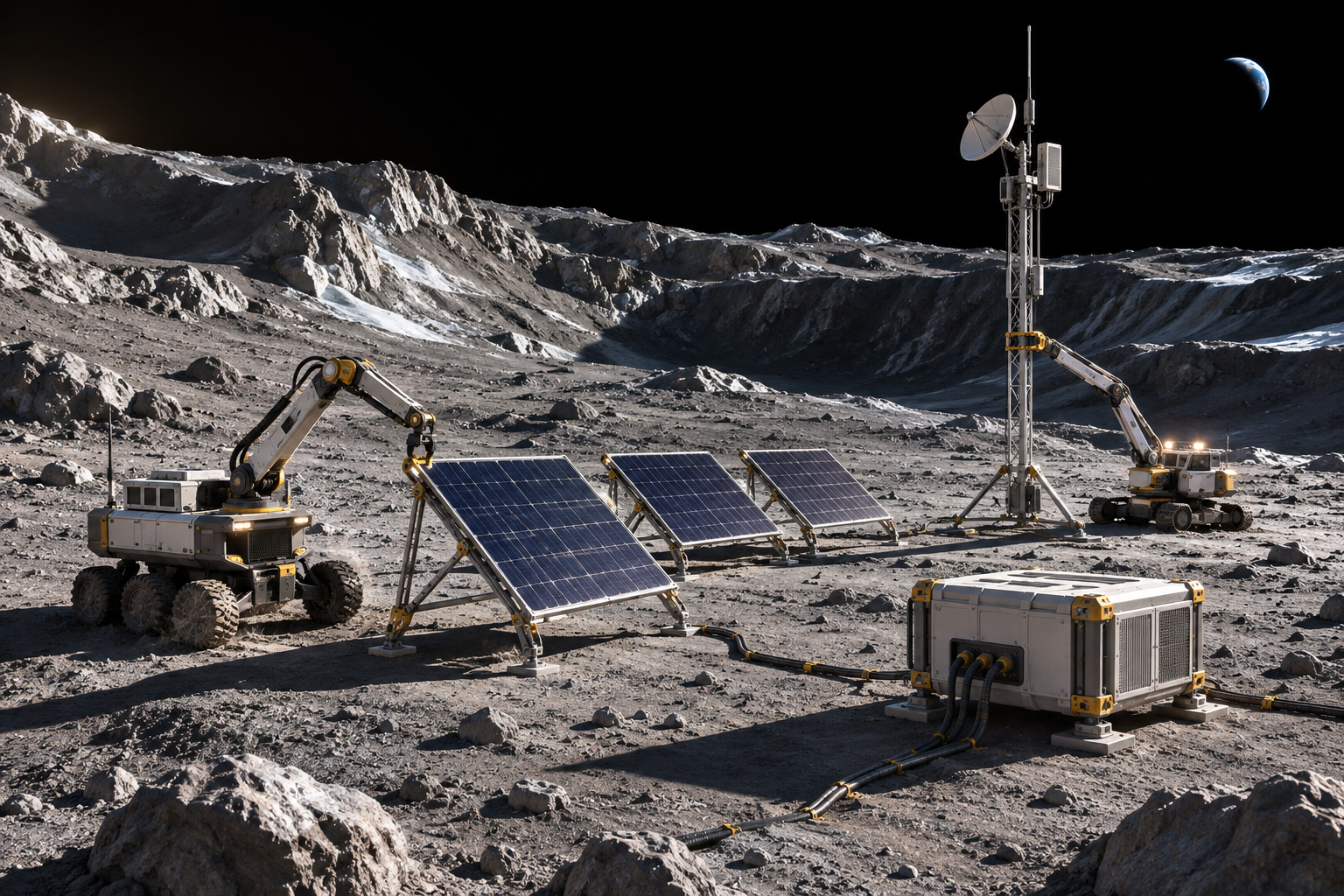
Illustration: early power and communications components can precede a larger integrated lunar surface system.
The best way to read all of this is mission by mission. PROMISE has a named destination, a target date, an 18-month science plan, and a stated base award. CLPS 2 establishes who may compete for future lunar deliveries. VADR task orders provide transportation capacity across the Earth–Moon system. MiniCAST begins with components. Together, they are groundwork for a sustained south-pole presence—not a completed Moon Base.
NASA’s full Nov. 7 release is the controlling source for the award values and mission details. For another example of how complex space hardware comes together one increment at a time, read our explainer on the completed ISS iROSA power upgrade. Then sign up at Cosmic Match to meet people who can happily debate whether lunar logistics or lunar geology is the more exciting part of this news.