Where Did the Oxygen Go? Hubble’s Dwarf-Galaxy Census Explained
Dwarf galaxies are supposed to be small but mighty chemical factories. A new census of 37 nearby systems finds that they still hold only 4% to 25% of the oxygen their stars are estimated to have made—about 11% on average. The oxygen has not “vanished,” and Hubble did not photograph it streaming away. Instead, researchers compared a reconstructed lifetime oxygen budget with what remains today. The shortfall is a sharp test for models of how galaxies grow, lose material, and enrich the space around them.
That result appears in a peer-reviewed paper published Nov. 2, following an August preprint. The observations themselves are archival: the news is the finished analysis and its institutional release, not a newly acquired Hubble image.
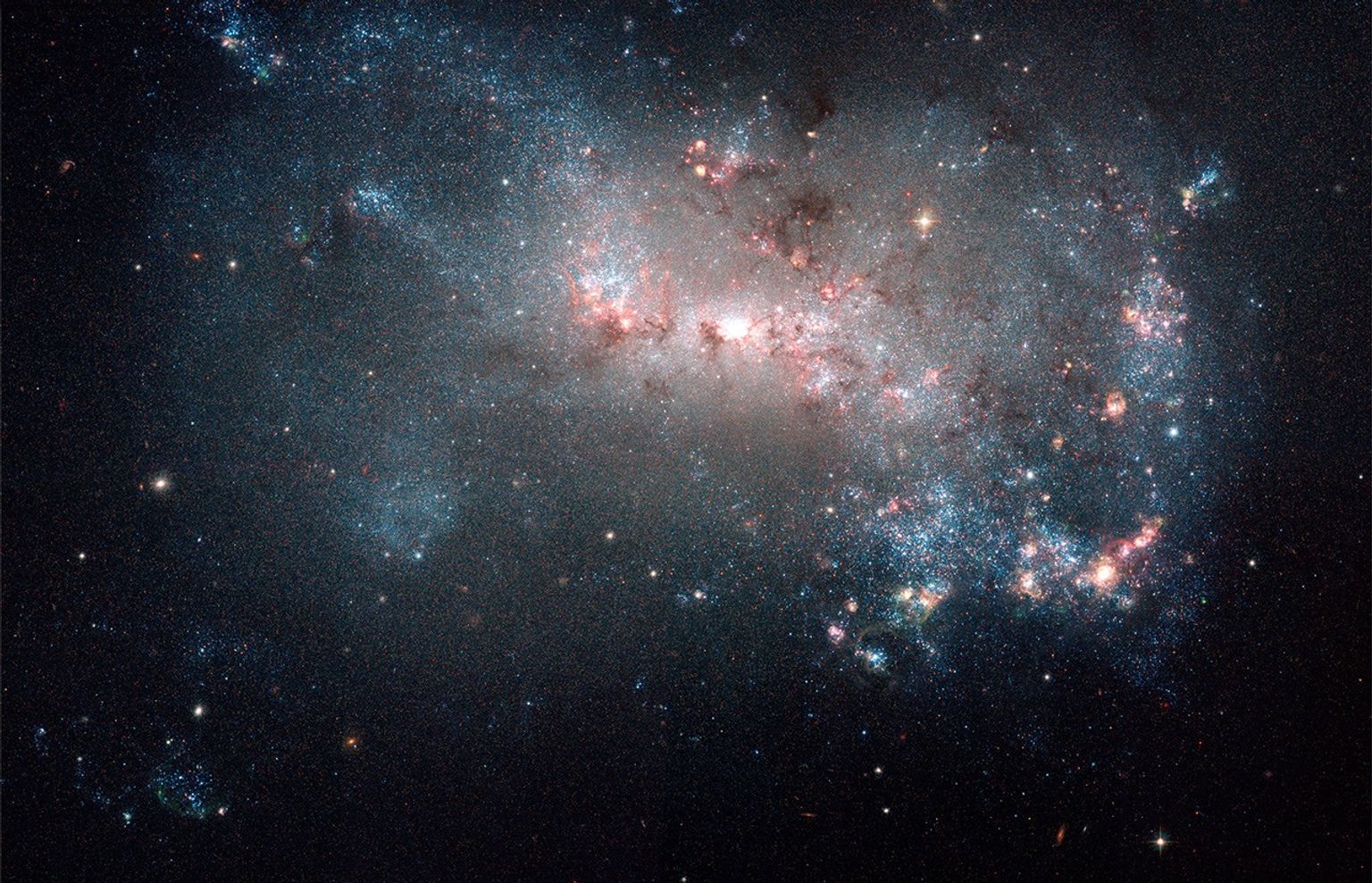
NGC 4449, one of the GLOW study galaxies. This archival Hubble image illustrates a target; it does not map the missing oxygen. Image: NASA, ESA, Hubble Heritage–ESA/Hubble Collaboration, Alessandra Aloisi (STScI, ESA).
What did Hubble’s dwarf-galaxy census find?
The Galaxies Losing Oxygen via Winds (GLOW) team studied 37 gas-rich dwarf galaxies within roughly 22 million light-years. They asked a deceptively simple question: based on each galaxy’s history of star formation, how much oxygen should its stars have produced—and how much can astronomers account for now in its stars, gas, and dust?
The answer is the striking part. Across the sample, the galaxies retain just 4% to 25% of the oxygen expected from their stellar histories, with an average near 11%. NASA’s release and the Rutgers summary describe the same central result: the inventory is much smaller than models predicted.
“Oxygen missing” is convenient headline shorthand, but it needs care. The study is not saying oxygen disappeared from reality. It means the team’s accounting finds far less oxygen inside the measured parts of these galaxies than their stars should have produced.
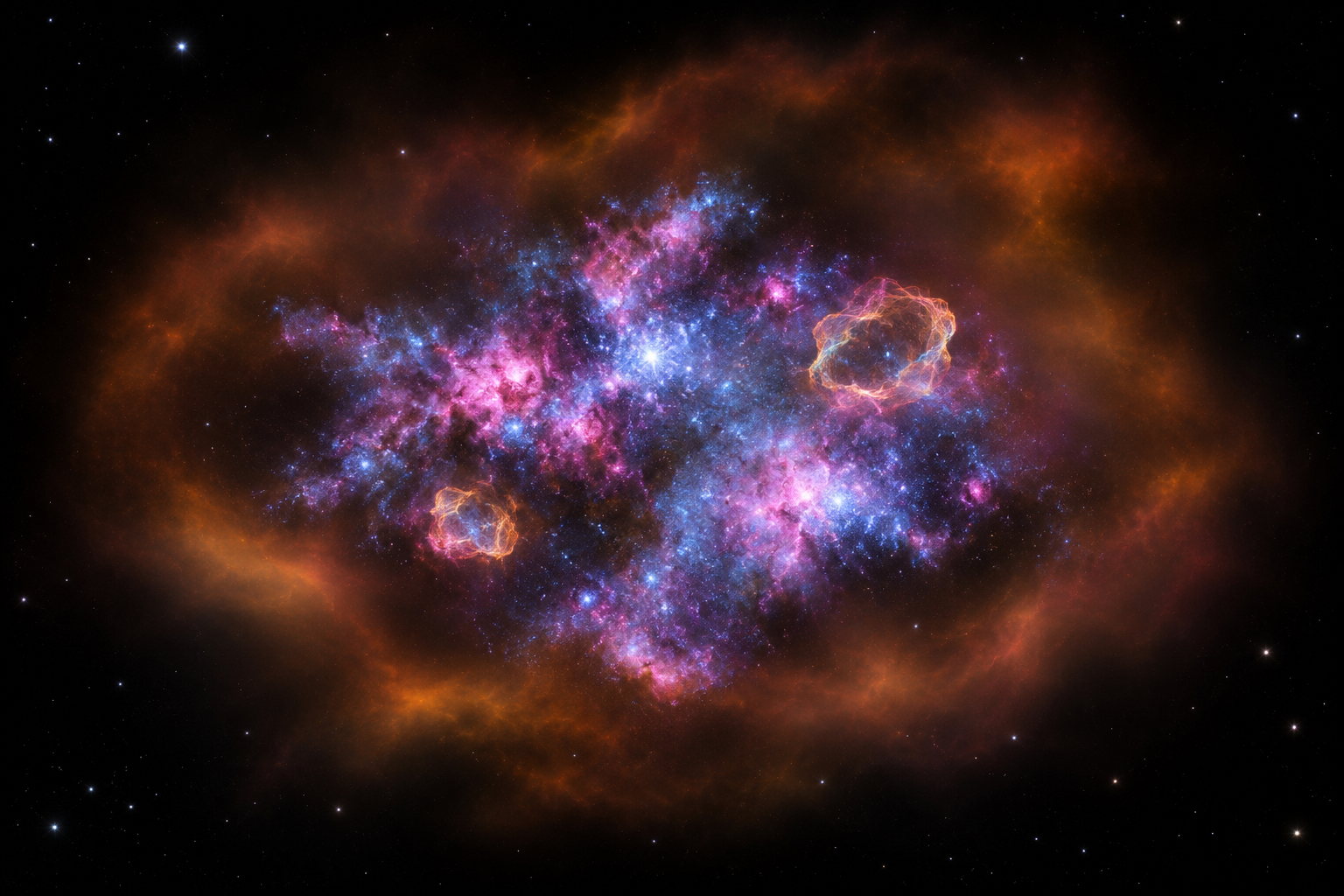
Conceptual illustration of a dwarf galaxy and a diffuse surrounding halo; it is not an oxygen map or a measurement from the study.
Why is oxygen a useful clue to galaxy evolution?
Stars forge oxygen, especially massive stars that end in supernova explosions. Oxygen also produces telltale spectral signatures, making it practical to measure. That makes it a useful tracer for a larger story: how galaxies recycle material, form later generations of stars, and seed their surroundings with heavy elements.
Small galaxies are especially valuable laboratories. Their shallower gravity makes it easier for energy from massive stars and supernovae to push gas outward. If those outflows carry metals with them, the difference changes how quickly a galaxy can build up the raw ingredients for future stars and planets.
This is also why the result belongs beside discoveries such as the double debris rings around a white dwarf: both are reminders that chemistry is a kind of cosmic diary. In this case, the diary is incomplete—and that incompleteness is the science.
How did the researchers count oxygen without seeing every atom?
They did not point Hubble at a glowing cloud and watch oxygen leave. The census combines several kinds of evidence. Archival Hubble optical images resolve individual stars in these unusually nearby galaxies, helping the team reconstruct when stars formed. They combined that with Spitzer infrared data, radio observations from the Very Large Array and Australia Telescope Compact Array, and ground-based measurements to estimate oxygen production and present-day reservoirs.

Conceptual illustration of multiwavelength observations used to build a galaxy inventory; the colored waves are illustrative, not data overlays.
The comparison is what matters: estimated production versus the oxygen still counted in stars, gas, and dust. It is an inference built from a carefully assembled budget, not a direct movie of atoms escaping. The technical account is available in the peer-reviewed Astrophysical Journal paper.
Where could the oxygen be now?
That is the open question, not a solved one. Supernova-powered galactic winds are a leading explanation for why dwarf galaxies retain so little oxygen. Some material may sit in the faint circumgalactic medium—the broad halo of gas around a galaxy. Some may have traveled farther into intergalactic space. The new census does not establish which destination contains most of it.
That uncertainty is productive. Models already expected dwarfs to lose oxygen; the observations suggest they may be even more efficient at it than the models assumed. Pinning down where the material ends up will help astronomers improve simulations of galaxy evolution across cosmic time.
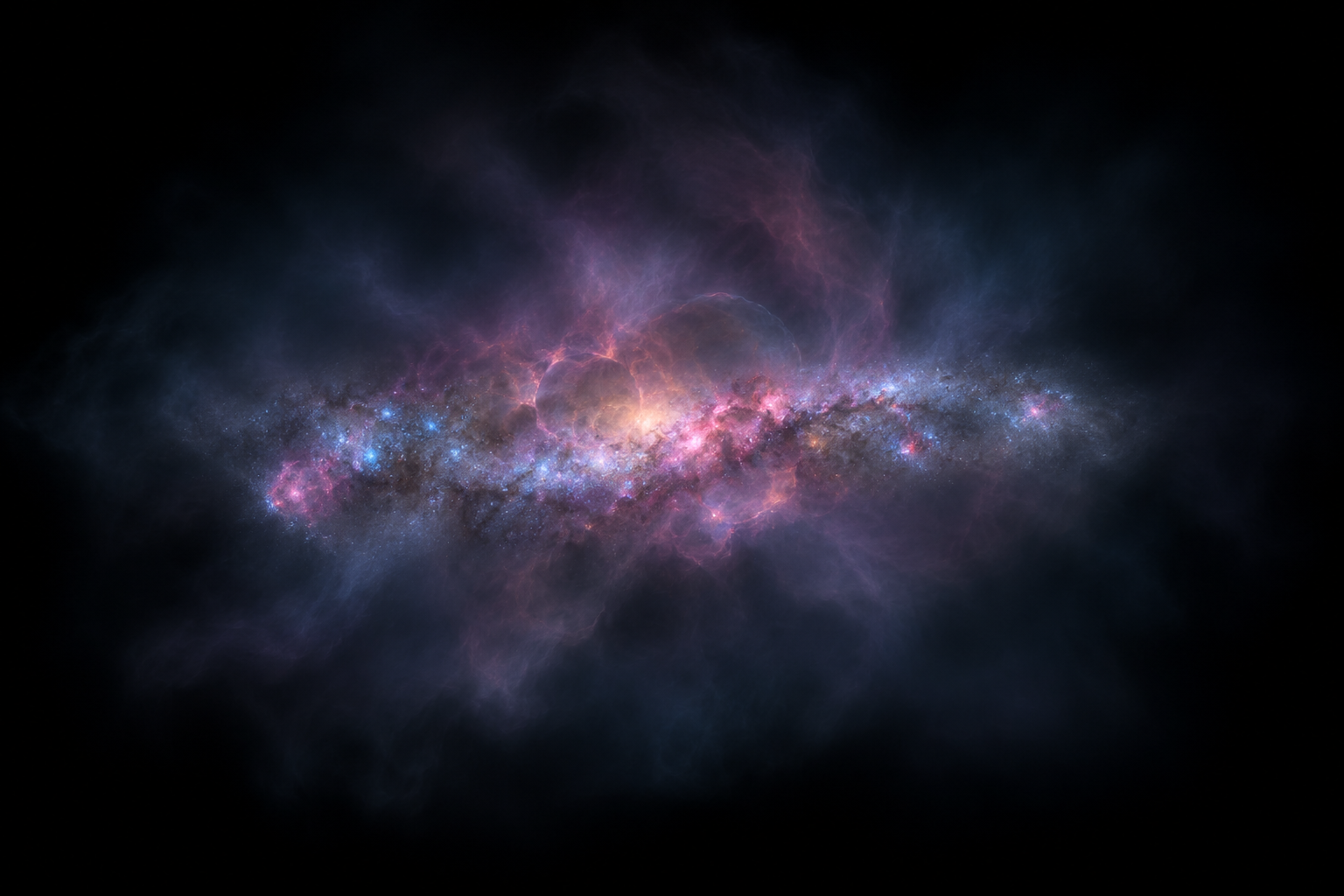
Artist’s concept of a diffuse galactic-wind halo. It represents one possible mechanism, not a direct observation of the missing oxygen.
Why this matters to people who love the night sky
You cannot look through a backyard telescope and watch oxygen leave NGC 4449. But the result makes familiar sky objects richer: every compact galaxy is part of a long exchange between stars and the space beyond them. When you share a telescope view or swap a favorite deep-sky target with the Cosmic Match community, you are looking at systems shaped by that same feedback loop.
The next step is not a dramatic reveal; it is better accounting. Future observations of still fainter dwarf galaxies, along with Hubble, Webb, and Roman-era follow-up, can test how their star-formation histories and environments affect what they keep—and what they release.
For another approachable look at how astronomers turn subtle clues into big questions, read our explainer on whether comets could have helped seed Earth’s chemistry. Then bring your own “wait, where did it go?” question to the community at cosmicmatch.io.