ESCAPADE’s Powered Earth Flybys: Why Two Mars Probes Come Home Before Leaving
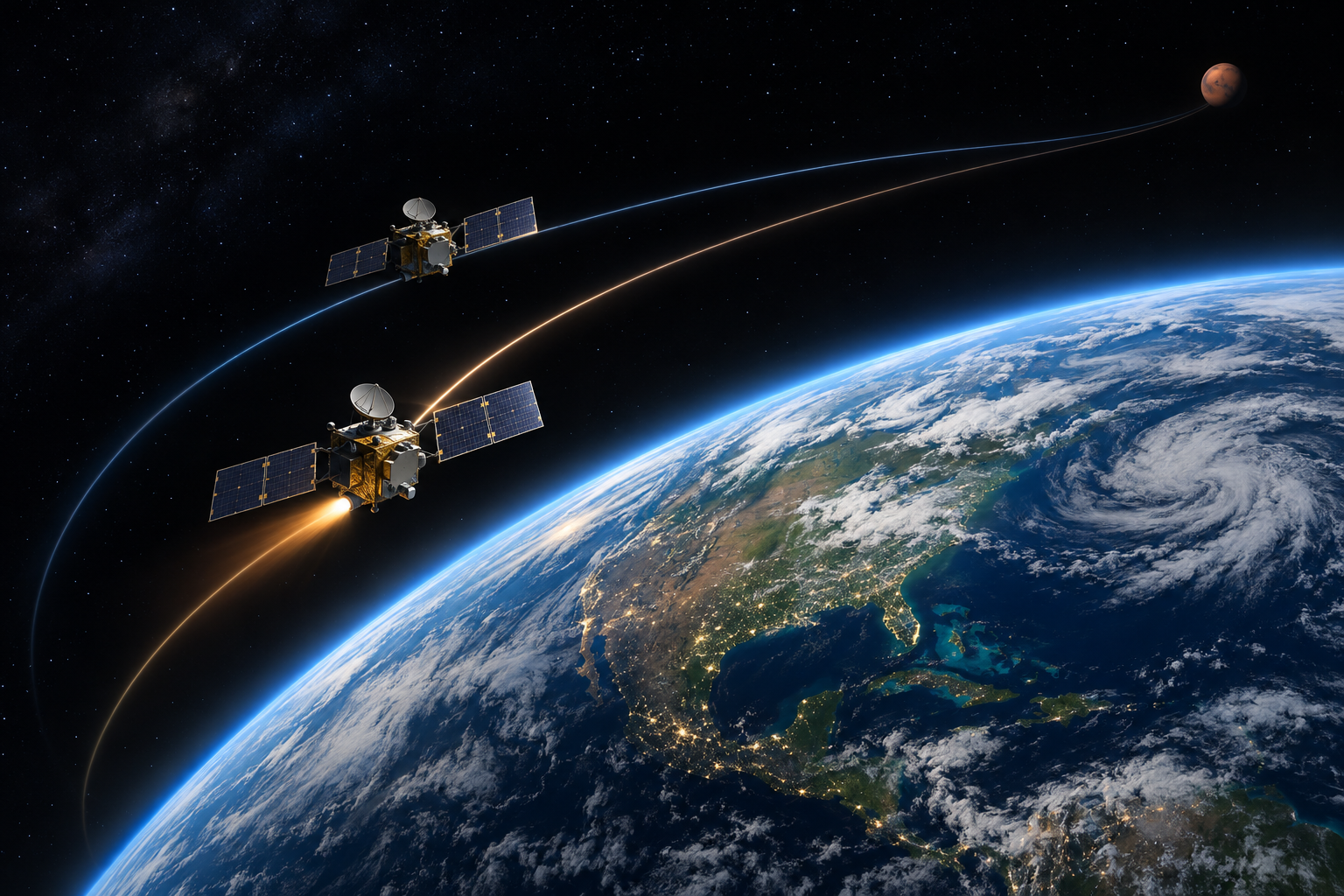
NASA's twin ESCAPADE spacecraft will make history before dawn on Nov. 7 and Nov. 9: each will sweep past Earth, fire its engine near closest approach, and use the combination to head for Mars. The maneuver is called a powered Earth flyby. It is not a sky show for the naked eye, but it is a remarkably creative piece of mission design—and a faint, telescope-only target for observers in favorable western-U.S. locations.
What is ESCAPADE doing near Earth in November 2026?
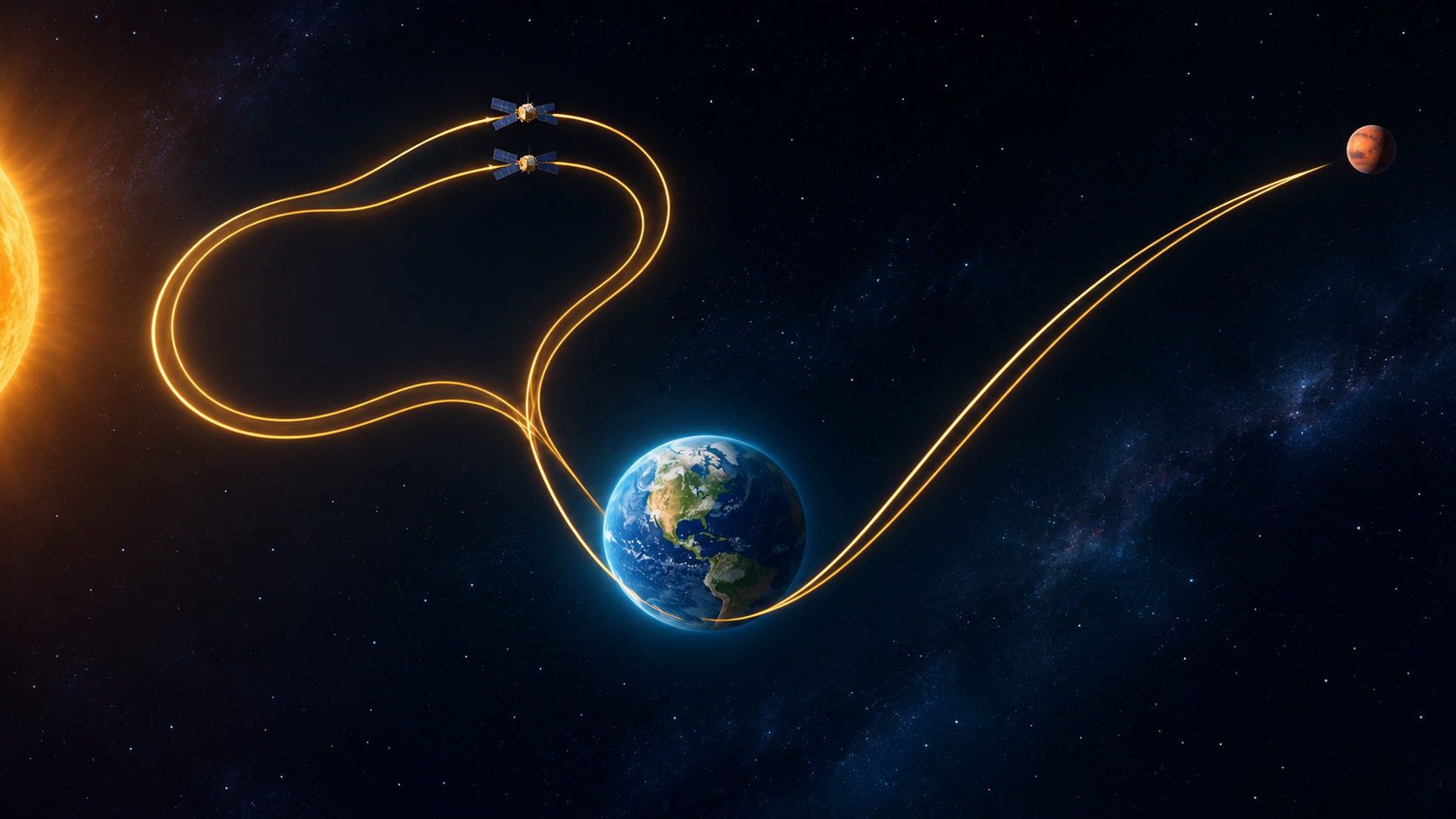
ESCAPADE—short for Escape and Plasma Acceleration and Dynamics Explorers—is a pair of Mars-bound spacecraft named Blue and Gold. Instead of leaving directly for Mars after their Nov. 13, 2025 launch, the probes spent about a year in a broad, kidney-bean-shaped Earth-proximity path around the Earth–Sun L2 region. That loiter gave Earth and Mars time to return to a favorable alignment.
Now the probes are coming back close to Earth one at a time. NASA says the first will reach closest approach and finish its engine burn at about 5 a.m. EST on Saturday, Nov. 7; the second follows at about 6 a.m. EST on Monday, Nov. 9. Their roughly 10-month cruise then leads to Mars arrivals on Sept. 7 and Sept. 9, 2027. The goal at Mars is a coordinated, two-spacecraft look at how the solar wind interacts with the planet’s magnetic environment and helps drive atmospheric loss.
Why is this called a powered Earth flyby?
A normal gravity assist borrows a little of a planet’s orbital momentum to change a spacecraft’s speed and direction. ESCAPADE adds an engine burn at the fast, low point of that swing: a trans-Mars injection burn of about nine minutes. NASA describes it as the first successful attempt by a Mars-bound spacecraft at this kind of powered flyby, also known as an Oberth maneuver.
The timing matters. At closest approach, each roughly refrigerator-size probe will be only about 600 to 1,100 miles above Earth’s surface, moving near 6.3 miles per second. The burn raises that to about 6.7 miles per second—more than 1,000 mph of added speed—while Earth’s gravity redirects the trajectory toward Mars.
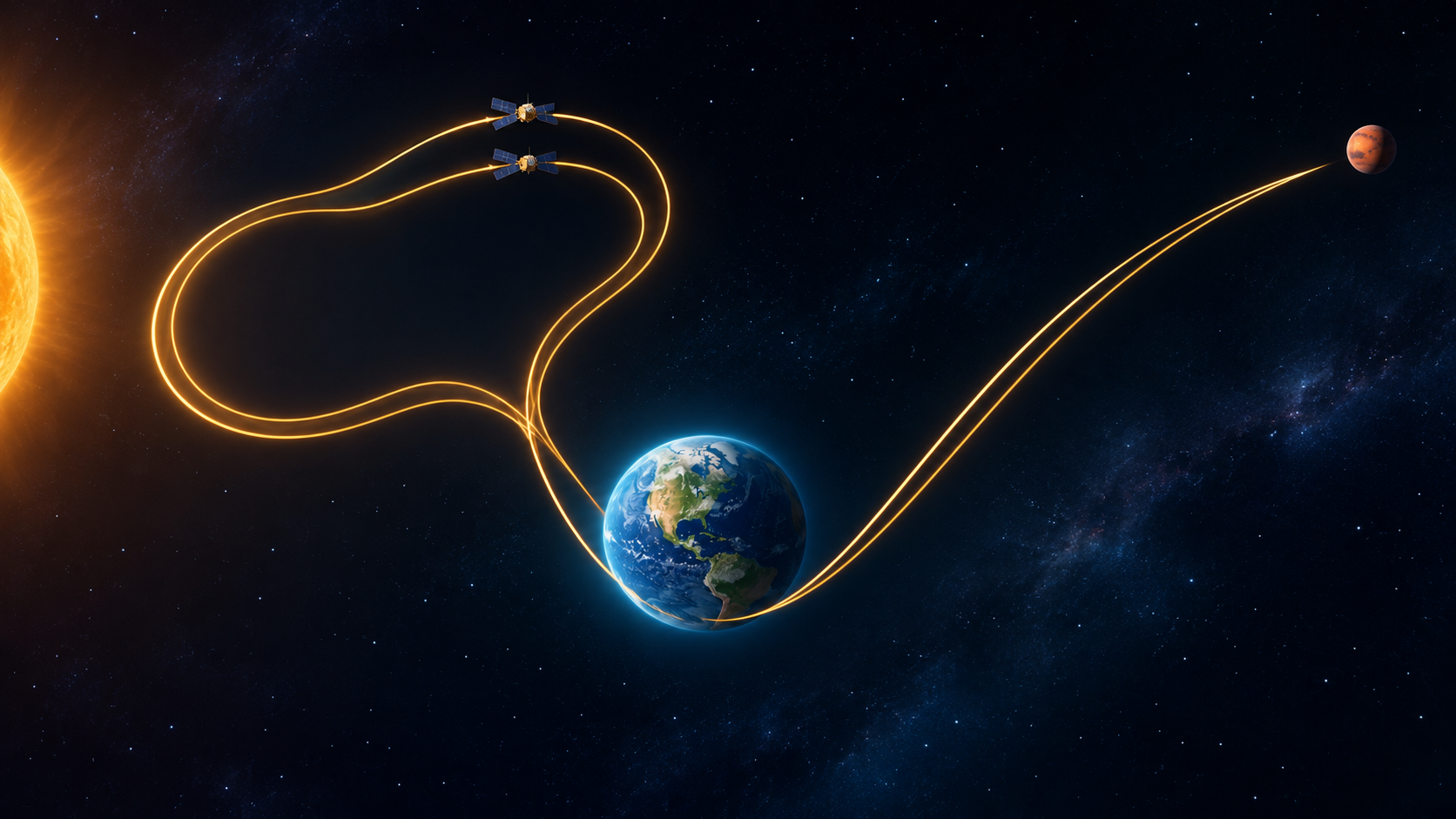
That is why the detour is not wasted time. It is a launch-and-loiter strategy designed to open up a Mars departure opportunity outside the traditional narrow launch window. UC Berkeley’s mission team describes it as a new route that lets a Mars mission launch almost anytime, then wait for the geometry it needs.
Can you see ESCAPADE through a telescope?
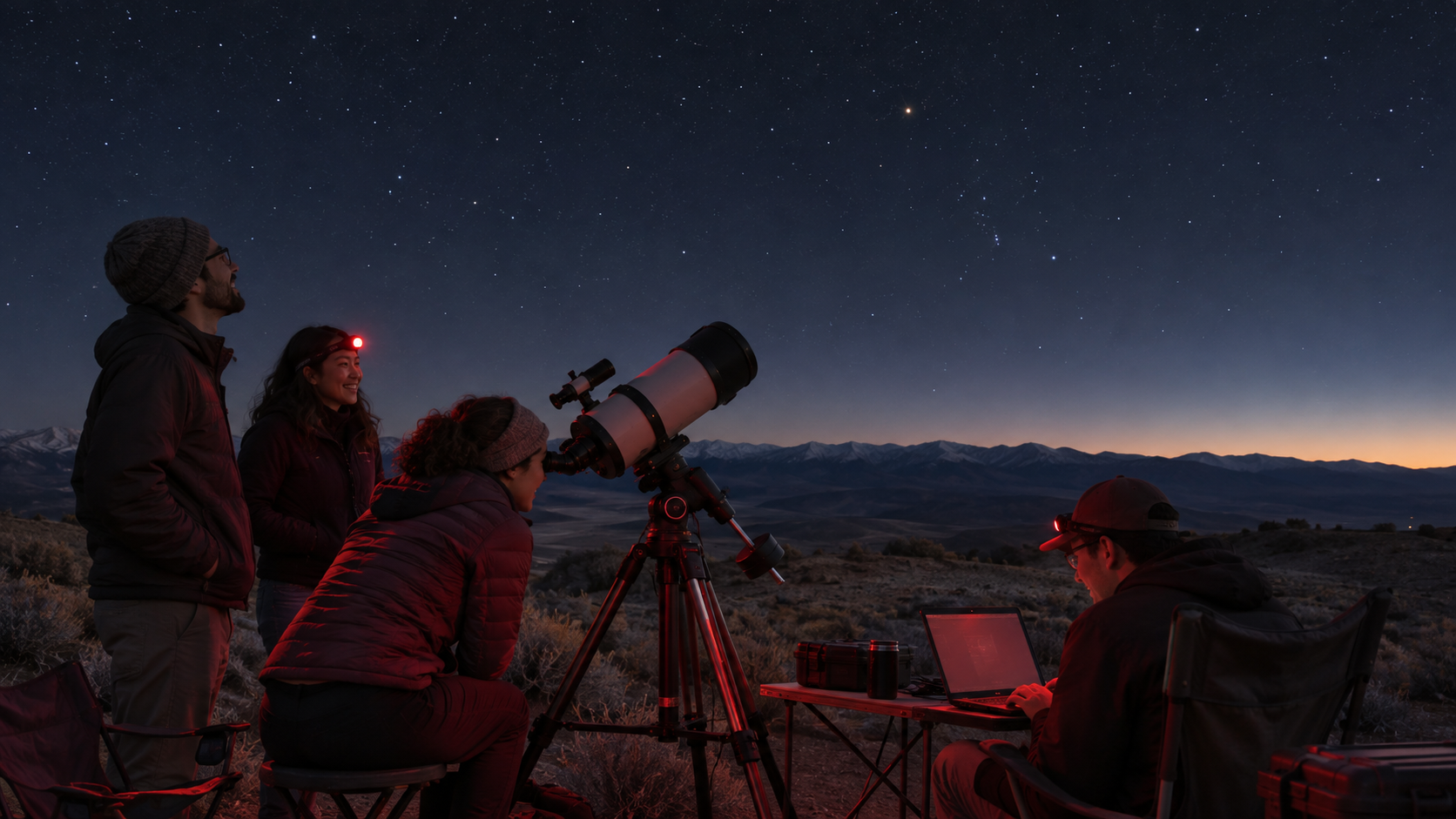
Possibly—but treat it as a challenging tracking project, not a local visibility promise. NASA says both spacecraft should be faint and that a telescope will most likely be needed to find them as dim points moving against the stars. In the hours before the maneuvers, the broad opportunity favors the western U.S.: the first is expected to be brightest there roughly midnight–1 a.m. PST on Nov. 7, and the second roughly 1–2 a.m. PST on Nov. 9.
Exact visibility changes sharply with location, horizon, weather, equipment, and the latest trajectory solution. Do not use a generic city pointing instruction. If you want to try, get topocentric coordinates for your exact observing site and time from NASA JPL's Horizons system, then plan a tracked telescope session. The engine burns themselves begin at 4:51 a.m. EST Nov. 7 and 5:51 a.m. EST Nov. 9 over southern Australia, where NASA expects telescopic visibility.
A good reason to follow the maneuver even if you do not observe
ESCAPADE makes a lovely reminder that interplanetary travel is not always a straight shot. The two probes first earned bonus science in Earth's distant magnetotail, then use a carefully timed return to transform a near-Earth loop into a Mars journey. Follow the official NASA mission update and NASA SVS trajectory animations for the best visual explanation as the events unfold.
If mission design gives you the urge to talk space with people who get it, join the Cosmic Match space community and bring your favorite orbital-mechanics question. For another Mars story with a Houston connection, read our guide to CHAPEA Mission 2's return.
FAQ
When are ESCAPADE's powered Earth flybys?
NASA lists the first closest approach and completed burn around 5 a.m. EST on Nov. 7, 2026, and the second around 6 a.m. EST on Nov. 9. Burn start times are about 4:51 a.m. EST and 5:51 a.m. EST, respectively.
Do I need a telescope to see ESCAPADE?
Probably. NASA says the probes will be faint, likely appearing as dim moving points, and a telescope is most likely required.
Why do the spacecraft come back to Earth before going to Mars?
Their yearlong Earth-proximity loiter lets them wait for Earth–Mars alignment, then use Earth's gravity plus a short engine burn to build speed for a Mars-bound path.