Mercury at Aphelion on July 1: What It Means When a Planet Is Farthest From the Sun
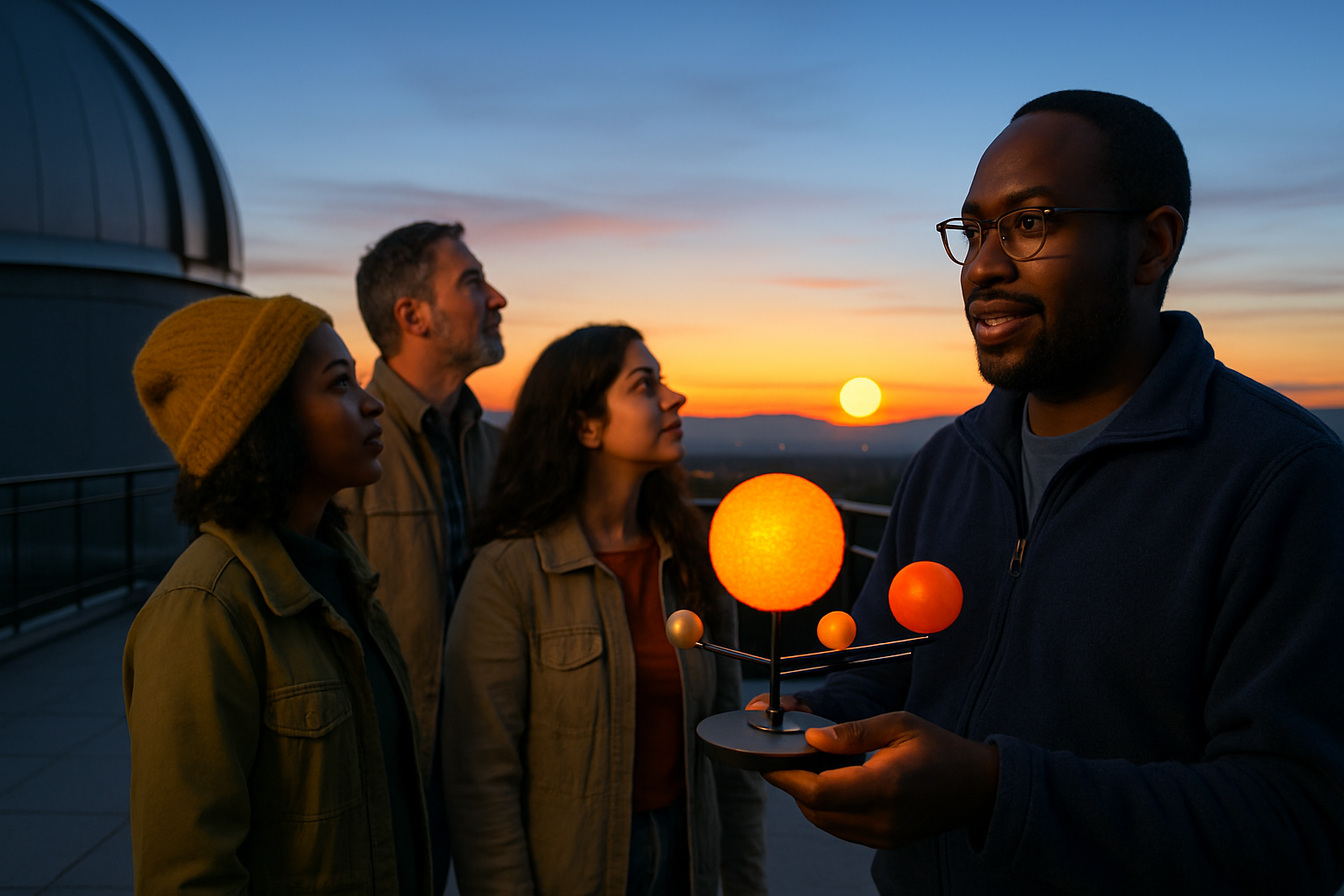
On July 1, 2026, Mercury reaches aphelion: the farthest point in its orbit from the Sun. The event lands at 09:53 UTC, and it is the kind of calendar item that can look technical until you translate it into plain language. No, Mercury is not stopping. No, it does not suddenly become easy to see in the sky. And no, this is not just astronomy trivia for people who already own telescopes.
Mercury at aphelion is actually one of the cleanest beginner examples of how planetary orbits work. If you have ever heard words like perihelion, eccentric orbit, or Kepler's laws and mentally filed them under “I should probably know that,” this is a good place to start.
 Mercury at aphelion is an orbit-shape story: a reminder that planets do not move around the Sun in perfect circles.
First, what does aphelion mean?
Aphelion is the point in a planet's orbit where it is farthest from the Sun. The opposite point is perihelion, where the planet is closest.
That sounds simple, but it tells you something important immediately: planetary orbits are not perfect circles. They are ellipses. Some are only slightly stretched, while others are much more obvious. Mercury falls into the second group.
NASA's basic explanation of Kepler's laws is the useful one here: when a planet follows an elliptical orbit, it moves fastest at perihelion and slowest at aphelion. So when Mercury reaches aphelion on July 1, it is not only farthest from the Sun on that orbit. It is also moving through the slowest part of that path.
If you are new to astronomy, this is one of the vocabulary words worth keeping. Once aphelion makes sense, a lot of other headlines start sounding less mysterious.
Why Mercury makes aphelion more interesting than most planets
Mercury is a great teaching example because its orbit is not close to circular by everyday solar-system standards. NASA says Mercury gets as close as 47 million kilometers to the Sun and as far as 70 million kilometers away. In The Sky's July 1 event page translates that to roughly 0.307 AU at perihelion and 0.467 AU at aphelion.
That is a big swing. In practical terms, Mercury's distance from the Sun changes by more than 50 percent across its orbit. That is why aphelion on Mercury feels more meaningful than aphelion on a planet with a more nearly circular path.
It also explains why beginner astronomy articles keep returning to Mercury's orbit. The planet is small, fast, close to the Sun, and unusually stretched out in the way it travels. If you want one object that makes orbital geometry feel real instead of abstract, Mercury is a strong candidate.
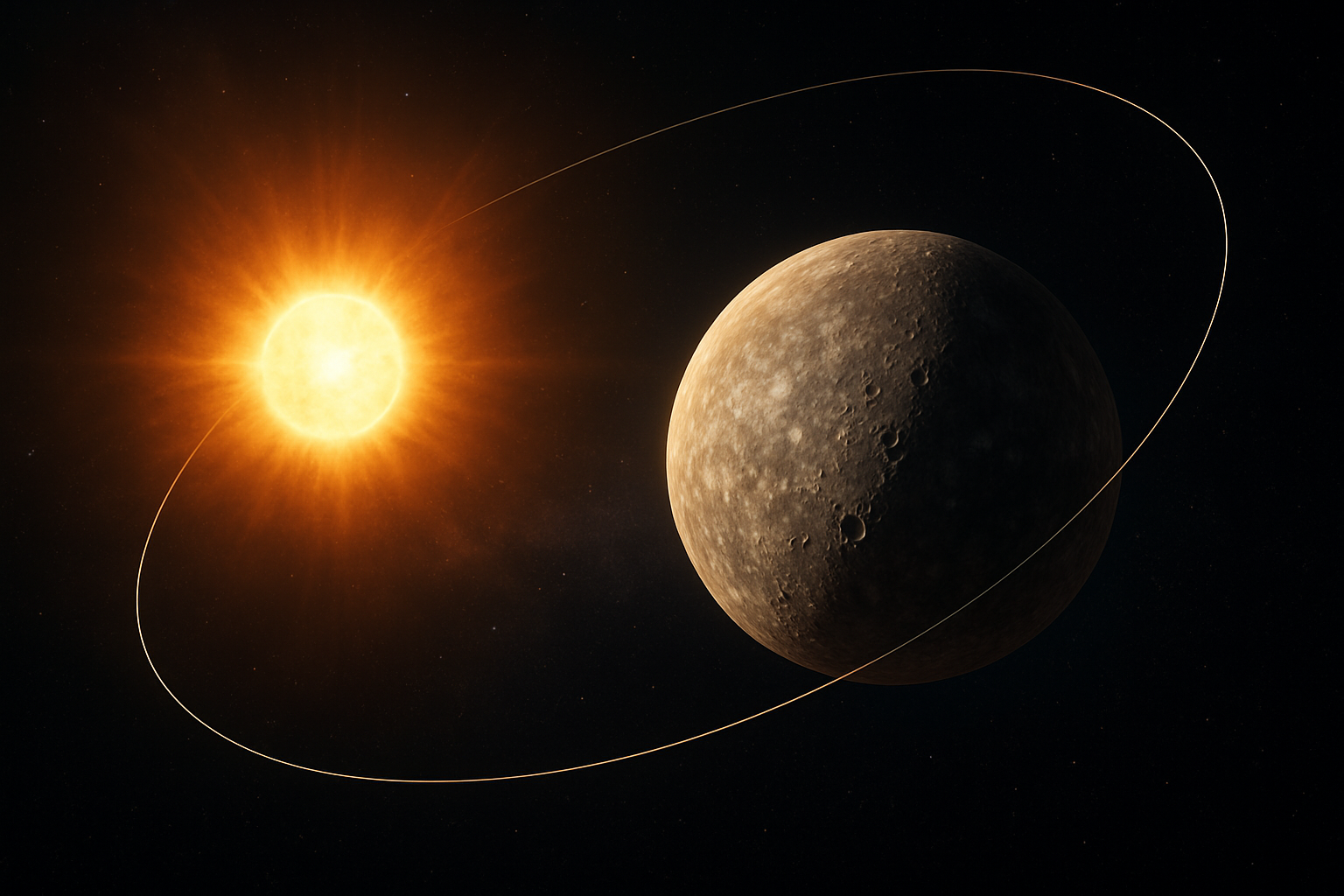 Mercury's orbit is visibly more stretched than the nearly circular orbits many people imagine when they think about the solar system.
What actually changes on Mercury at aphelion?
The short answer is distance, speed, and sunlight.
At aphelion, Mercury is at its maximum Sun-distance for that orbit. Because it is farther away, the amount of solar energy reaching the surface is lower than it is at perihelion. In The Sky notes that Mercury receives more than twice as much energy from the Sun at perihelion as at aphelion.
That sounds dramatic, and it is, but it does not mean Mercury turns into a comfortable planet when it is farthest out. Mercury still has extreme conditions. NASA notes that daytime surface temperatures can climb to about 430°C (800°F), while night temperatures can plunge to about -180°C (-290°F) because the planet has almost no atmosphere to hold heat.
Aphelion also does not create Earth-like seasons on Mercury. NASA says Mercury's axis is tilted only about 2 degrees, so it stays nearly upright as it orbits the Sun. That tiny tilt means the planet does not get the kind of strong seasonal pattern we experience on Earth.
So if you want the beginner version, it is this: Mercury at aphelion means the planet is farther from the Sun, moving more slowly in its orbit, and receiving less solar energy than it does at perihelion. It does not mean “Mercury is cool now,” and it does not mean “Mercury is having summer or winter.”
What aphelion does not tell you about seeing Mercury from Earth
This is the part that trips up a lot of people the first time they read a sky calendar.
Aphelion is not a visibility event. It tells you where Mercury is in its orbit around the Sun, not whether Mercury is conveniently placed in our sky after sunset or before sunrise.
If your actual goal is to spot Mercury, you usually care more about events like greatest elongation or the planet reaching a higher altitude in the morning or evening sky. Those are the dates that change how far Mercury appears from the Sun in our view, which is what makes it easier or harder to catch near the horizon.
That is why our earlier guide to Mercury's best evening visibility in June 2026 focused on horizon geometry rather than orbital vocabulary. It is also why a wider roundup like the June 2026 stargazing calendar serves a different purpose than an explainer like this one.
Aphelion matters because it helps you understand the planet. Visibility dates matter because they help you decide when to walk outside.
 You do not need a telescope to care about orbital science. Understanding one term like aphelion makes the rest of the sky easier to read.
Why beginners should care anyway
Astronomy gets more fun the moment the words start connecting.
Once you understand aphelion, you can decode perihelion. Once you understand why Mercury moves slower at aphelion, Kepler's second law starts feeling less like a school-memory phrase and more like a real description of motion. Once you see that orbital distance and sky visibility are not the same thing, a lot of astronomy headlines stop sounding contradictory.
That kind of progress matters even if you never buy a telescope. It makes planetarium talks easier to follow. It makes space news more legible. It gives you better instincts when a social post claims a planet is “best tonight” for reasons that do not quite add up.
And if you like learning this stuff with other people, you can join the astronomy community at Cosmic Match or sign up free to meet local stargazers. The goal is not to sound like an expert. The goal is to spend more time around people who enjoy asking the same questions you do.
The takeaway
Mercury at aphelion on July 1, 2026 is a real event, but its value is mainly explanatory. It shows that Mercury follows a noticeably elliptical orbit, that planets move slowest when they are farthest from the Sun, and that orbital science and observing conditions are not the same thing.
That is a useful distinction for any beginner. The sky gets easier to understand when you stop treating every calendar item as a viewing guide and start seeing some of them as maps of how the solar system actually works.
A fresh example of careful space-news reading
A new study of LHS 1140 b’s helium signal is another reminder to separate an observation from the larger conclusion: the team found atmosphere evidence, while follow-up measurements will test what it means.