The Moon Will Point You to Antares and Scorpius This Weekend. Here's How to Use It.
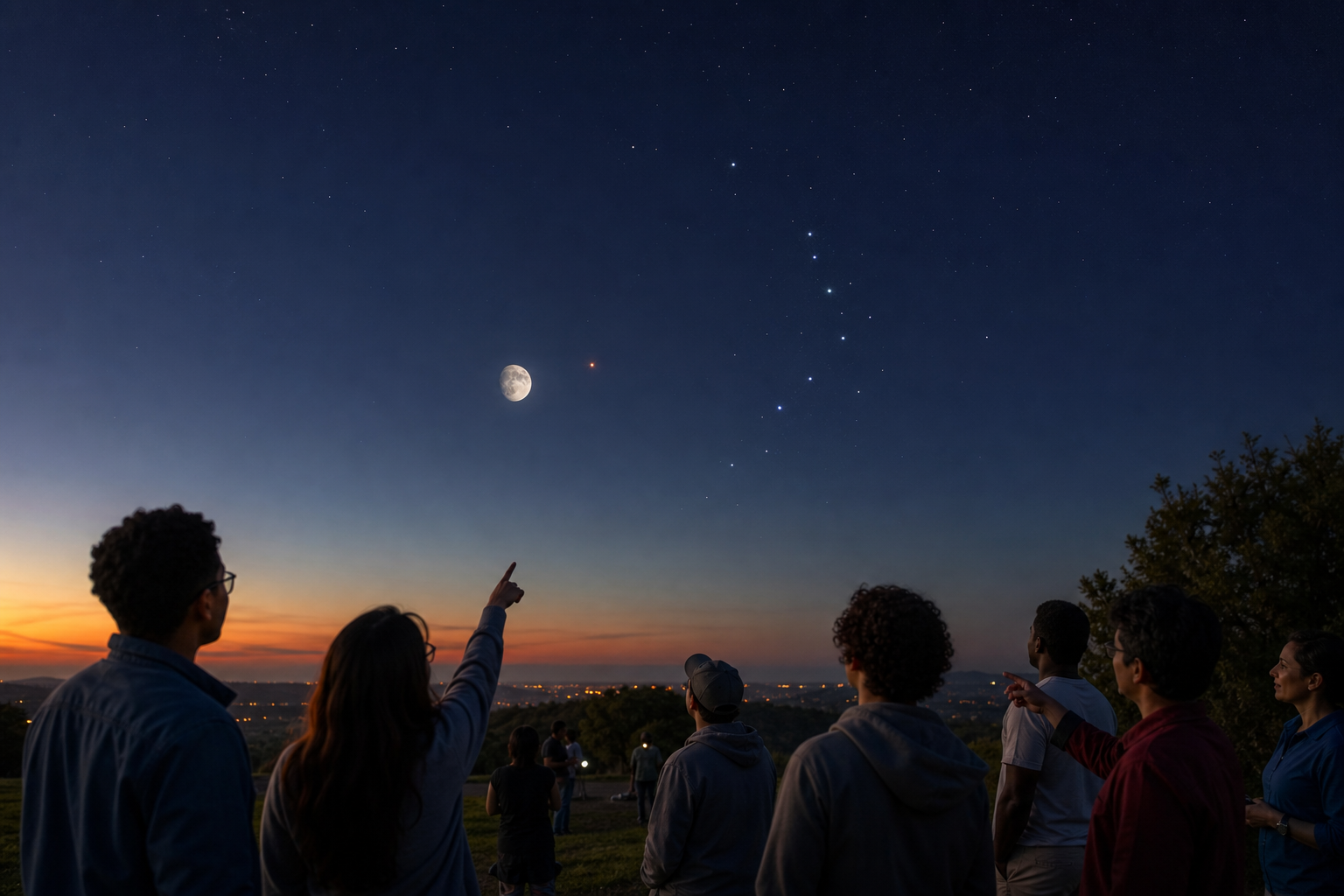
On Friday and Saturday evenings, June 26 and 27, 2026, the waxing gibbous Moon will do something useful for beginners: it will sit right beside Antares, the red heart of Scorpius the Scorpion. That matters because Scorpius is one of the easiest summer constellations to recognize once you know where to start, but one of the easiest to miss if you walk outside without an anchor point.
This weekend, the Moon is the anchor point. EarthSky's June 24, 2026 sky guide notes that as darkness falls on June 26 and 27, the Moon will shine near Antares, and Sky & Telescope's June 19-28 weekly guide places the Moon just beside the Scorpion's head on Friday and still close to Antares on Saturday. So if you have been meaning to learn one real summer constellation instead of randomly scanning bright stars, this is the window.
If you want the bigger month view first, our June 2026 stargazing calendar maps the rest of the month's easy sky events. If you are building a longer evening around it, our summer triangle guide gives you the next bright pattern to catch once Scorpius is up.
What Happens on June 26 and 27
The basic timeline is simple:
- Friday, June 26: the Moon shines under the head of Scorpius, with Antares about 5 to 6 degrees to the Moon's left, according to Sky & Telescope.
- Saturday, June 27: the Moon shifts to the lower left or left of Antares, still by about 6 degrees.
That is close enough to be obvious to the naked eye, even from bright cities, once the sky gets properly dark. You do not need a telescope for the main event. You need a clear southern view and a little patience for twilight to fade.
Antares is the star you are trying to learn. NASA's June skywatching material calls it a bright guide star for summer observing, and NASA's Messier 4 page uses the same point more directly: use the bright star Antares to help you find M4, the closest globular cluster to Earth. In other words, if you can learn Antares this weekend, you are not just learning one star. You are learning one of the best southern signposts in the summer sky.
How To Find Antares First
Go outside about 60 to 90 minutes after sunset and face the southern half of the sky.
From Austin and Houston, Scorpius stays fairly low, so a clean horizon matters. Trees, apartments, parking-garage edges, and bright low-angle haze can all make the pattern harder than it should be. From Los Angeles, the constellation sits a bit higher than it does in Texas, but it is still a southern-sky target, not something high overhead.
Here is the easiest sequence:
- Find the bright Moon first.
- Look for a single orange-red star right next to it. That is Antares.
- Once you have Antares, look for the three-star head of Scorpius around it.
- Then trace the rest of the Scorpion as the body curves downward and then leftward from Antares.
Sky & Telescope's wording is useful here: the stars around Antares form a distinctive pattern in upper Scorpius. That is why this constellation teaches so well in person. You do not have to memorize the whole outline in one shot. You find Antares, then let the rest of the shape appear around it.

What It Should Look Like From Austin, Houston, and Los Angeles
The pairing is visible from all three of Cosmic Match's live markets, but the experience is not identical.
Austin: Look south-southeast after dusk, then more southerly as the evening settles in. The main challenge is usually not finding the Moon. It is giving the lower southern sky enough time to darken. If downtown glow is strong, drive a little west or south, or head somewhere with a broader skyline.
Houston: The geometry is similar to Austin, but the air often looks softer and brighter low on the horizon. That makes Antares slightly easier to appreciate once the sky gets darker than you think it needs to. Do not judge the view too early.
Los Angeles: You get a small altitude advantage over Texas. Antares and the top of Scorpius will feel less squeezed into the horizon glow, especially if you have a southern view away from local obstructions. This is still an after-dark target, but it is friendlier than many low-southern objects are from urban Southern California.
If you want a reason to turn this into an actual outing instead of a two-minute driveway check, line up a local skywatch with people who will care that you found the Scorpion on purpose: meet Austin stargazers, find Houston astronomy locals, or connect with Los Angeles skywatchers. If you want official venue ideas beyond a DIY skywatch, our Austin, Houston, and Los Angeles stargazing roundup now collects the strongest public options in one place.
A Bonus Target Once You Have Antares
This is where the weekend pairing gets better than a one-night photo op.
NASA's Hubble Messier catalog calls Messier 4 relatively easy to find because of its proximity to Antares. M4 is a globular cluster in Scorpius, about 5,500 light-years away, and NASA describes it as the closest globular cluster to Earth. With a small telescope, or even steady binoculars under decent skies, it becomes a natural next step after you lock onto Antares.
That makes this weekend useful for mixed-experience groups:
- one person can enjoy the naked-eye Moon-and-star pairing
- another can use Antares as the launch point for M4
- everybody still gets the same shared sky moment
If you are new to the southern summer sky, that is a good night. You are not learning an abstract chart. You are learning a real route: Moon -> Antares -> Scorpius -> M4.
Why This Weekend Is Better Than Trying Randomly Next Month
You can find Scorpius on other June and July nights, but this weekend gives you a built-in marker that makes the first attempt easier.
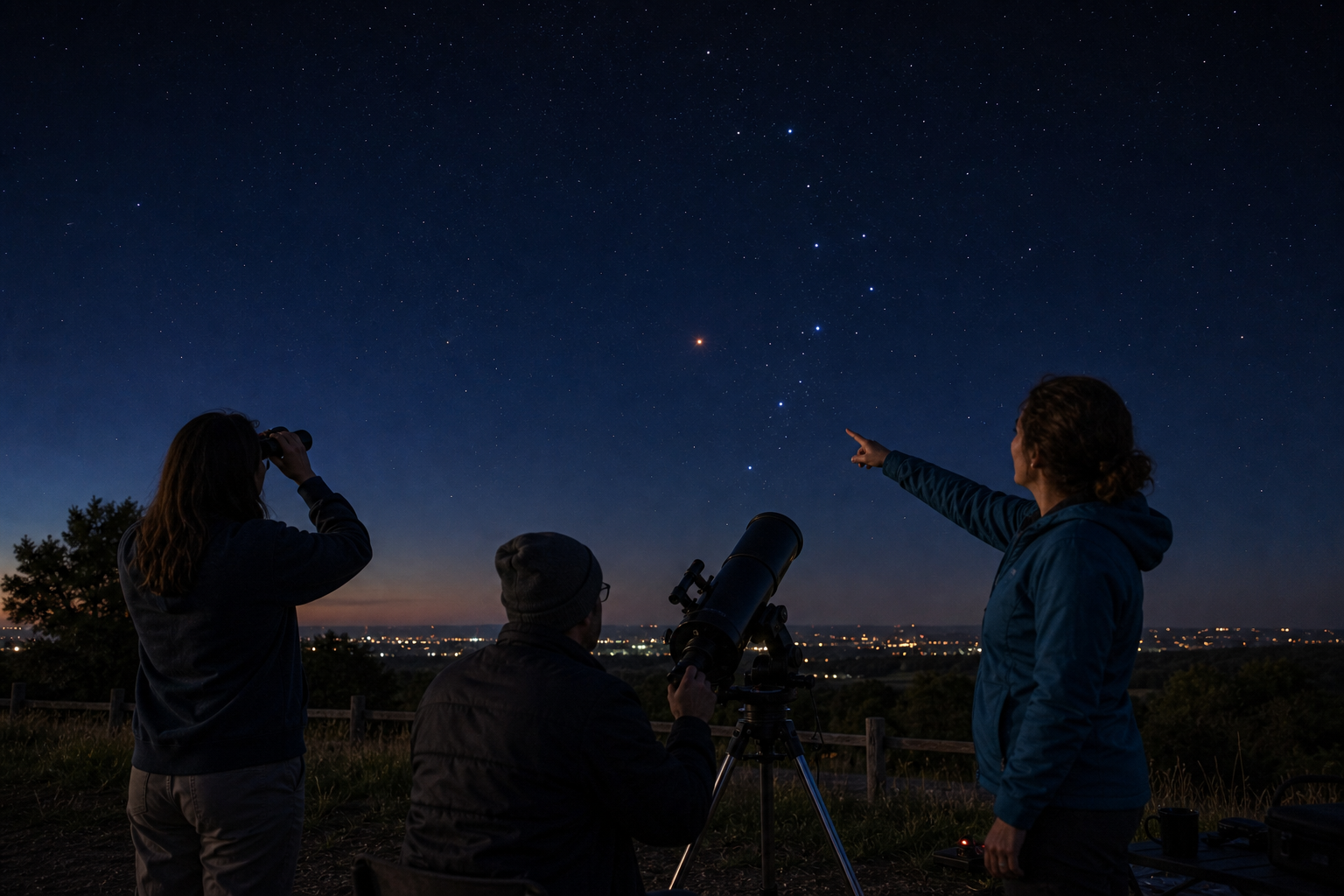
EarthSky's current guide frames the event exactly the right way: as darkness falls on June 26 and 27, the Moon will be near Antares. That means you are not relying on memory, star apps, or a perfect sense of direction. You are letting the brightest thing in that part of the sky point you toward the red star you need.
There is also a practical timing advantage. By June 29, the full Strawberry Moon arrives, and the Moon moves on toward Sagittarius and the Teapot. So the clean "Moon points to Antares" setup is strongest on the evenings Carl assigned this ticket to target.
For beginners, that matters. The best first constellation is usually not the most famous one. It is the one that gives you a clean success on your first try.
Bottom Line
If you go out on June 26 or June 27, 2026, wait for darkness, and look toward the southern sky, the Moon will lead you straight to Antares. Once you have Antares, Scorpius becomes much easier to trace, and you can use the same guide star to jump to Messier 4 if you have binoculars or a small telescope.
For Austin, Houston, and Los Angeles, the practical advice is the same: give twilight time to fade, protect your southern horizon, and let the Moon do the locating for you. This is one of the rare beginner-friendly sky lessons that is both easy and genuinely memorable.
If you want more people in your orbit who know why Antares matters before you even finish pointing it out, join free on Cosmic Match.
If you also want to know whether the same June 26-27 window is worth using for meteors, our June Bootids 2026 weekend guide sets realistic expectations for a weak, moonlit shower.