August 2026 Partial Lunar Eclipse: Exact Times for Austin, Houston, and Los Angeles
August 2026 Partial Lunar Eclipse: Exact Times for Austin, Houston, and Los Angeles
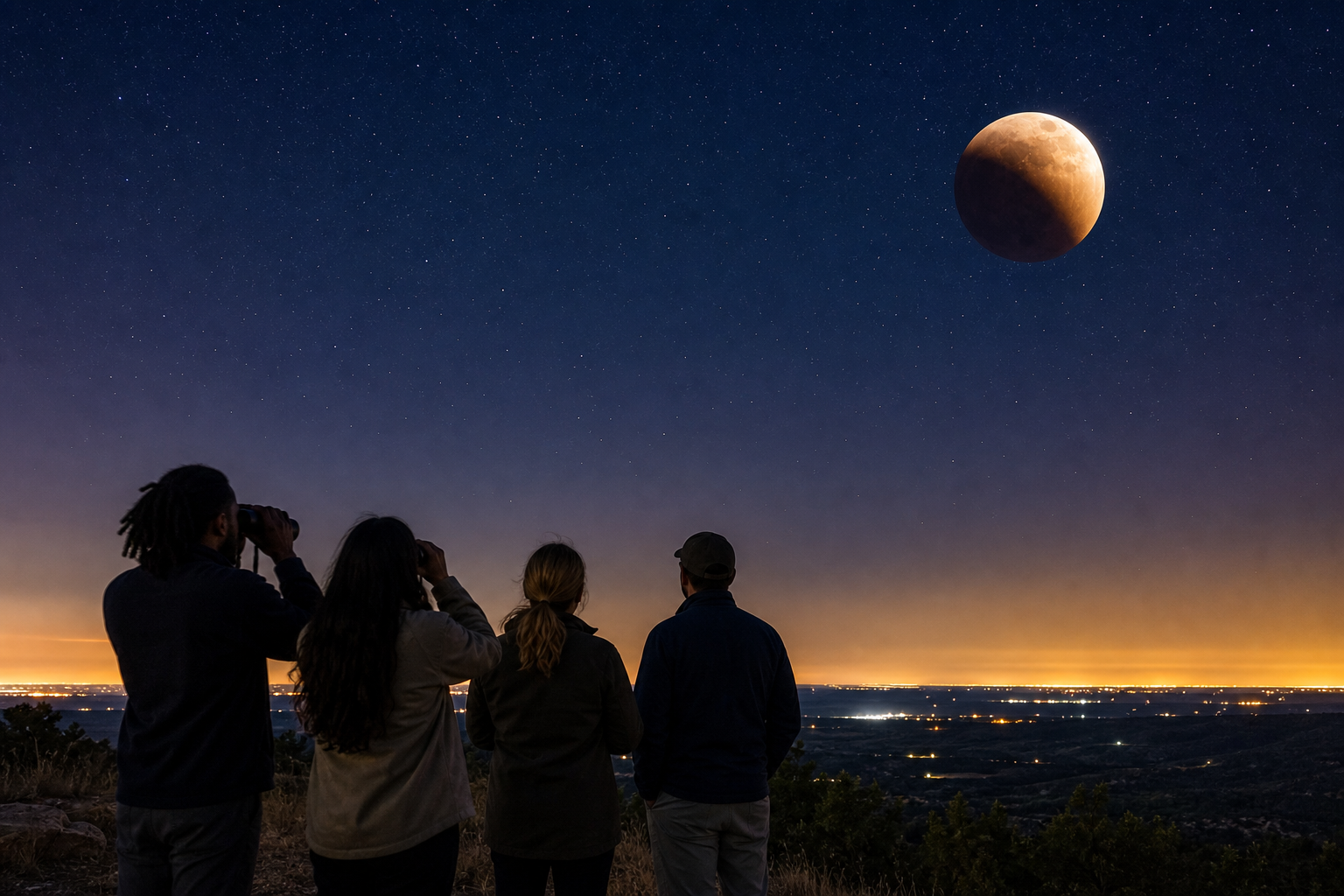
The late-evening Moon on Thursday, August 27 will slide deeply into Earth’s darkest shadow. In Austin and Houston, the visible sequence runs from 8:23 p.m. CDT to 2:01 a.m. CDT; in Los Angeles, the Moon rises after the faint penumbral phase has already begun, but the dramatic partial phase starts at 7:33 p.m. PDT. You need no telescope and no eclipse glasses—just a clear view toward the east-southeast and a few fellow skywatchers.
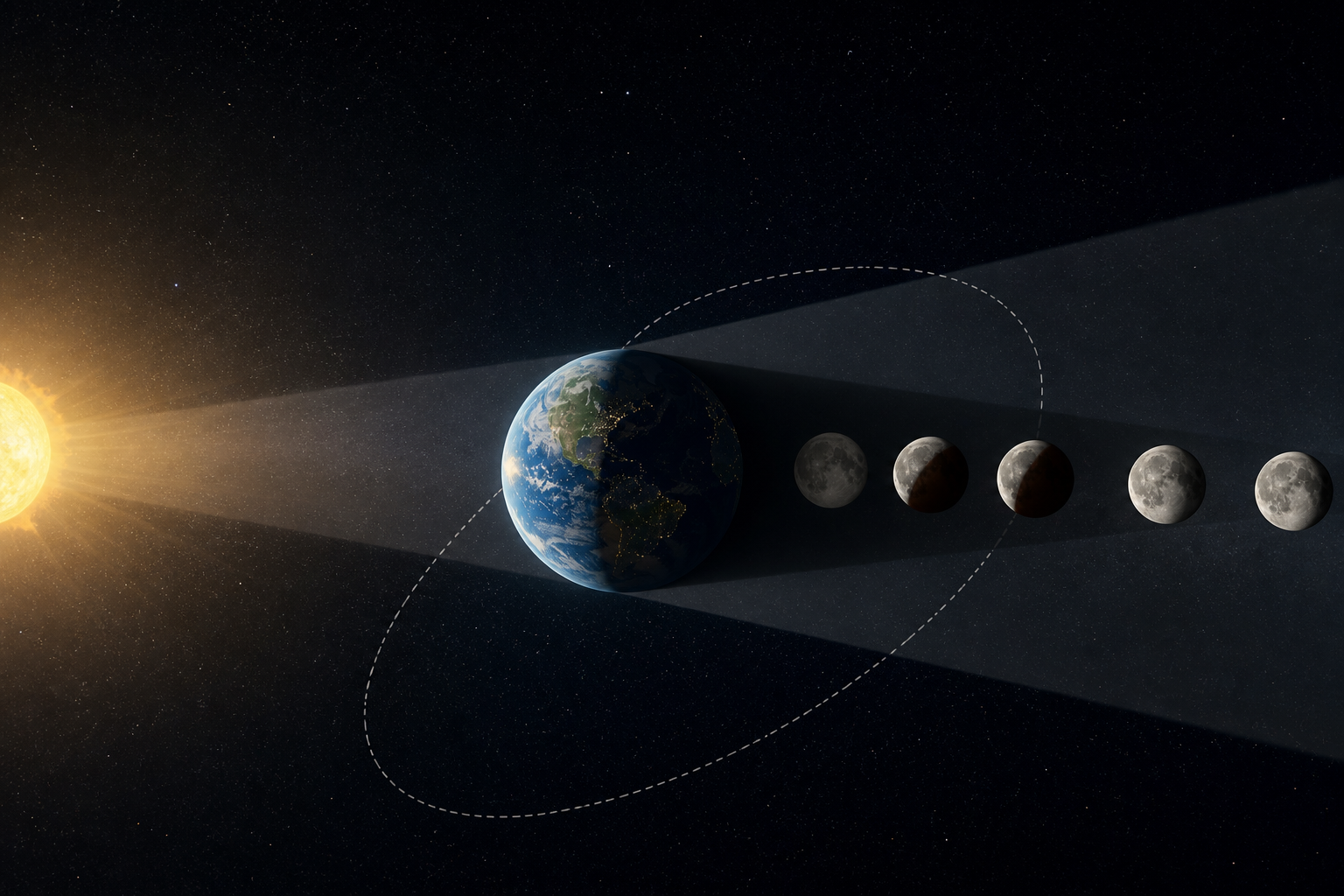
Despite the event’s UTC date of August 28, it begins on the evening of August 27 in all three cities. This is a partial lunar eclipse, not a total one: at maximum, Earth’s umbra covers about 93% of the Moon’s diameter, so a bright sliver remains. NASA’s eclipse table lists the event as partial with an umbral magnitude of 0.930.

What time is the August 2026 partial lunar eclipse in each city?
All times below are local. “Penumbral” means the Moon is entering or leaving Earth’s faint outer shadow; it can be subtle. The partial phase is the main event, when the dark curved bite of Earth’s umbra becomes obvious.
| City | Penumbral begins | Partial begins | Maximum eclipse | Partial ends | Penumbral ends |
|---|---|---|---|---|---|
| Austin (CDT) | Thu Aug. 27, 8:23 p.m. | 9:33 p.m. | 11:12 p.m. | Fri Aug. 28, 12:51 a.m. | 2:01 a.m. |
| Houston (CDT) | Thu Aug. 27, 8:23 p.m. | 9:33 p.m. | 11:12 p.m. | Fri Aug. 28, 12:51 a.m. | 2:01 a.m. |
| Los Angeles (PDT) | Not visible before moonrise | 7:33 p.m. | 9:12 p.m. | 10:51 p.m. | Fri Aug. 28, 12:01 a.m. |
The city calculations come from timeanddate’s Austin eclipse page, Houston page, and Los Angeles page. Give yourself 15–20 minutes before the partial phase—not because you need equipment, but because the best part of any sky event is having time to settle in and compare notes.
Is this a total lunar eclipse?
No. A total lunar eclipse would put the entire lunar disk inside Earth’s umbra. On August 27–28, the Moon passes very deeply through the umbra but never fully enters it. That is why “deep partial lunar eclipse” is more accurate than “total” or “Blood Moon.”
At maximum, most of the Moon may take on a dim coppery or reddish-brown cast while a narrow section stays brighter. The exact color depends on Earth’s atmosphere and your local transparency, so treat any color prediction as a possibility, not a promise.
Austin: a simple eclipse plan
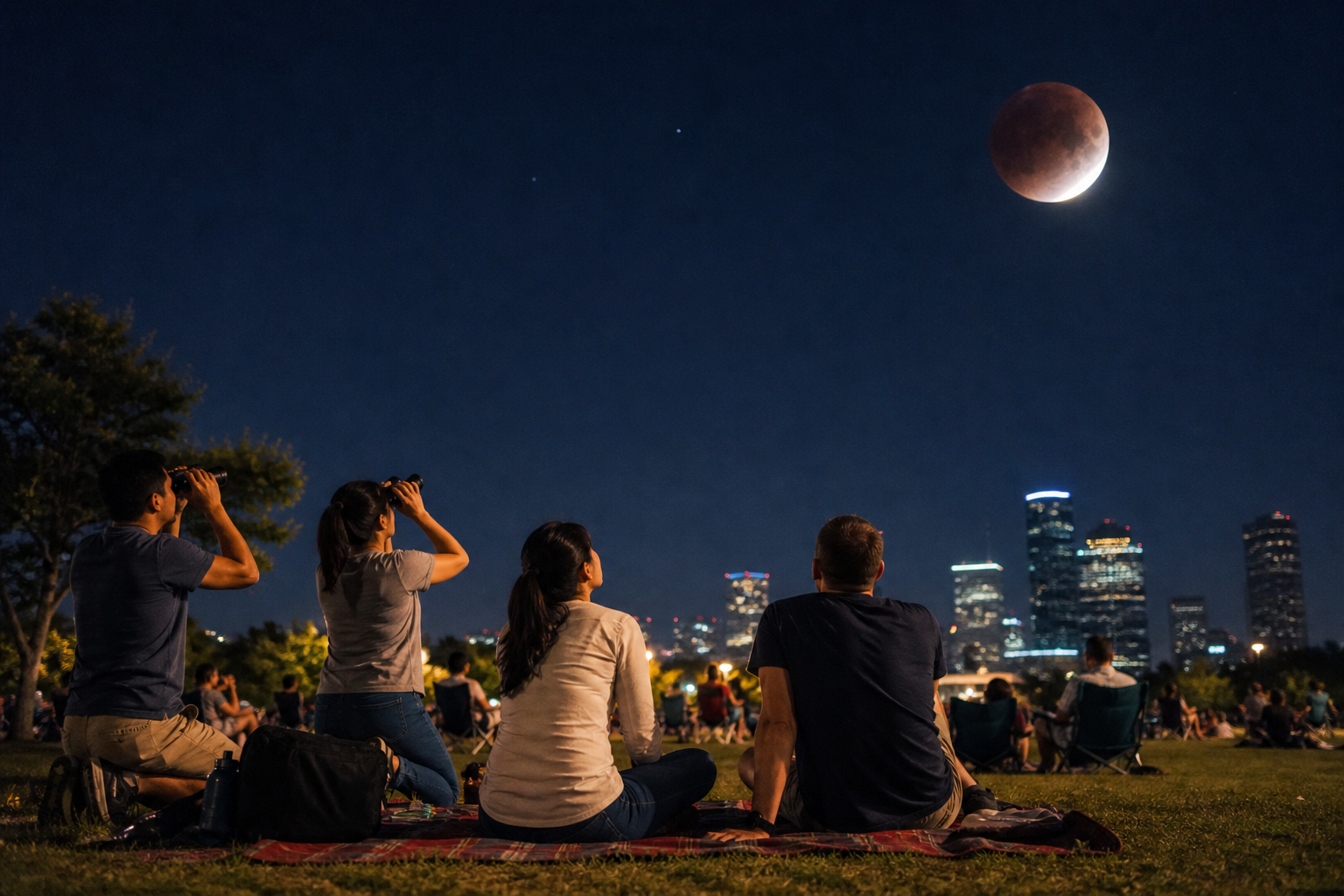
Austin’s Moon is low in the east-southeast at the penumbral start—about 6° high—then climbs to roughly 38° by the 11:12 p.m. maximum. That means a porch, overlook, park, or backyard with an unobstructed eastern horizon is useful early; it becomes less critical later.
Aim to be outside by 9:15 p.m. CDT. By 9:33 p.m., the partial phase begins, and the change becomes much easier to spot with the naked eye. The most photogenic moment is likely around the 11:12 p.m. maximum, when the Moon is comfortably above the horizon. If weather or a busy evening changes your plan, the post-maximum phase remains worthwhile through 12:51 a.m.
Want company for the wait? Find your Austin stargazing community on Cosmic Match, then bring a blanket, water, and a friend who will be delighted by a Moon that looks a little strange.
Houston: when should you look up?
Houston’s timetable matches Austin’s, but the Moon begins slightly higher—about 8° at 8:23 p.m. and nearly 40° at maximum. Start looking east-southeast around 9:15 p.m. CDT and try to protect the late-evening window around 11:12 p.m.
Humidity and summer haze can soften a low Moon, which makes the partial phase even more satisfying once it climbs. Binoculars can reveal more lunar detail, but they are optional; a lunar eclipse is designed for naked-eye viewing. If a cloud bank is moving through, keep checking: the eclipse lasts long enough that a brief opening can still deliver the main shadowed view.
For a small local watch party, meet Houston space and sky fans through Cosmic Match. A shared “is that shadow getting darker?” is an excellent icebreaker.
Why does Los Angeles have a low-horizon challenge?
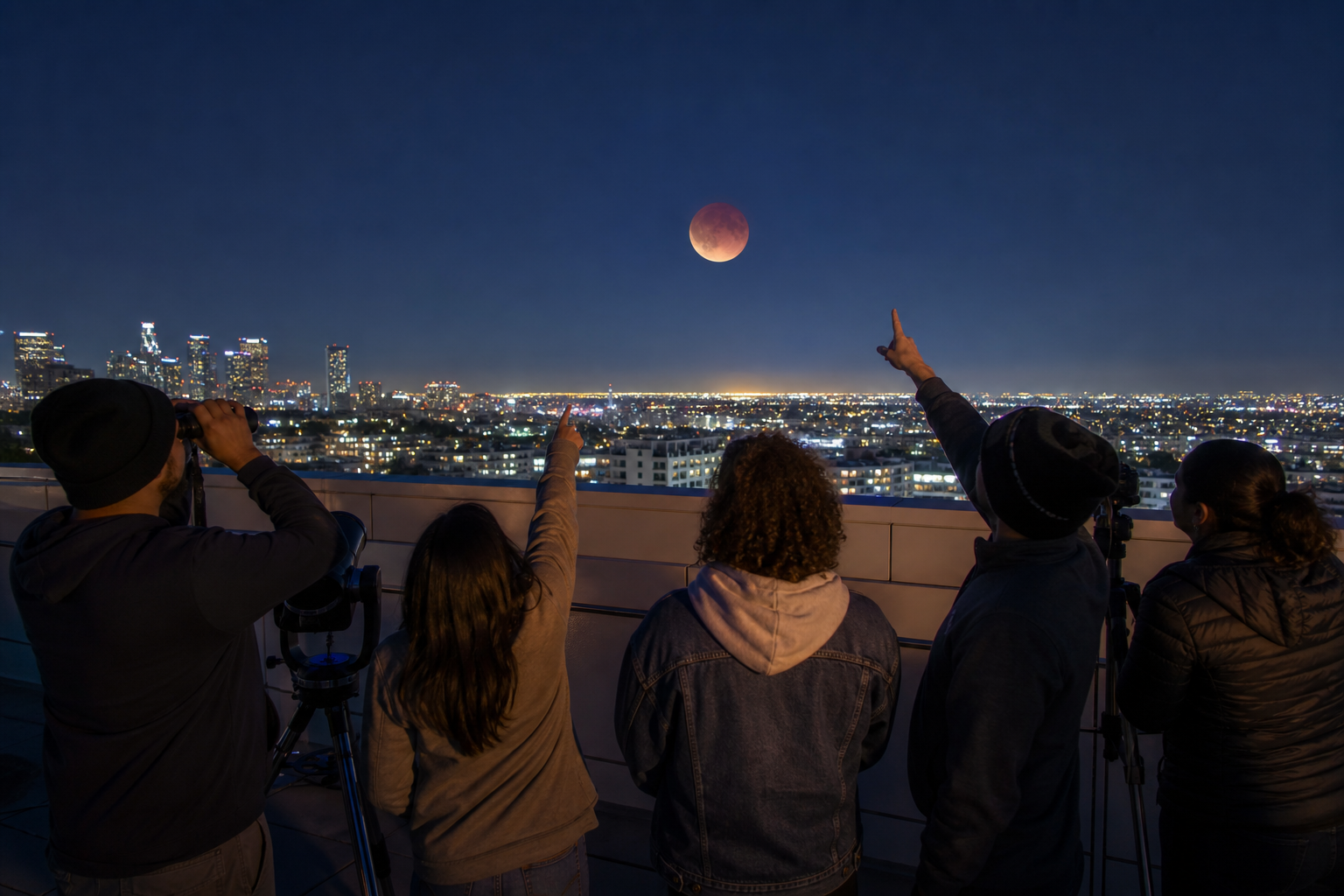
Los Angeles gets a different opening act. The penumbral phase starts at 6:23 p.m. PDT, while the Moon is still below the horizon. Moonrise is at 7:17 p.m., and the partial phase begins at 7:33 p.m., with the Moon only about 3° up in the east-southeast.
That makes an open eastern horizon essential. Skip a location blocked by apartments, hills, trees, or a tall skyline; the first visible moments could be the most frustrating otherwise. The payoff is strong: maximum arrives at 9:12 p.m., when the Moon has climbed to about 21° and the view should be much easier. The partial phase ends at 10:51 p.m., so this city’s plan does not require an all-nighter.
Do I need a telescope or eclipse glasses?
Neither. Lunar eclipses are safe to view directly with your eyes because you are looking at the Moon, not the Sun. Binoculars or a small telescope can add texture, but they are a bonus, not an entry fee.
Your useful kit is wonderfully low-key:
- A clear east-to-southeast view, especially early in Los Angeles
- A weather check shortly before you head out
- Water, a light layer, and a chair or blanket
- A phone set to local time, preferably dimmed so your eyes stay adjusted
- A group chat or Cosmic Match plan so nobody watches alone by accident
If you are new to informal observing, our no-telescope Perseids city night plan has the same core mindset: start with your eyes, pick a comfortable spot, and let curiosity lead.
Make it a shared sky moment
A lunar eclipse moves slowly enough for conversation. Invite someone to join you for the partial phase, bring a couple of chairs, and give the Moon time to change. You can join the Cosmic Match community free to connect with other people who genuinely get excited about a clear forecast and an open horizon.
The headline timing may say August 28 because the greatest eclipse occurs at 04:14 UTC. For Austin, Houston, and Los Angeles, your calendar reminder should say Thursday night, August 27. Look east-southeast, watch the dark curve advance, and enjoy a rare reminder that Earth is part of the view.
FAQ
What is the best time to see the eclipse in Austin and Houston?
The most dramatic moment is maximum eclipse at 11:12 p.m. CDT on Thursday, August 27. The partial phase runs from 9:33 p.m. to 12:51 a.m.
What is the best time to see the eclipse in Los Angeles?
Watch from 7:33 p.m. PDT, when the partial phase begins, through maximum at 9:12 p.m. Choose a spot with a very open east-southeast horizon because the Moon is low at first.
Will the Moon turn completely red?
No. This is a partial, not total, lunar eclipse. Much of the Moon may look dim or reddish near maximum, but a bright portion remains outside Earth’s darkest shadow.
Do I need special eye protection for a lunar eclipse?
No. Lunar eclipses are safe to view with unaided eyes, binoculars, or a telescope. Solar-eclipse glasses are not needed.