Danuri Images Confirm Falcon 9 Lunar Impact Site—What They Show
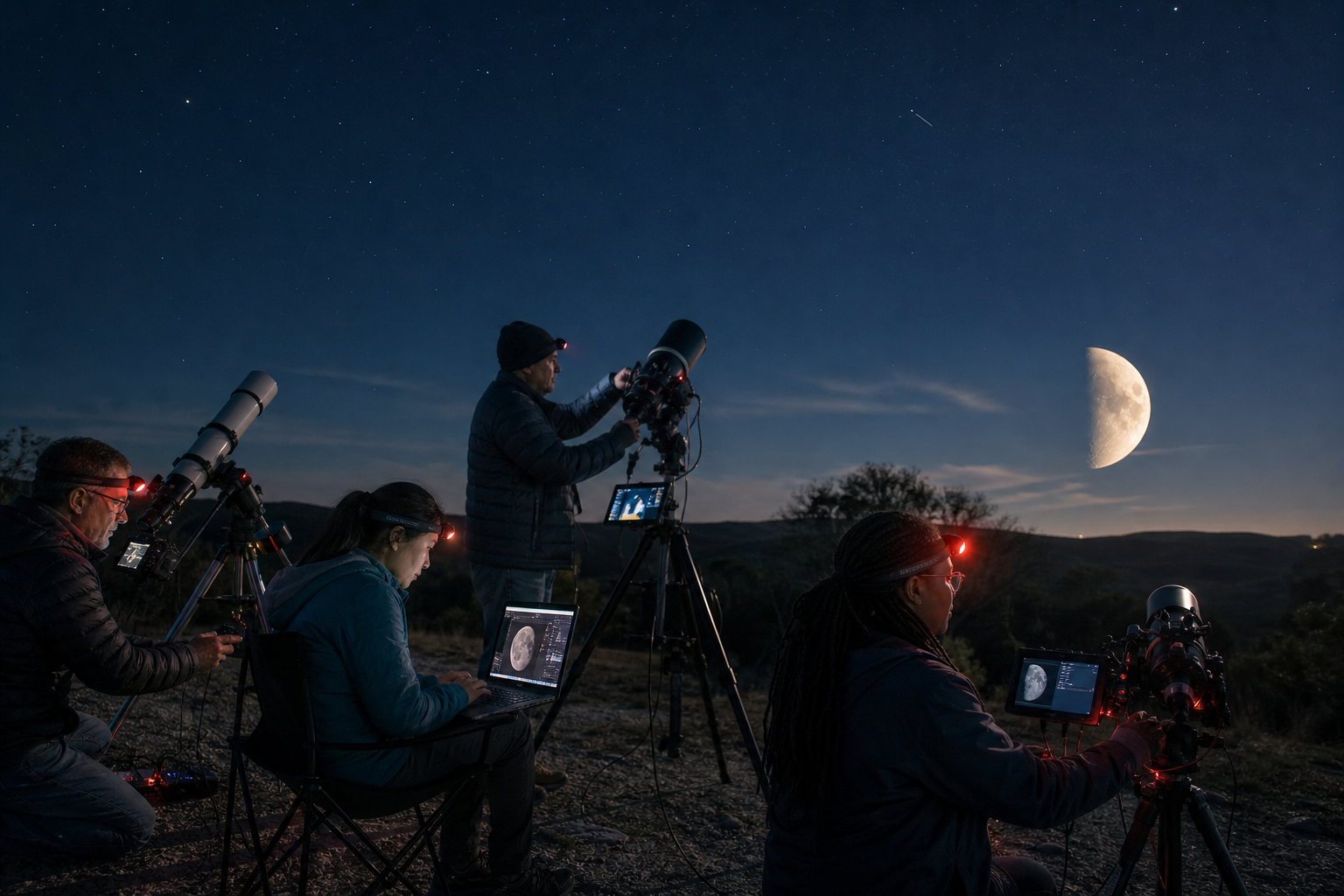
Outcome update — August 7, 2026: South Korea’s Danuri lunar orbiter has now supplied before-and-after images of the predicted Falcon 9 impact site, confirming a new, darker disturbed area and ejecta where the upper stage struck the Moon on August 5. This upgrades the evidence from time-correlated ground spectroscopy to direct surface confirmation from lunar orbit. KARI has not released a measured crater diameter. NASA’s pre-impact estimate of about 60 feet (roughly 18 meters) wide—and a previously circulated 27-meter figure—are predictions, not measurements from Danuri.
A spent Falcon 9 upper stage hit the Moon near the Einstein and Bell crater region at approximately 06:35 UTC on August 5, 2026. The sequence now has three mutually reinforcing parts: a predicted trajectory, a short-lived VLT debris signature at the expected time, and Danuri images showing a fresh change at the expected site.
That last step matters. The photographs do not simply add another indirect clue: they compare the surface before and after the event. They show altered, darker terrain and material thrown outward from the impact area. NASA’s Lunar Reconnaissance Orbiter (LRO) follow-up is still pending as of this August 7 update; it may offer an additional independent look, but Danuri has already established the surface-level confirmation.

What do Danuri’s Falcon 9 lunar impact images confirm?
The Korea Aerospace Research Institute’s Danuri update shows imagery taken before and immediately after the collision. KARI says the paired images allow analysis of changes caused by the impact itself. In the new view, the terrain at the predicted site is visibly darker, with a fresh disturbed feature and ejecta surrounding it.
That is direct orbital confirmation that the impact changed the lunar surface at the predicted location. Associated Press reporting describes Danuri making multiple lunar-orbit passes and obtaining the before-and-after shots; Space.com’s report likewise identifies the feature as the crater produced by the Falcon 9 upper stage.
There is an important limit on what those images establish today: KARI has not published a measured diameter for the fresh crater. A visible crater is not the same as a released measurement.
What was known before Danuri photographed the site?
NASA and independent observers had already made a strong case that the upper stage would hit the Moon. NASA’s pre-impact observing plan said its tracking gave the object a 100% chance of lunar impact and placed the event near Einstein and Bell craters.
The first observational support after the event came from the European Southern Observatory’s Very Large Telescope in Chile. It detected sodium and lithium extending tens of kilometers into space for about five to ten minutes after the predicted time. That time-correlated signature supported the collision, but it was not an image of the surface.
Danuri resolves the central surface question. The chronology is now straightforward:
- Trajectory prediction: tracking placed the Falcon 9 upper stage on a lunar-impact path.
- Post-impact spectroscopy: VLT recorded a brief sodium-and-lithium debris signature at the expected time.
- Orbital surface imagery: Danuri’s before-and-after views show the changed terrain and ejecta at the predicted site.
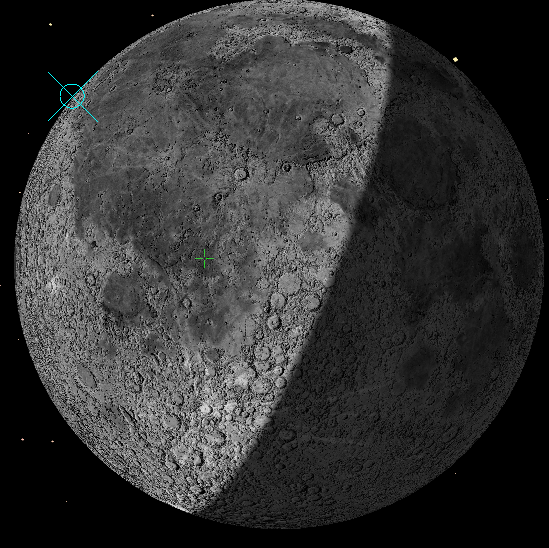
Predicted impact-region map from Project Pluto, published as public domain.
Has Danuri measured the Falcon 9 crater size?
No. The released images confirm a fresh impact feature, but KARI has not announced a measured crater diameter. It would be inaccurate to turn an image-based confirmation into a precise size claim.
Before the impact, NASA estimated that the incoming upper stage could create a crater about 60 feet wide and 12 feet deep. That is a model prediction, not a Danuri measurement. Likewise, any 27-meter estimate reported before image analysis should be read as a prediction unless and until an imaging team releases a calibrated measurement.
This distinction is more than a wording preference. Crater dimensions require image scale, geometry, lighting conditions, and analysis—not merely a visible dark patch. Future work from KARI, LRO, or other teams may refine the size, but the responsible current summary is: Danuri confirms the surface change; no measured crater diameter has been released.
Is NASA LRO follow-up still pending?
Yes, as of August 7. NASA said before the event that LRO and ShadowCam aboard Danuri would look for opportunities to image the site before and after impact, subject to lighting, orbital timing, spacecraft position, and data return. Danuri’s images have arrived first. NASA LRO imagery, when released, would be a valuable independent follow-up rather than the first confirmation.
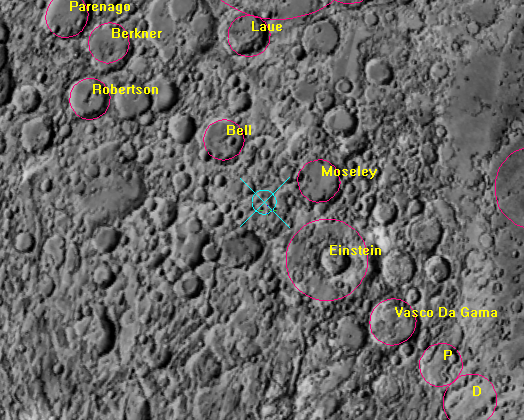
Close-up of the projected region from Project Pluto, public domain.
Why does a before-and-after orbital image matter?
Lunar impacts are difficult to watch in real time from Earth. An orbital comparison sidesteps that challenge by holding location and viewing geometry close enough to isolate a new change. It also lets researchers study ejecta patterns and the relationship between an impact’s predicted energy and its visible mark on the Moon.
This is exactly the kind of observation that makes astronomy collaborative: trackers define the target, ground observatories catch fleeting chemical evidence, and spacecraft reveal the surface result. If you enjoy comparing lunar images, trading observing notes, or planning a skywatching session, join the Cosmic Match astronomy community. In Central Texas, you can also meet fellow stargazers in Austin for help following the next unusual event.
For another evidence-first space explainer, read our Betelgeuse B guide.
FAQ
Did Danuri confirm the Falcon 9 lunar impact?
Yes. Danuri’s before-and-after orbital images show a fresh, darker disturbed area and ejecta at the predicted impact site, providing direct surface confirmation of the August 5 collision.
Did Danuri measure the new crater’s diameter?
No. KARI has released images but no measured crater diameter. NASA’s approximately 60-foot (18-meter) figure was a pre-impact prediction, not a measurement from Danuri.
What did the VLT observe?
The VLT detected a brief sodium-and-lithium signature extending tens of kilometers into space shortly after the predicted impact time. That was early post-impact support; Danuri now adds the surface evidence.
Has NASA’s Lunar Reconnaissance Orbiter released its own image?
Not as of August 7, 2026. NASA LRO follow-up remains pending and could provide an independent view of the impact site.