Mercury and Jupiter Meet Before Sunrise August 15: When to Look in Austin, Houston, and LA
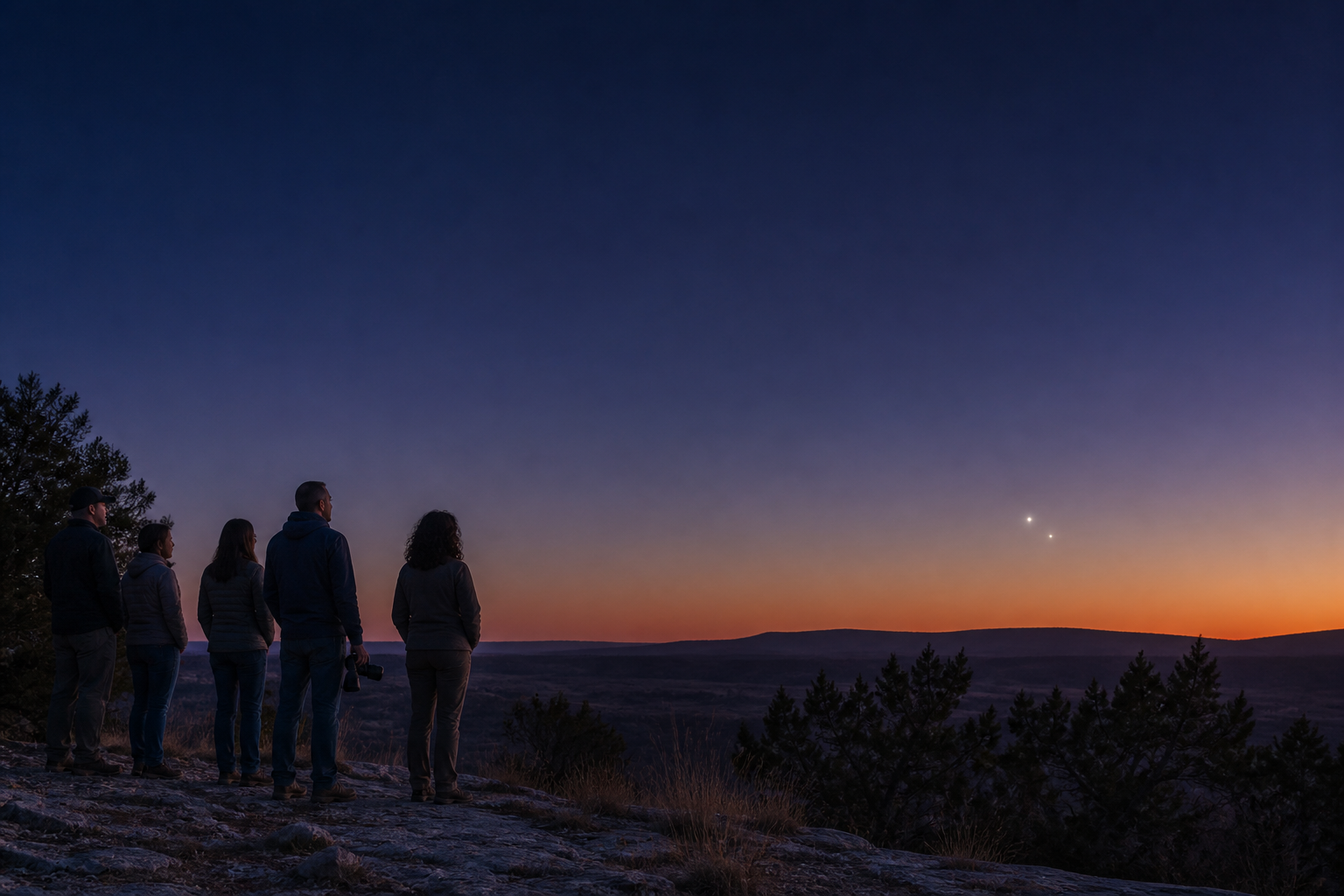
Mercury and Jupiter will appear only about 0.6° apart in the east-northeast before sunrise on Saturday, August 15, 2026. For Austin, Houston, and Los Angeles, the practical window is roughly 30–40 minutes before local sunrise—not the formal 09:13 UTC conjunction time, when both planets are still below the local horizon. Find a low, unobstructed view east-northeast, bring a friend, and keep it simple: this is a bright, no-telescope morning-sky moment.

When can you see Mercury and Jupiter on August 15?
Set an alarm for the short pre-sunrise window below. Jupiter (about magnitude -1.8) and Mercury (about magnitude -1.2) should be the compact bright pair low in the growing twilight. They are close enough to fit behind the tip of a raised finger at arm’s length—roughly 33 arcminutes apart at conjunction.
| City | Best target window | Sunrise | Where to look |
|---|---|---|---|
| Austin | 6:18–6:28 a.m. CDT | 6:58 a.m. CDT | Low east-northeast |
| Houston | 6:09–6:19 a.m. CDT | 6:49 a.m. CDT | Low east-northeast |
| Los Angeles | 5:34–5:44 a.m. PDT | 6:14 a.m. PDT | Low east-northeast |
The listed conjunction occurs at 09:13 UTC (4:13 a.m. CDT / 2:13 a.m. PDT), a useful astronomical timestamp but not your viewing appointment. The planets remain close together as they rise later, which is why the dawn window is the one worth sharing with your observing crew.
What do Mercury and Jupiter look like before sunrise?
Look for two steady, bright points low over a clear horizon. Jupiter should be the brighter one; Mercury will be nearby. The pair sits in Cancer and is near the Beehive Cluster (M44), though M44 will be a much tougher catch in the brightening sky.
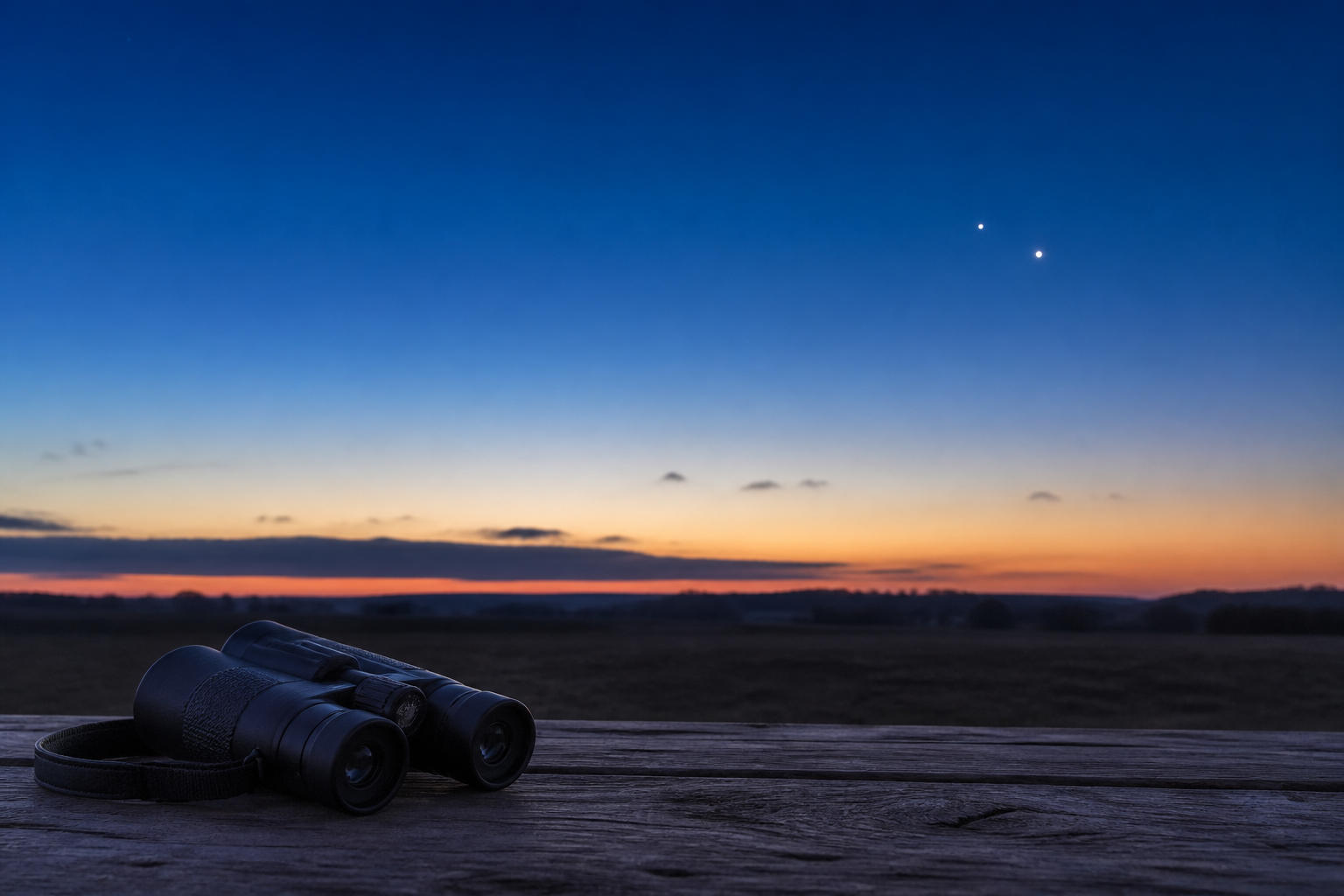
No telescope is required. Naked-eye viewing is the point here, and it is the easiest way to take in the pair and its low-horizon setting. If haze, trees, apartments, or a distant ridge block your view, a different location matters far more than extra gear.
Do you need binoculars for the Mercury-Jupiter conjunction?
Not necessarily. Start with your eyes. Binoculars can help separate the pair from the brightening dawn, but only use them while the Sun is safely below the horizon. Never sweep or point binoculars or a telescope near the Sun; even a brief accidental look can cause permanent eye damage. Pack optics away before sunrise.
A low east-northeast horizon is non-negotiable. Try a lakeside path, open field, rooftop with safe access, or a hill-country overlook—anywhere legal and familiar where buildings and trees do not eat the bottom slice of sky. Go with someone when possible, respect site rules, and keep your flashlight red and dim.
A five-minute plan for Austin, Houston, and LA
- Arrive 10–15 minutes before your city’s target window so you can orient yourself without rushing.
- Face east-northeast and scan just above the cleanest part of your horizon.
- Give your eyes a minute; dawn contrast is the challenge, not the brightness of Jupiter.
- Once you find the pair, take a mental snapshot and share it—this is a lovely one to spot together.
- Stop observing and put binoculars away before sunrise.
For another low-pressure sky outing, use our Perseids no-telescope city night plan to build a simple observing kit and choose a comfortable place to look up. And if you want people to trade sightings with, join the Cosmic Match astronomy community or find stargazing partners in Austin—a predawn check-in makes that alarm feel much less antisocial.
Why this tiny pairing is worth waking up for
Mercury is famously elusive because it never strays far from the Sun in our sky. Seeing it beside unmistakable Jupiter gives beginners a natural reference point: find the brighter bead, then notice its smaller neighbor. The 15th is not about a dramatic giant-planet show; it is about catching a brief, human-scale alignment before the day begins.
Bring a warm drink, send a “did you spot it?” message afterward, and leave room for the possibility that clouds win. A cloudy morning is still a good reason to plan the next sky watch with people who get why two dots near dawn can be a whole event.
Sources
- In-The-Sky.org conjunction calculation (JPL DE440-based; formal time, separation, magnitudes, and safety warning)
- EarthSky’s August 2026 Mercury guide (August 15 dawn timing, 0.6° separation, and binocular guidance)
- Astronomy.com’s August 14–21 sky guide (pairing and M44 context)
FAQ
What time is the Mercury-Jupiter conjunction on August 15, 2026?
The geocentric conjunction is at 09:13 UTC. In Austin, Houston, and Los Angeles, that happens before the planets rise, so use the local pre-sunrise windows above instead.
Can I see Mercury and Jupiter without a telescope?
Yes. Both are bright enough for naked-eye viewing under a clear, unobstructed east-northeast horizon. Binoculars may help in twilight, but they are optional.
Which direction should I face?
Face low toward the east-northeast shortly before sunrise. Buildings, trees, and ridges can hide the pair, so choose the clearest horizon you can safely access.
Is it safe to use binoculars at dawn?
Only while the Sun remains below the horizon, and never point optics near it. Stop observing and put binoculars away before sunrise.