Hubble and Webb See the Cat’s Head Nebula Differently—Here’s Why
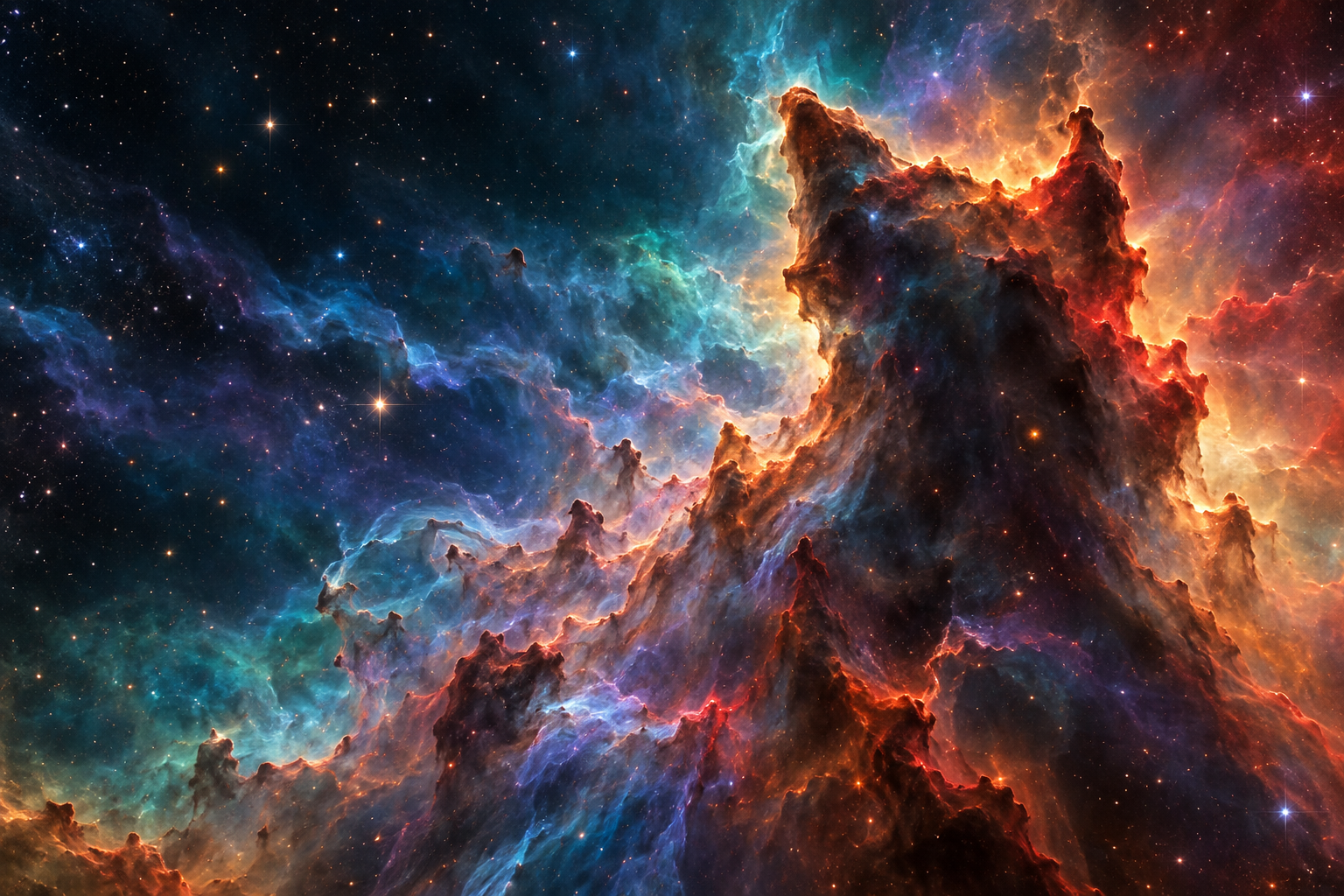
NASA and ESA released coordinated Hubble and Webb views of the Cat’s Head Nebula on October 29, 2026—and the difference is physical, not just cosmetic. In the Carina Nebula about 7,500 light-years away, Hubble’s visible light maps an opaque dust pillar and glowing ionized edge; Webb’s near-infrared peers farther through dust to reveal stars and fine structure; Webb’s mid-infrared traces warm dust and carbon-rich molecules. They are three useful readings of the same star-forming pillar, not three versions of one photograph.
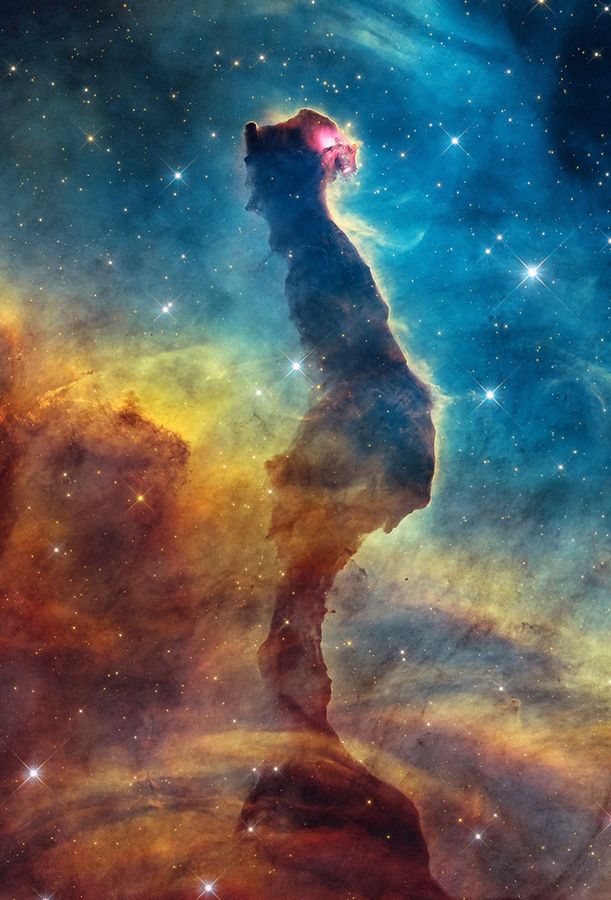
NASA/ESA Hubble view. Credit: NASA, ESA, STScI; image processing: Joseph DePasquale (STScI). Source and image details.
Why does the same nebula look so different in Hubble and Webb images?
A telescope image is a translation of selected wavelengths into visible color. That matters because dust, gas, molecules, and stars do not all emit or transmit light in the same way. The Cat’s Head—also identified with the Carina Nebula’s HH 903 region—has been sculpted by ultraviolet radiation and winds from nearby massive stars. Less-dense material is stripped away while denser dust hangs on, creating the narrow, cat-like silhouette.
Hubble and Webb are therefore complementary rather than competitors. The shape stays recognizable, but the clues change as the instruments sample different light. When you compare them, resist the urge to read the palette as a literal map of temperature. The assigned colors are a deliberate visual encoding of measurements through filters.
What does Hubble’s visible-light image show?
In Hubble’s view, the central filament reads as a dark brown, nearly opaque pillar because visible light is efficiently blocked and scattered by dust. That silhouette is the point: it shows where the dust is dense enough to hide the background.
Look along the pillar’s right edge. Its hazy yellow rim is consistent with gas being lit and ionized by ultraviolet radiation from massive neighboring stars. The colorful material around it includes light from oxygen, hydrogen, and sulfur, plus starlight scattered by dust. This is a snapshot of stellar feedback at work—radiation heating and photoevaporating exposed gas while denser pockets temporarily resist.
The red “eye” is intriguing, but it should stay a may, not a certainty: NASA says it may mark a young star still partly embedded in dust. That scientific restraint is part of what makes multiwavelength comparisons valuable.
How does Webb NIRCam see through the dust?
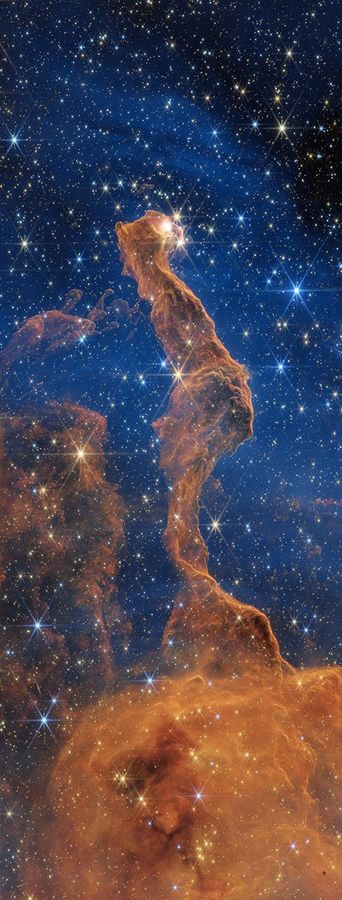
Webb NIRCam view. Credit: NASA, ESA, CSA, STScI; image processing: Joseph DePasquale (STScI). Official asset record.
Near-infrared light is less hindered by dust than visible light, so Webb’s NIRCam makes the filament partly transparent. Its complex surface and wispy material to the left stand out, while a dense scatter of stars appears across the scene. Some stars remain dust-shrouded even here—“infrared” is not a magic X-ray vision setting—but the view reaches meaningfully farther into the cloud.
This observation was made on May 27, 2026. Its field is about 2.3 arcminutes across, or roughly 5.4 light-years at Carina’s distance. NIRCam combined several filters into a color composite; the colors identify filter assignments rather than natural eyesight. A faint jet-like feature near the cat’s belly may hint at an outflow associated with a young star, another reason the structure is more than a pretty silhouette.
For people who enjoy learning to read astronomical images, this is the same curiosity that makes a shared processing session so rewarding: compare the data, name what is actually supported, and leave room for what follow-up observations must settle. Find others who love that kind of sky conversation at Cosmic Match.
What does Webb MIRI add beyond the near-infrared view?
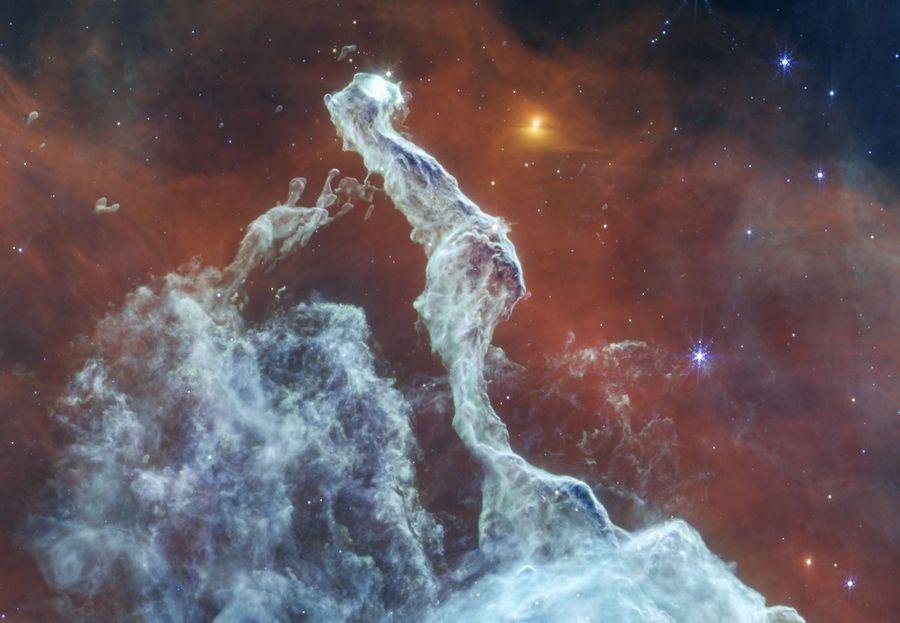
Webb MIRI view. Credit: NASA, ESA, CSA, STScI; image processing: Joseph DePasquale (STScI). Source and image description.
MIRI works at longer, mid-infrared wavelengths. In this view, emission from warm dust and carbon-based molecules outlines fine structure that is easy to miss elsewhere. The bluish-green portions include emission from polycyclic aromatic hydrocarbons (PAHs), molecules energized by starlight; delicate globules and strands to the pillar’s left become especially conspicuous.
That does not mean every color is a simple thermometer. NASA and ESA emphasize that the color and brightness variations can reflect a mix of PAH emission, dust continuum, local irradiation, and composition. To the right, a bright yellow source sits against reddish surrounding emission. It is likely an infant star embedded in dust, but a narrow filament appears to cross it and the image alone cannot prove that the two are physically connected.
The useful way to compare the three views
Try this sequence when you open the official images:
- Start with Hubble: trace the dust silhouette and the glowing, irradiated rim.
- Switch to NIRCam: look for the extra stars, translucent dust, and texture revealed beyond the visible-light blockage.
- Finish with MIRI: follow the warm-dust and PAH-emission structures, especially the fine filaments and globules.
The payoff is a better mental model: a nebula is not a painted backdrop. It is a changing mix of dust, gas, radiation, molecules, and forming stars. If you want a friendly place to swap image-processing discoveries or plan a night under darker skies, join the Cosmic Match astronomy community. And if this comparison has you reaching for a camera, our permission-first guide to dark-sky photography near Austin is a practical next read.
FAQ
Is the Cat’s Head Nebula a separate nebula from Carina?
No. “Cat’s Head Nebula” is the nickname for a small, distinctive dust-pillar region within the much larger Carina Nebula star-forming complex.
Are the colors in the Webb images the colors a person would see?
No. The images are color composites: data from different filters are assigned visible hues so researchers and viewers can distinguish wavelength-dependent features.
Can amateur astronomers photograph this exact pillar from Earth?
It is a very challenging deep-sky target in the southern Carina region, not a casual visual target. The released Hubble and Webb images are the right way to study this specific detail; amateur work can still explore the wider Carina Nebula from suitably dark southern skies.
Why use both Hubble and Webb instead of one telescope?
Their wavelength coverage reveals different physical components. Together, visible, near-infrared, and mid-infrared observations provide a more complete view of dusty star formation than any one view alone.