Best Planisphere for Beginners: Austin, Houston & LA
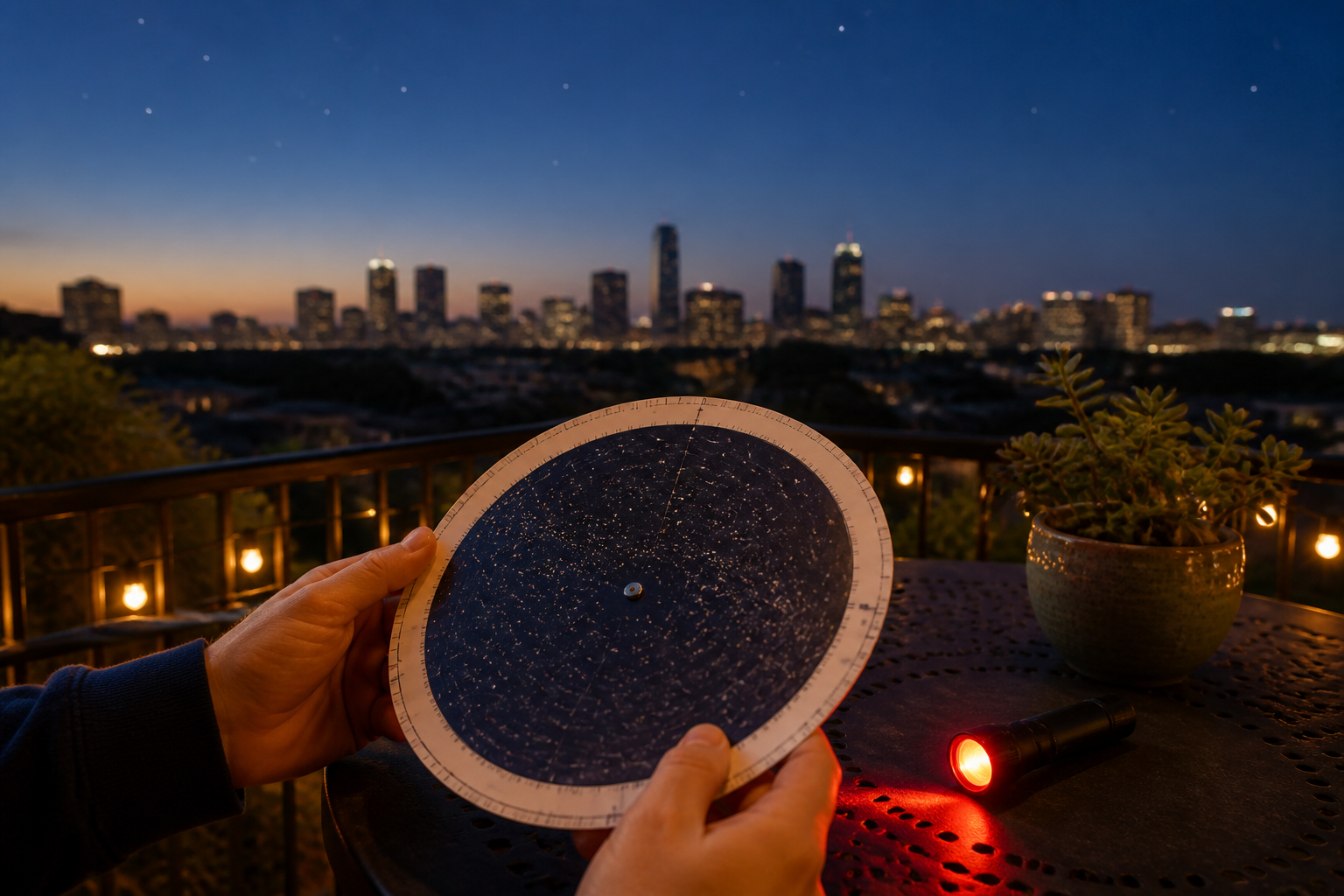
A planisphere is one of the best first tools for learning the sky in Austin, Houston, or Los Angeles: it is a rotating paper star chart matched to your latitude, and it works without a subscription, signal, or glowing screen. For all three cities, start with a Northern Hemisphere wheel made for roughly 30°–35° north. It will not tell you the Moon’s phase or point to a planet in real time, but it will teach you which constellations belong in your sky tonight—and where to look for them.

What is a planisphere—and what does it actually show?
A planisphere (also called a star wheel) has a printed star map under an oval viewing window. Rotate the date against the time, and the window reveals the bright stars and constellations that should be above the horizon for that moment. It is an overview tool: excellent for learning the seasonal sky, finding familiar constellations, and planning a short observing session.
It is deliberately simpler than a live sky app. A standard wheel does not update for a planet’s current position, the Moon’s exact phase, satellites, comets, or a surprise nova. Those objects move relative to the background stars. Use a real-time source for those details, then use the planisphere to understand the larger map around them.
That simplicity is a feature for beginners. Once you can recognize a few anchor patterns—say, the Big Dipper, the Summer Triangle, or Orion—you are no longer starting every night from zero.
Which latitude band should Austin, Houston, and LA use?
Latitude is the purchase decision that matters. A planisphere’s horizon window is drawn for a particular slice of Earth, so a wheel for 40° north is not the best match for the Gulf Coast or Southern California.
- Austin: about 30° N—choose a 30° N wheel or a 30°–35° N range.
- Houston: about 30° N—use the same 30° N or 30°–35° N option.
- Los Angeles: about 34° N—choose 30°–35° N when available; a 35° N wheel is also a sensible close match.
Many makers sell latitude-specific versions or a small range. Check the product’s stated observing latitude before you buy, not just the words “Northern Hemisphere.” Sky & Telescope’s planisphere guide explains why one narrow latitude range matters; David Chandler’s latitude selector is another useful way to compare options.
What should beginners look for in a planisphere?
Skip “best overall” lists and look for a few practical qualities instead.
The correct latitude comes first. A readable 30°–35° N wheel is more useful here than a fancy chart designed for a northern state.
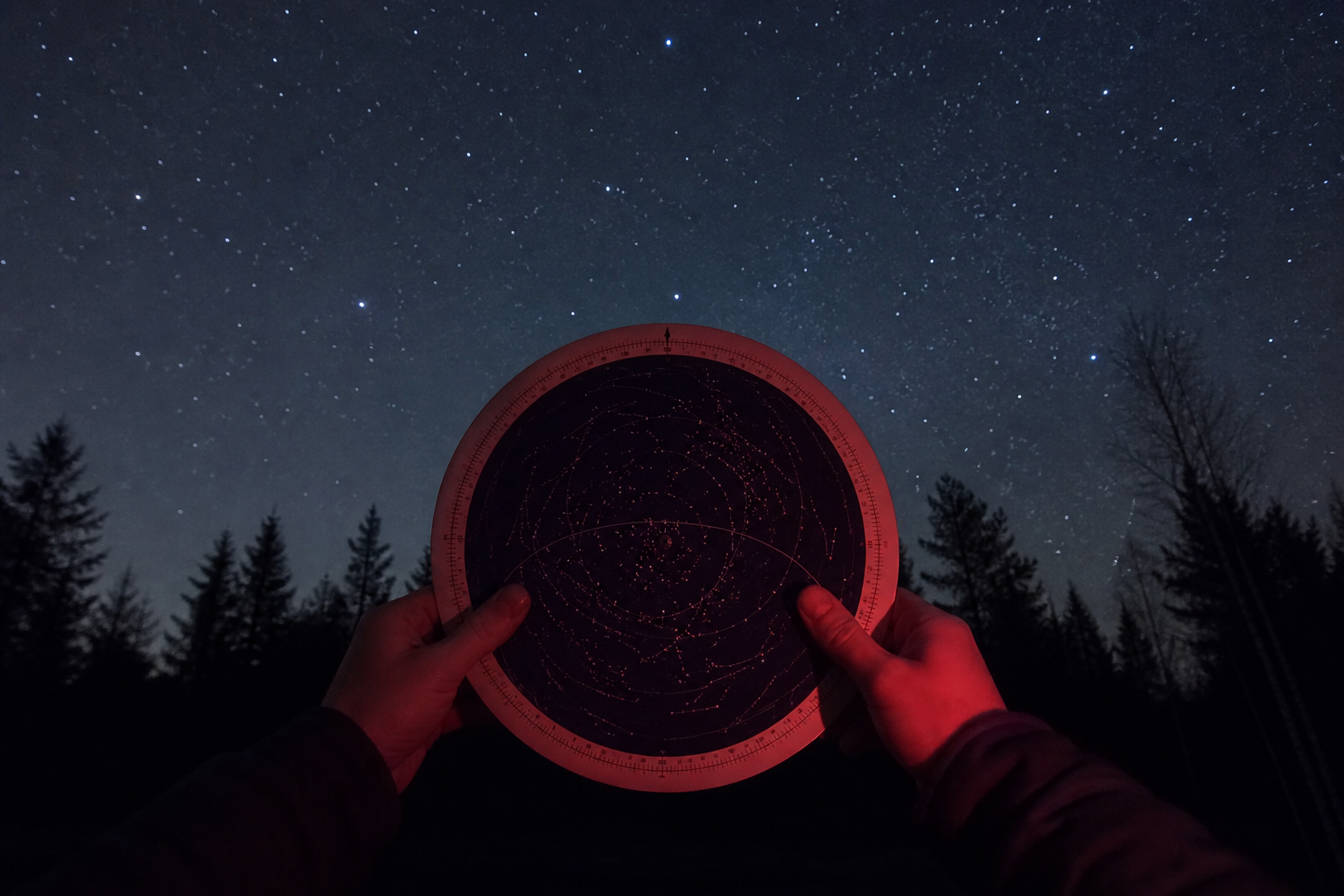
Choose large, high-contrast printing. Small pocket wheels are portable, but a larger wheel is easier to read under a dim red light. You want constellation lines and major stars that you can distinguish without turning on a bright flashlight.
Look for durable, simple construction. A laminated or sturdy card wheel survives dew and a backpack better than thin paper. The window should rotate smoothly, and the date/time scale should be easy to line up. You do not need a branded “premium” model to learn the sky.
Check the time instructions. Some wheels ask you to account for daylight saving time; follow the instructions printed on the specific model. A planisphere is approximate by design, and a small time difference is normal.
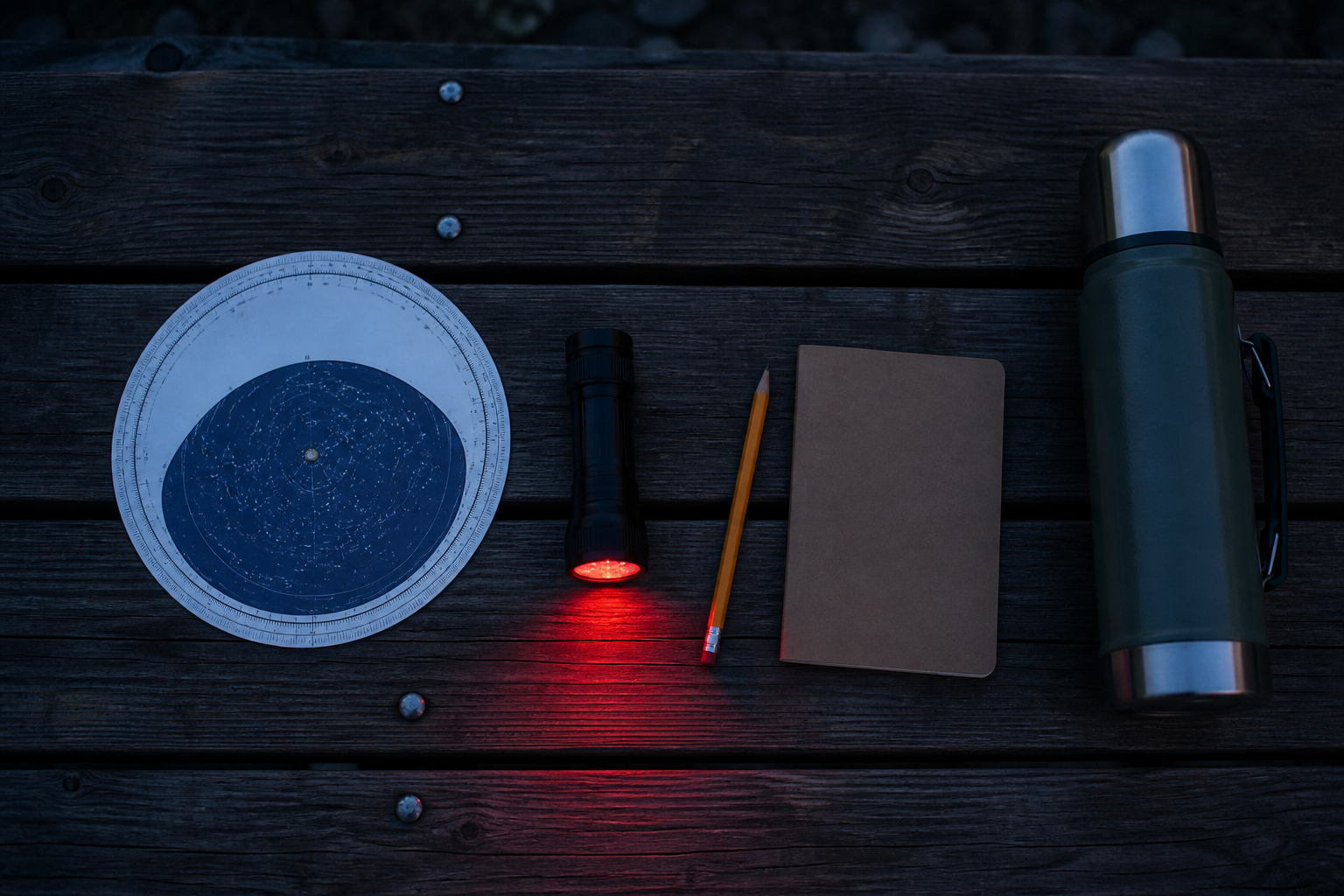
Add a dim red light, not more gear. Red light helps you read the chart while preserving more dark adaptation than a white phone screen. If your light is too bright, point it away from the wheel or cover part of it with red film.
How do you use a planisphere on your first night?
Try this ten-minute routine after twilight, when the first bright stars are appearing.
- Set the wheel’s date and local time using its printed instructions.
- Walk somewhere with an open view—your porch, balcony, or a local park works.
- Face north and hold the chart upright, with its north edge toward the actual northern horizon. Do not hold it flat like a dinner plate.
- Start with one bright pattern, not the whole map. In late summer, try the Summer Triangle; in winter, look for Orion.
- Compare the brightest dots and shapes first. City light pollution hides many faint stars, but the major patterns remain your friends.
For an Austin-specific place to practice, pair this routine with our Austin stargazing guide. If you are learning on a shared outing, bring the chart before the group starts setting up—passing it around is a surprisingly good icebreaker.
Do you need a planisphere if you have a sky app?
No. You can begin with the naked eye and a willingness to look up. An app can be terrific for checking a planet or identifying an unfamiliar bright point, especially when it has a red-night mode. A planisphere does a different job: it slows the map down enough for your brain to learn the sky’s seasonal rhythm.
The honest no-purchase fallback is to use a free printable star chart or a free planetarium website in night mode, then practice the same one-constellation routine. You can also attend a public observing night and ask someone to point out an anchor constellation. The goal is not to own a wheel; it is to become comfortable finding your way overhead.
If you do buy one, consider it a low-pressure companion rather than a test. There is no need to memorize every constellation. Take it out a few times, notice what has moved since last month, and let familiarity build.
Make the first night social, not complicated
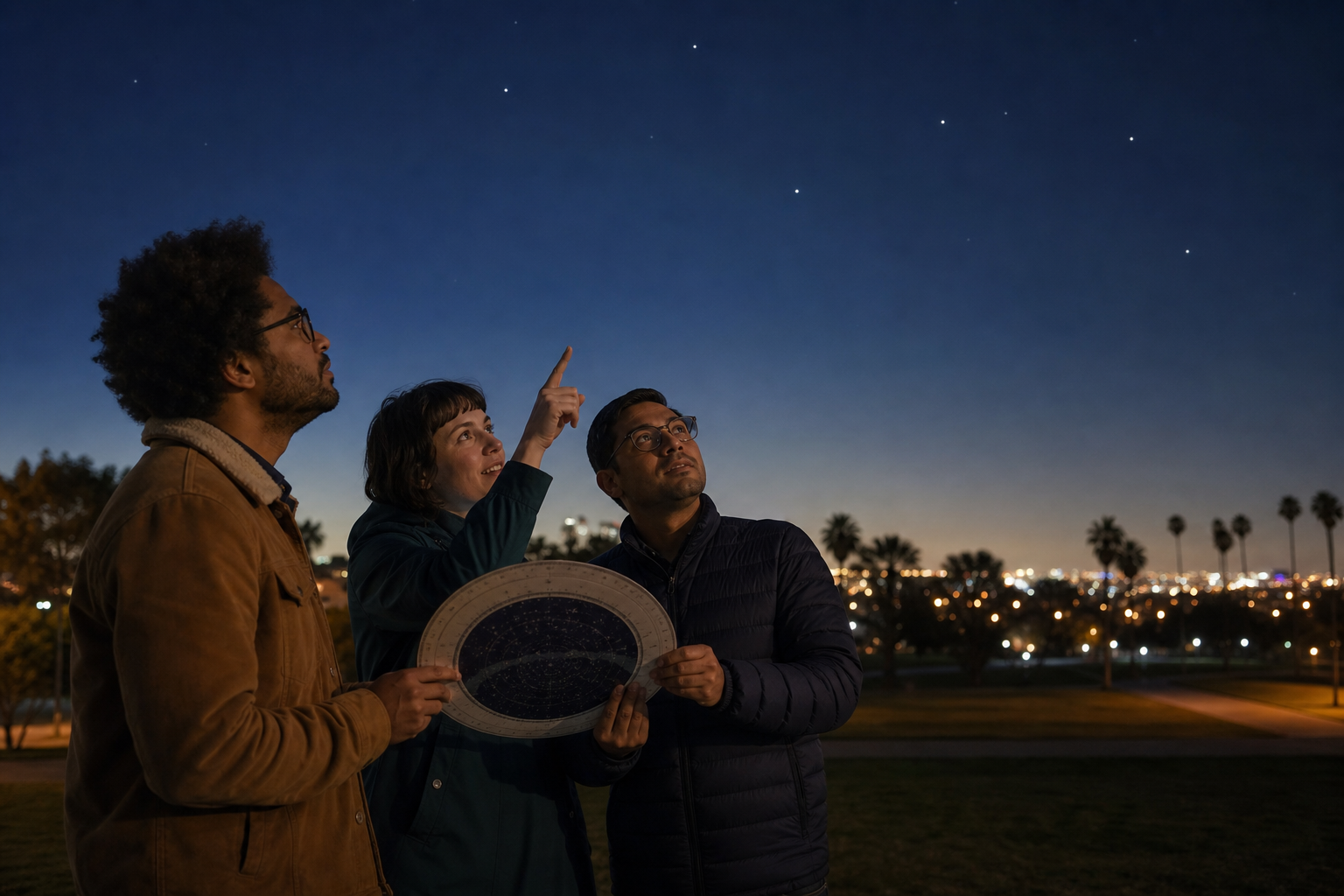
A paper chart gives a small group something useful to gather around. One person can hold the red light, another can match a bright star, and everyone can take a turn spotting the pattern. Start with the same no-fuss attitude in our beginner stargazing chair guide: comfort and a clear view matter more than a pile of equipment.
Want to find people who would rather swap constellation stories than scroll indoors? Join the Cosmic Match astronomy community free and connect around your next skywatching plan.
FAQ
What is the best planisphere for beginners in Austin, Houston, or LA?
Choose a Northern Hemisphere planisphere made for about 30°–35° north latitude, with clear large printing and a simple rotating window. Austin and Houston fit near 30° N; Los Angeles is near 34° N.
Can a planisphere show me the Moon and planets tonight?
Not reliably. It maps the background stars and constellations for a date and time. Check a real-time astronomy source for the Moon, planets, satellites, comets, and transient events.
Do I need a telescope to use a planisphere?
No. It is made for naked-eye orientation and is especially useful before you own any optical equipment. Binoculars can come later if you want a closer view.
Why does my planisphere not match every star I can see?
It is an approximate map for a latitude range and usually emphasizes brighter stars. Local horizon obstructions, city light, daylight-saving instructions, and your observing time can all affect the match.