Hubble and Webb Found 27 Tiny Worlds Beyond Neptune—And Fewer Than Expected
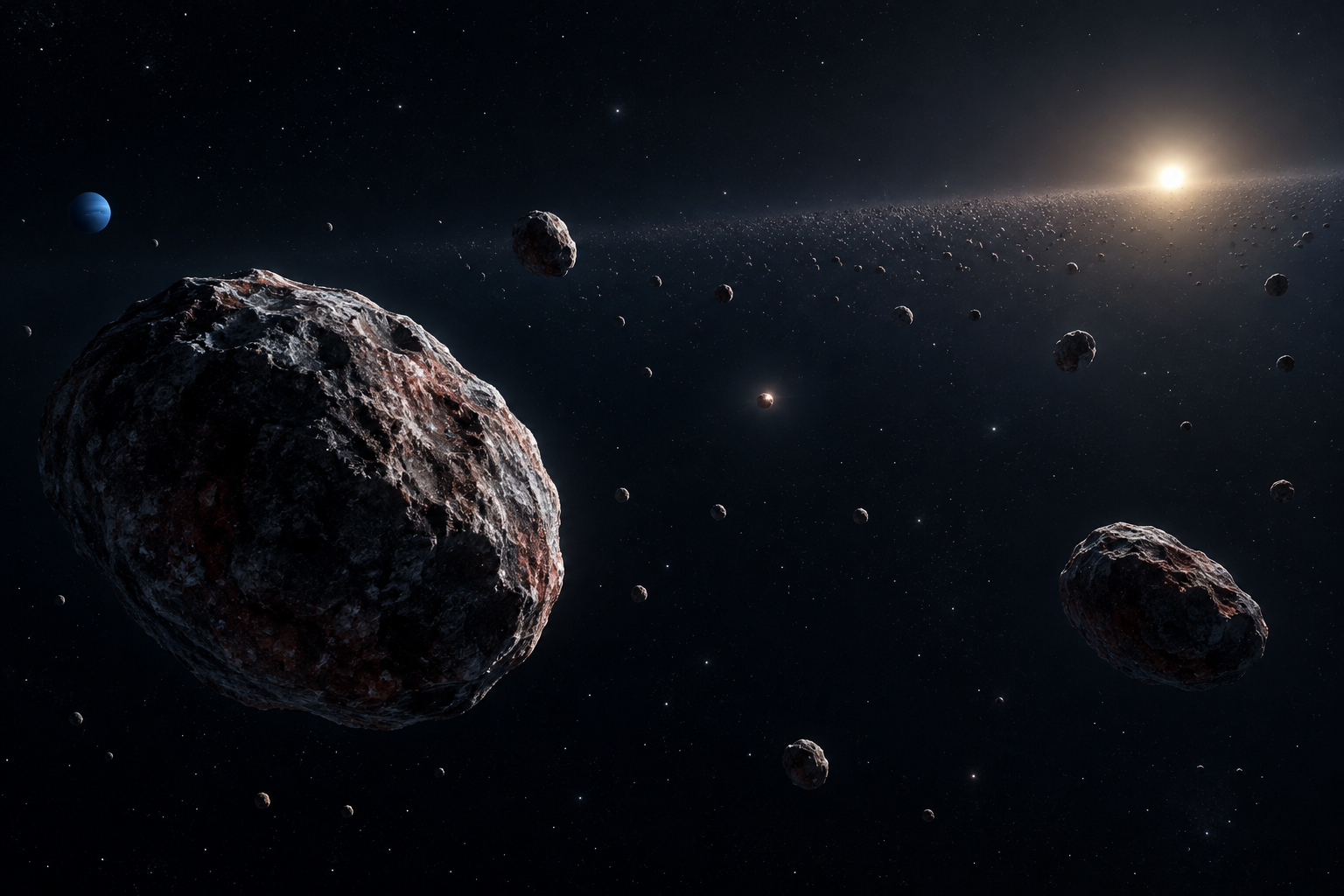
NASA’s Hubble and James Webb space telescopes have identified 27 previously unknown objects beyond Neptune, including one about 3 miles (5 kilometers) wide. The surprise is not simply that the team saw objects this faint. In the deepest trans-Neptunian-object survey yet, it found fewer very small bodies than some planet-formation models predict—and the smallest objects still carry the same broad color relationships as their larger neighbors.
That gives scientists a sharper, still-evolving clue to the solar system’s early construction site. These worlds are far too dim to view from Austin, Houston, or Los Angeles with amateur gear: NASA says most are more than 100 million times fainter than unaided-eye objects. But the result is a wonderful reminder that the quietest specks can preserve the loudest history.

Illustration: Cosmic Match editorial concept. It is an artist’s visualization, not a resolved image of any newly discovered object.
What did Hubble and Webb find beyond Neptune?
The joint survey found 27 new trans-Neptunian objects, or TNOs: small, faint, icy bodies that orbit the Sun beyond Neptune. They are members of the wide family of outer-solar-system objects that includes the Kuiper Belt’s better-known residents, such as Pluto.
The smallest new detection is estimated at roughly 5 kilometers across—about five times smaller than the limit NASA cites for the most sensitive ground-based telescopes. At that scale and distance, the objects do not look like little worlds with visible terrain. To Hubble and Webb, they are extraordinarily faint points of light.
The accomplishment came from observing the same patch of sky at the same time. Hubble measured visible light; Webb measured infrared light. Together those data let researchers estimate colors, sizes, and orbits more effectively than either observatory could alone.
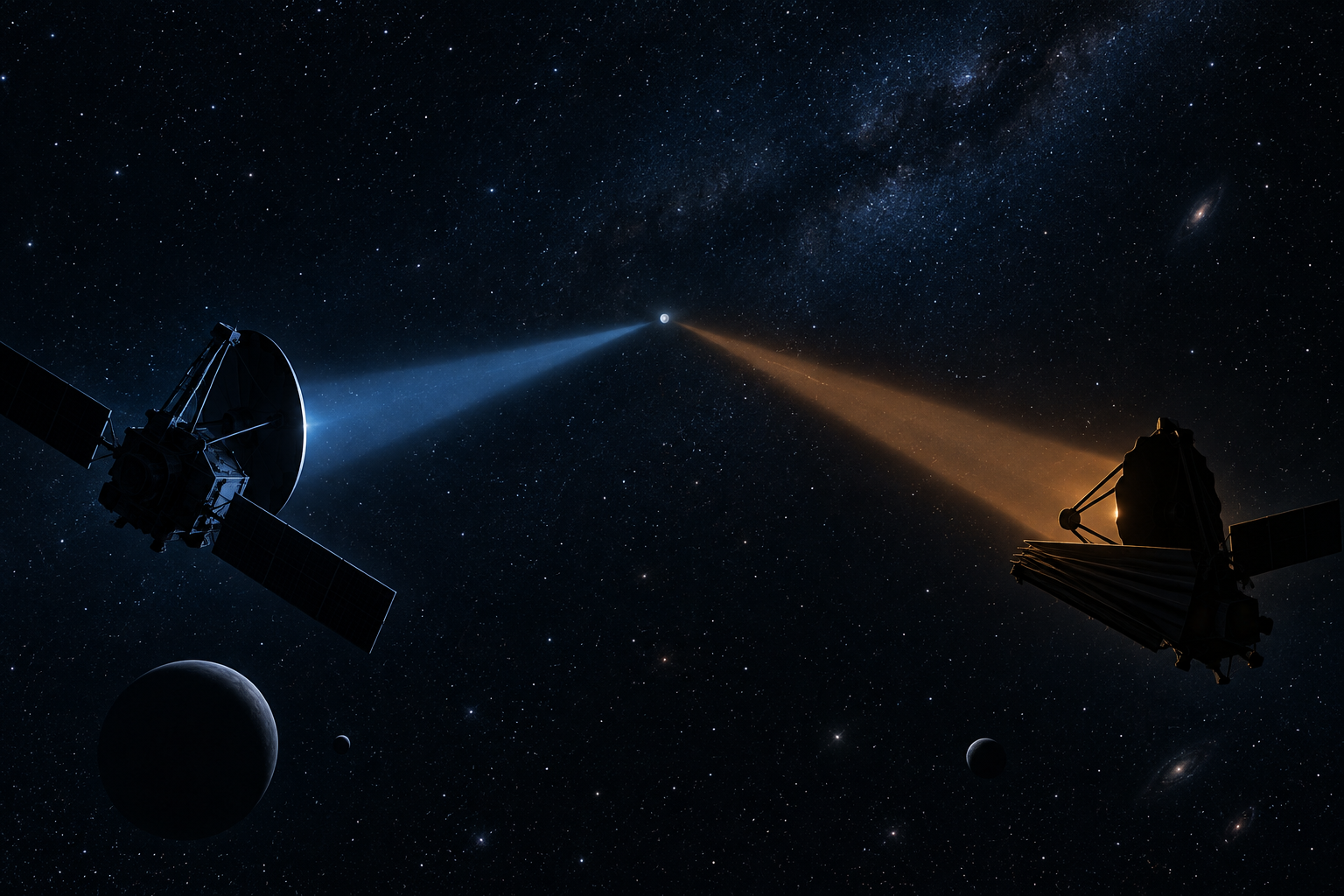
Illustration: Cosmic Match editorial concept showing complementary visible-light and infrared observations; it is not a literal depiction of the survey geometry.
Why are fewer tiny worlds a scientific surprise?
Think of the early solar system as a disk of dust and pebbles that built larger solid pieces called planetesimals. Those planetesimals were the raw material of planets. Beyond Neptune, many were left in a cold, distant archive rather than merging into worlds like Earth.
The new size measurements show fewer very small TNOs than some models of planet formation predict. That is a constraint, not a verdict. It does not mean scientists have disproved those models or solved exactly how the missing bodies were made, destroyed, or avoided. It means any successful explanation has to account for the observed shortage.
The two populations measured by the team also have surprisingly similar overall size distributions. “Dynamically cold” TNOs tend to remain on relatively circular orbits close to the solar system’s plane. “Dynamically hot” TNOs have more tilted and elongated orbits, reflecting a more eventful early history that likely included outward shuffling as the giant planets migrated.
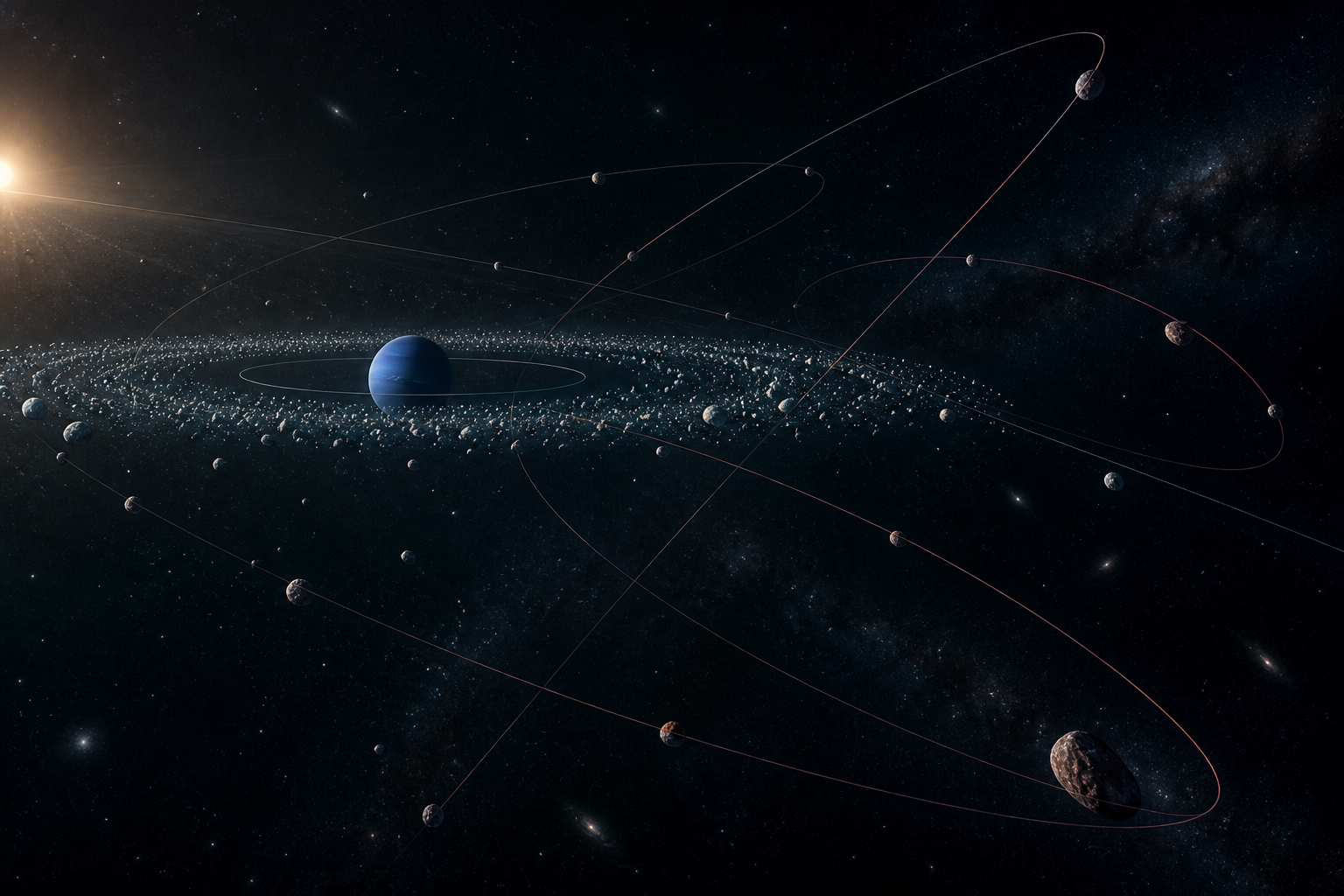
Illustration: Cosmic Match editorial concept of orbital populations. The paths are a visual metaphor, not a scale map of individual discoveries.
Do the new objects still remember the early solar system?
In an important sense, that is the question. Before these observations, researchers expected many small TNOs to have been battered by collisions enough to alter their surfaces. Instead, the teams found that the small objects follow the same color relationships as their larger family members.
Color is useful because it acts as a broad clue to surface composition and history. The observation may mean collisions have changed these bodies less than expected, that there have been fewer collisions, or that their surfaces retain primordial material especially well. Those are interpretations the teams are still testing—not settled answers.
NASA’s accompanying hero image is also worth reading carefully: it is an artist’s concept, not a photograph of a newly found TNO. The actual discoveries are points of light in highly sensitive observations.
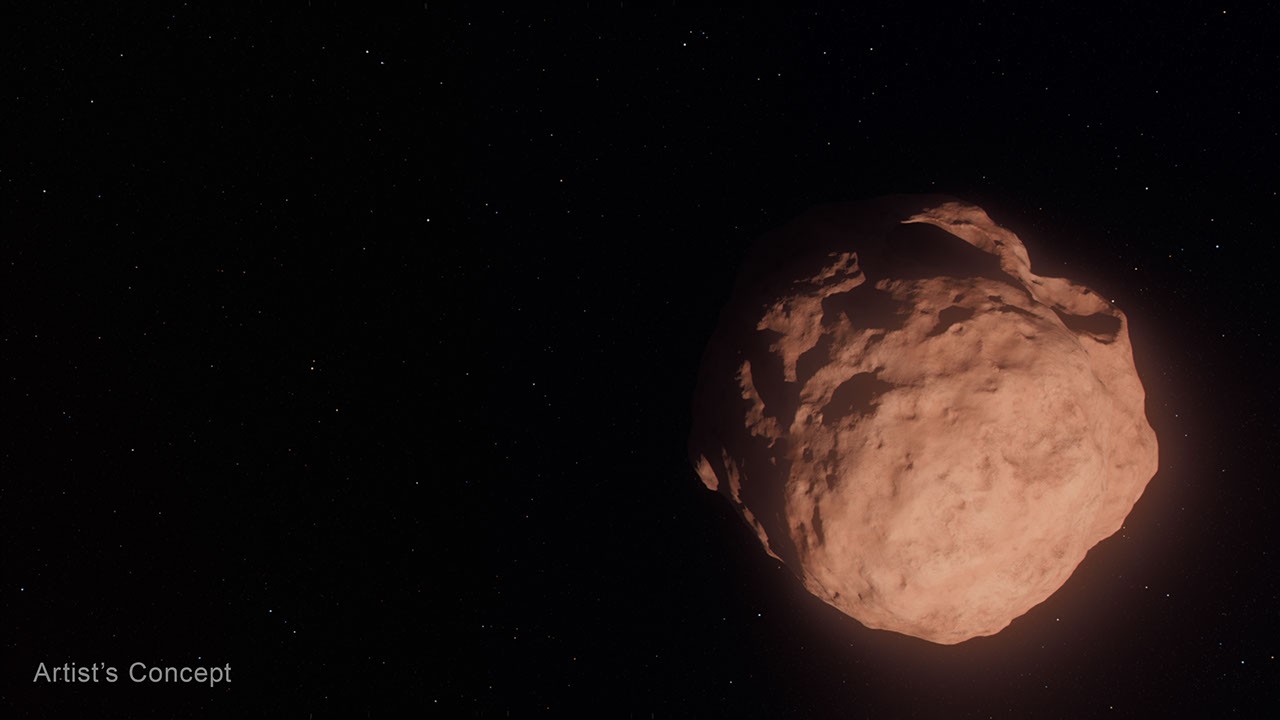
NASA artist’s concept of a trans-Neptunian object. Artwork: NASA, ESA, Leah Hustak (STScI). Used here as an illustration; the 27 new objects are not resolved in telescope images.
Can I see these trans-Neptunian objects from my backyard?
No—not these particular objects. They are a professional-observatory discovery, and no city’s sky conditions change that. That boundary is part of what makes the result so cool: Hubble and Webb are extending the solar system’s census into a regime that ground-based observing cannot yet reach.
You can still make outer-solar-system science part of a local observing night. Our guide to Saturn’s newly observed south-pole decagon is a useful companion for understanding what space telescopes can reveal beyond the reach of backyard optics. Then take a simple night-sky walk with people who enjoy asking the next question: connect with Austin stargazers or join the Cosmic Match community free.
What happens next?
The immediate result is a better census of small outer-solar-system bodies. The longer project is understanding why their abundance and colors look the way they do. More observations, dynamical modeling, and comparisons with other Kuiper Belt surveys will test whether the signal reflects how planetesimals originally formed, later collisions, or a combination of both.
For now, the clean takeaway is delightfully modest: 27 faint new worlds have made the solar system stranger in a measurable way. They do not overturn planet-formation science; they give it a more demanding puzzle to solve.