Saturn Has a New 10-Sided Wave—and It Is Not a Second Hexagon
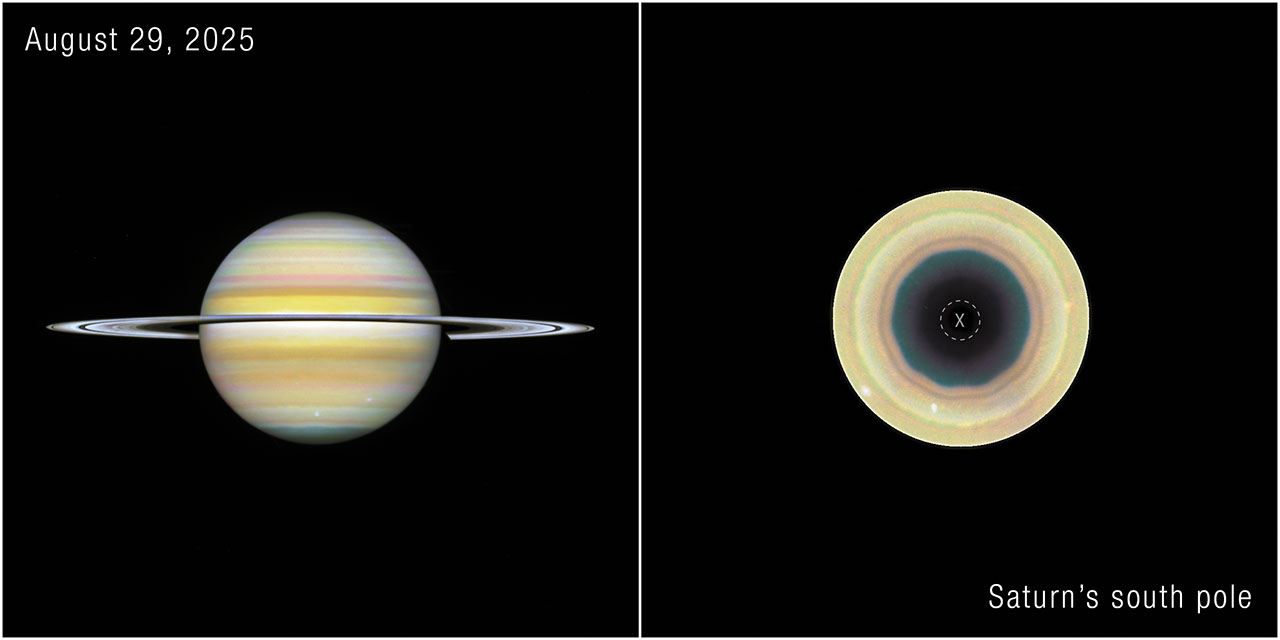
NASA’s Hubble Space Telescope has found a giant, evolving 10-sided wave around Saturn’s south pole—and it is not simply a southern copy of the planet’s famous northern hexagon. The new feature sits in a powerful jet stream near 63° south latitude, appears at more than one atmospheric altitude, and has strengthened in observations dating back to 2023. That makes it an unusually good chance to watch a planetary weather pattern take shape in real time.
The headline version is simple: Saturn now has another striking geometric-looking pattern. The scientific version is more interesting. Hubble’s data show a mobile, layered atmospheric wave, while the northern hexagon is a long-lived, nearly stationary pattern. The shapes rhyme; they are not interchangeable.
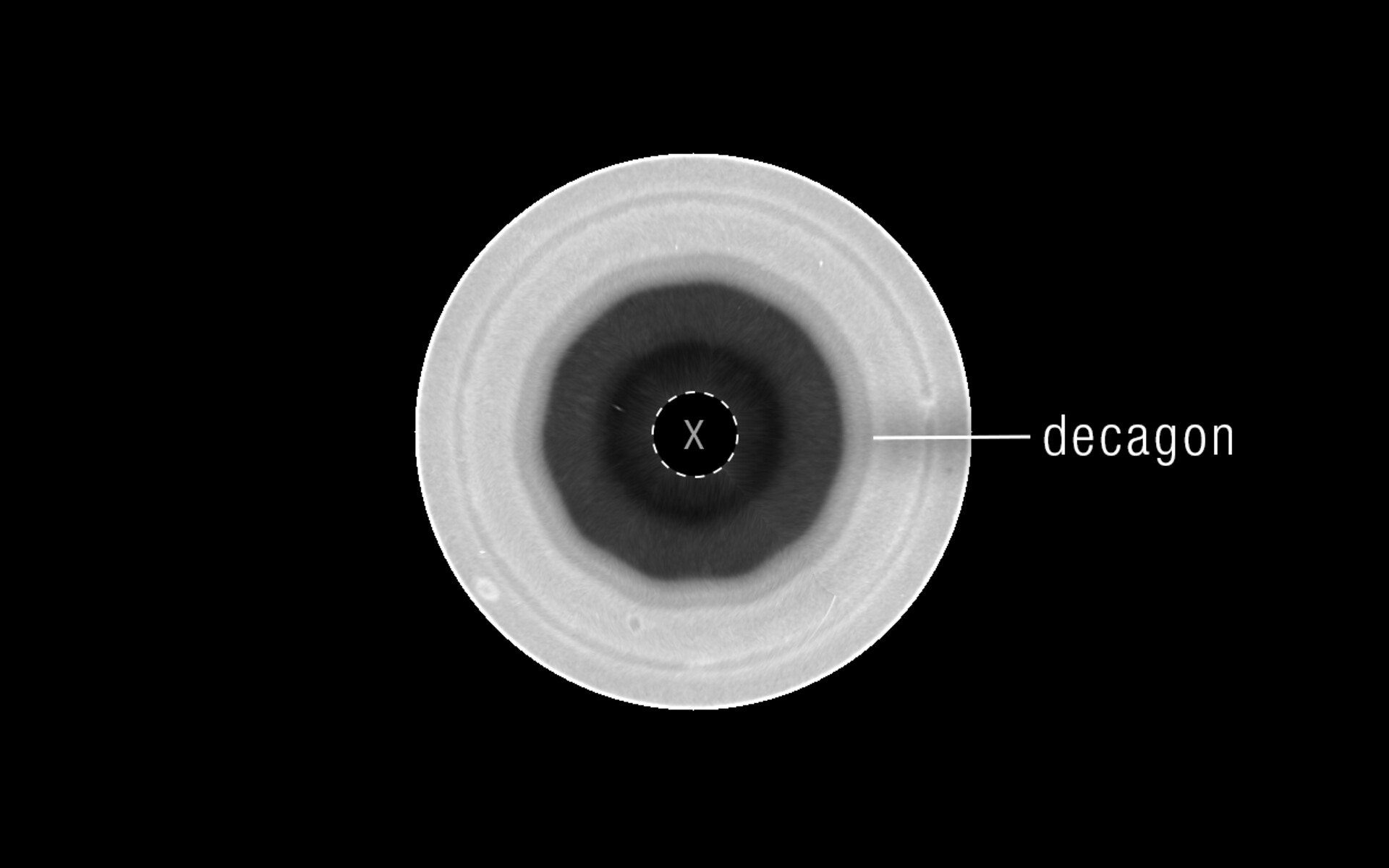
Image: NASA, ESA, STScI, A. Sánchez-Lavega (University of the Basque Country), A. Simon (NASA-GSFC), M. Wong (UC Berkeley); image processing: A. Pagan (STScI).
What did Hubble actually find at Saturn’s south pole?
Hubble observed a 10-sided atmospheric wave encircling Saturn’s south pole. ESA/Hubble places the feature’s center at about 63 degrees south latitude. It is embedded in a jet stream—the fast-moving band of atmosphere that helps organize weather on a giant planet.
Researchers stitched together annual observations from Hubble’s Outer Planet Atmospheres Legacy (OPAL) program. There are hints of the structure in 2023 data; ground-based observers noticed a subtle wavy band in 2024, and later imagery made the pattern clearer. Cassini, which orbited Saturn from 2004 to 2017, did not show evidence of a long-lived southern counterpart.
That timeline matters. “New” does not mean Hubble watched a decagon pop into existence on one afternoon. It means the available observations suggest the pattern has emerged and become more pronounced within the recent record. Scientists still need more monitoring to learn how it formed and how long it will last.
Is the south-pole decagon a second Saturn hexagon?
No. It is fair to compare the two features, but not to call them the same thing with different side counts. Saturn’s northern hexagon has been observed for more than 40 years and was already known from Voyager-era observations. Cassini showed it as a nearly stationary, pole-encircling planetary wave.
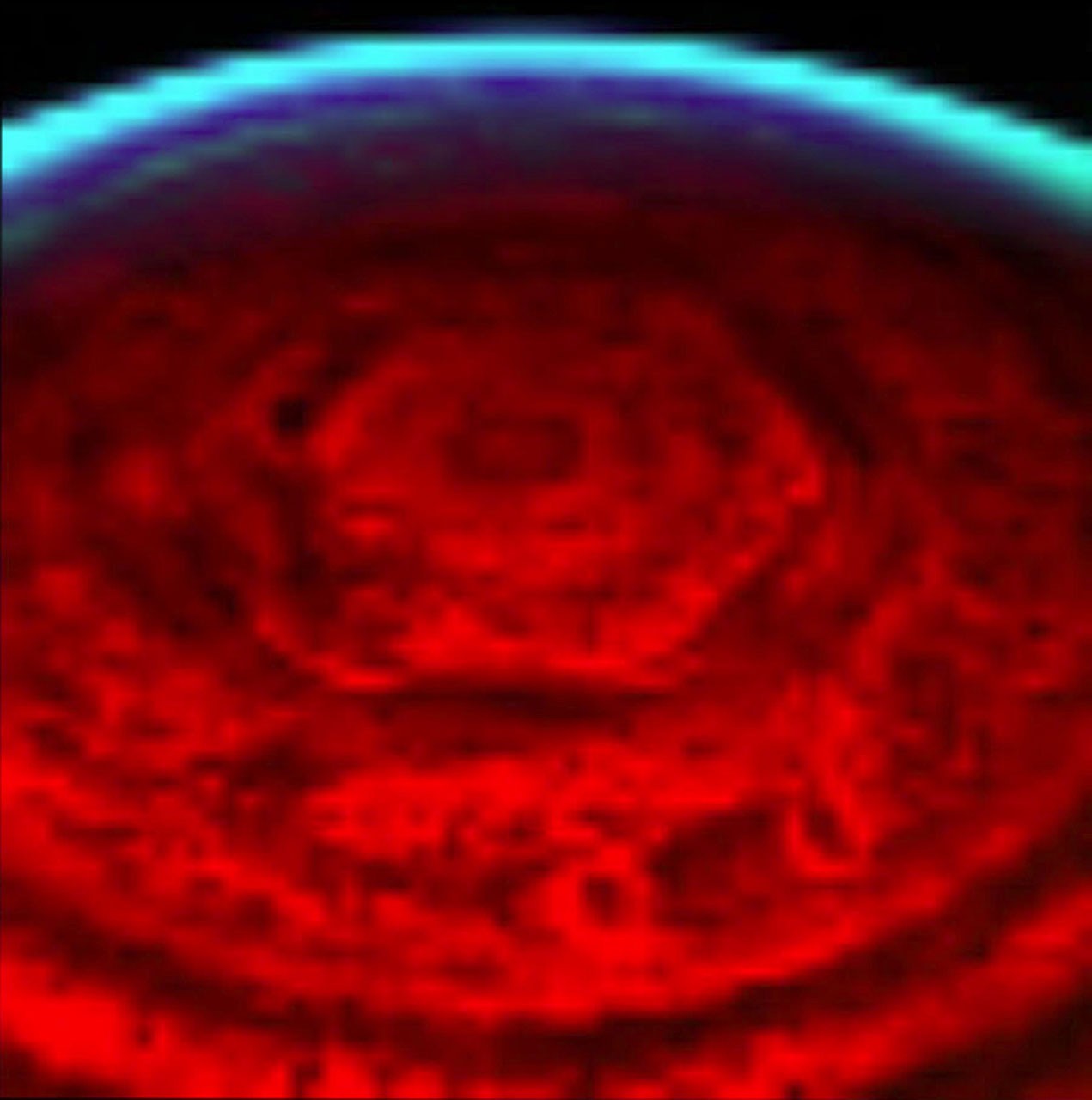
Image: NASA/JPL/University of Arizona. Cassini’s infrared view shows the long-known northern hexagon, included here for comparison.
The southern decagon, by contrast, looks mobile. Its apparent position shifts a little when Hubble observes at different wavelengths. That is not evidence that the sides are racing around the planet like a solid outline; those wavelengths sample different atmospheric altitudes. The shift tells researchers that the pattern extends vertically through multiple layers rather than living only in the visible cloud tops.
So the safest mental picture is not a rigid ten-sided fence around the pole. Think of a large-scale wave shaped and carried by a jet stream in a deep, layered atmosphere. Saturn’s clouds make that wave visible to Hubble in different ways at different wavelengths.
Why do different Hubble wavelengths matter?
A telescope image is not just a prettier photograph. Different filters let astronomers see light emerging from different levels of Saturn’s hazy atmosphere. When the decagon’s position looks slightly different across those views, it offers a clue about height and structure. NASA says the feature extends through multiple atmospheric layers.
That is also why this discovery is bigger than a wonderfully weird polygon. It gives atmospheric scientists a developing test case: why did this regular-sided wave appear now, how does it interact with the south-polar jet, and will it settle into something as durable as the north-polar hexagon? Hubble, Webb, and computer models can now follow those questions rather than infer everything from a single snapshot.
For a gentle way into planetary observing, our no-telescope skywatching field guide explains how to spot Saturn as a steady golden point beside the Harvest Moon later this month. You will not see the decagon from your backyard—but knowing that an entire weather system is turning above that tiny point makes the view richer.
Can I see Saturn’s decagon with a telescope?
Not visually. Even large amateur telescopes cannot resolve this south-polar atmospheric wave as a ten-sided feature from Earth. Saturn itself is a rewarding telescope target: its rings, major moons, and changing tilt are all within reach under good conditions. But the decagon is a result of professional imaging and analysis across time.
That distinction is an invitation, not a buzzkill. Bring the official Hubble image to a casual observing night, find Saturn together, and let the conversation travel from what your eyes can see to what a long-running space telescope can reveal. Join the Cosmic Match community free to meet people who are just as happy to trade sky notes as they are to look up.
What comes next for the decagon?
The honest answer is that nobody knows yet. The research team plans continued Hubble observations, potential Webb follow-up, and modeling work to test whether the wave becomes stable, changes form, or fades. That uncertainty is the story: planetary atmospheres are active systems, not static maps.
Sources
- NASA: Hubble Tracks New Decagon Encircling Saturn’s South Pole
- ESA/Hubble: Decagon on Saturn’s south pole (single-filter image)
- NASA Photojournal: Saturn’s Strange Hexagon (Cassini)
FAQ
Where is Saturn’s south-pole decagon?
The wave is centered around 63° south latitude, within a powerful southern jet stream. Hubble sees it around Saturn’s south pole, which has become more visible from Earth as Saturn’s seasons change.
Did Hubble discover a permanent 10-sided storm?
No. Hubble found a developing, multi-layer atmospheric wave that has become more pronounced since it was first evident in 2023 observations. Its formation mechanism and longevity remain open questions.
How is the decagon different from Saturn’s northern hexagon?
The northern hexagon is a long-lived, nearly stationary wave observed for decades. The newer southern feature has 10 sides, is still strengthening, and shifts in apparent position across Hubble’s wavelength views because those views probe different altitudes.
Can I see the decagon from Earth?
You can see Saturn with the unaided eye and enjoy its rings through a telescope, but resolving the south-polar decagon requires professional observations such as Hubble’s.