Sally Ride's First Flight: Why Her 1983 Mission Still Matters
On June 18, 1983, Space Shuttle Challenger lifted off on STS-7 and Sally Ride became the first American woman in space. That sentence is familiar enough to sound like a museum placard, but it still lands with real force because it changed what American spaceflight looked like in public. For women who love launch history, observatories, mission timelines, or simply the feeling of looking up and wanting in, Ride's first flight still feels close.
What makes the mission last is that STS-7 was not ceremonial. Ride launched as one of five crewmembers on a demanding six-day shuttle mission. She helped fly a real working flight that deployed two communications satellites, carried out experiments, and used the shuttle's robotic arm to deploy and later retrieve the Shuttle Pallet Satellite. Challenger landed on June 24, 1983, and the mission entered history as both a technical success and a cultural hinge point.
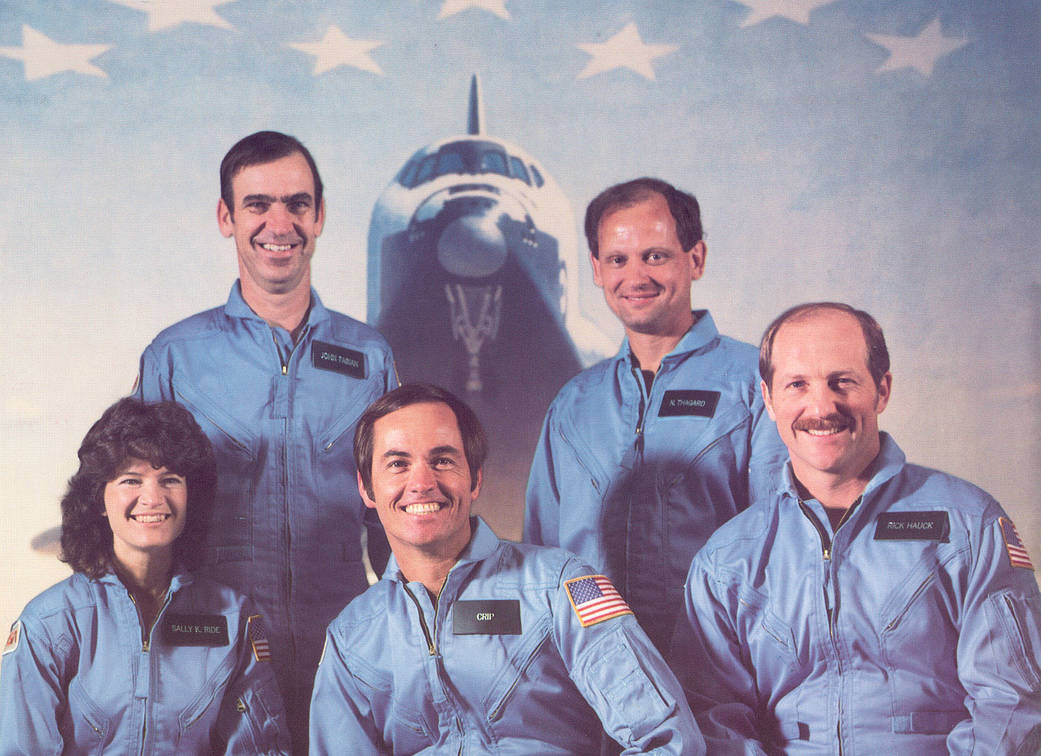 NASA. Sally Ride flew STS-7 with Commander Robert Crippen, Pilot Frederick Hauck, and Mission Specialists John Fabian and Norman Thagard.
STS-7 was a real working flight, not a symbolic first
It is easy, decades later, to flatten Sally Ride's story into a single line about being first. NASA's own mission summary makes clear that STS-7 was bigger than that. The crew aboard Challenger completed the shuttle program's first five-person mission, flew for 6 days, 2 hours, 23 minutes, and 59 seconds, and handled one of the more complex shuttle flights to that point.
Ride's role mattered inside that workload. Before the mission, NASA had already used her as CAPCOM for earlier shuttle flights and trained her deeply on the remote manipulator system, the shuttle's robotic arm. On STS-7, that background showed. She used the arm to deploy the Shuttle Pallet Satellite and bring it back, a milestone that proved the shuttle could do more than launch payloads and wave goodbye. It could work with hardware in orbit and return it.
That detail is worth sitting with because it keeps the story honest. Ride was not aboard Challenger so NASA could stage a headline and move on. She was there because she was qualified for the job and because the job itself mattered.
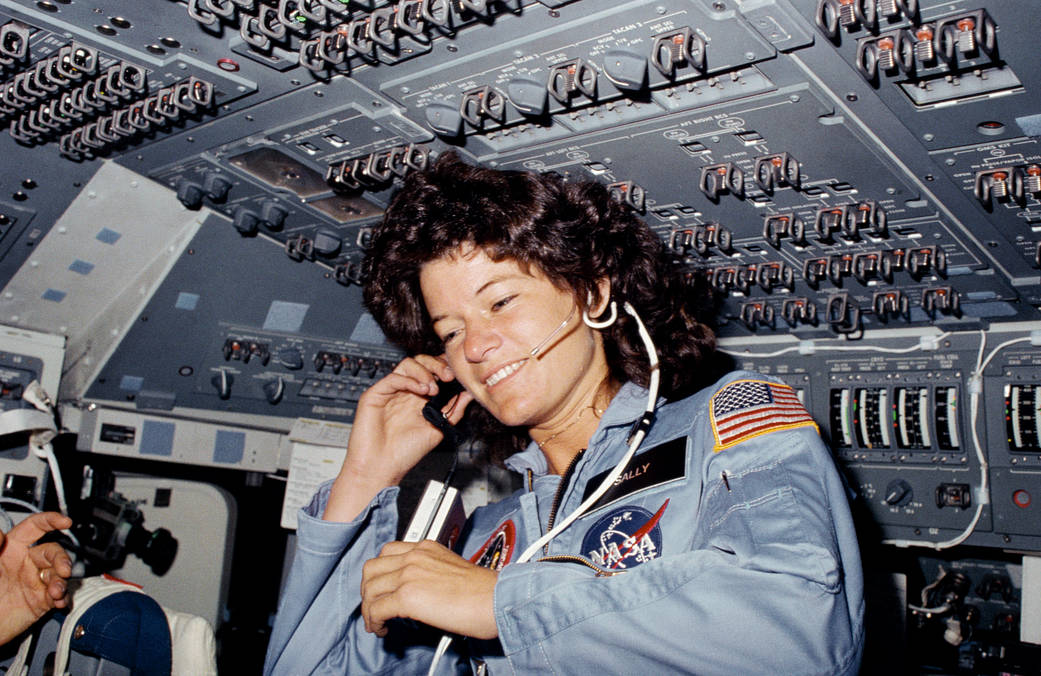 NASA. Ride on Challenger's flight deck during STS-7, the mission that made her the first American woman in space.
Her launch changed who looked imaginable in space
NASA's 1978 astronaut class was the first American selection class to include women. That fact matters almost as much as the launch itself. The shuttle era widened the astronaut pipeline beyond test pilots alone and created room for scientists and engineers with different backgrounds. Ride, a physicist from Los Angeles who earned a doctorate at Stanford, arrived in NASA at exactly that turning point.
That is part of why her June 1983 flight still resonates. It did not just add one more biography to a wall. It changed the public picture of who could belong in human spaceflight. For girls and women watching from classrooms, living rooms, libraries, and planetariums, the change was visible all at once. The person on the mission patch did not have to fit the old script.
The cultural effect also outlived the launch day. Ride later flew again on STS-41G, served on both shuttle accident investigation boards, and went on to build Sally Ride Science so more girls and young women could see science as a place they belonged. The through-line is clear: first she crossed the barrier, then she spent years widening the doorway.
Why that still matters for women who love space now
Not every woman who feels something when she reads about Sally Ride wants to become an astronaut. Plenty want something more immediate and ordinary, but no less meaningful. They want to ask better questions at a planetarium event. They want to show up at a public star party without feeling like the least technical person there. They want friends who understand why a crew announcement, a docking test, or a shuttle anniversary can make a whole week more interesting.
That is where Ride's legacy still feels current. She helped make space enthusiasm more socially legible for women. She made it easier to imagine yourself not at the edge of the conversation, but inside it.
You can see that long arc in the way modern crew stories land. When NASA names astronauts now, the public conversation includes a wider range of readers and fans than it once did. If you want a present-day example, our breakdown of the Artemis III crew announcement shows how much attention still gathers around who gets to represent the next chapter of human spaceflight. For a current mission where the drama is less about ceremony and more about keeping a spacecraft alive, our Swift Boost rescue explainer walks through why NASA is trying to save the observatory instead of replacing it early.
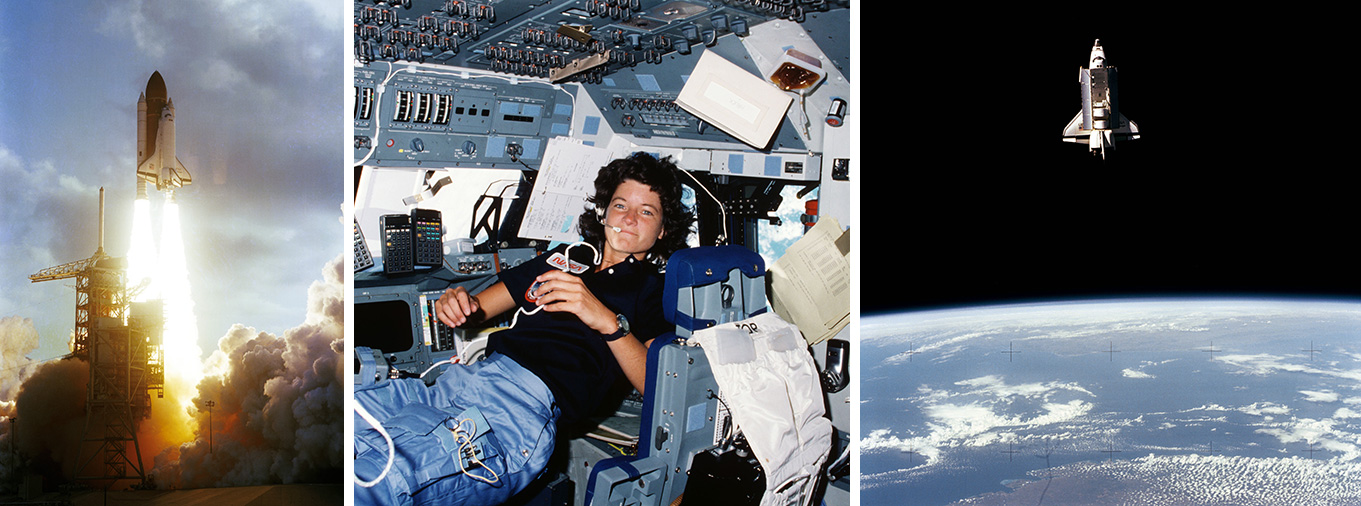 NASA. STS-7 remains one of the clearest visual milestones in American human spaceflight history.
A better way to mark the Sally Ride anniversary
A lot of anniversary content turns famous people into inspiration wallpaper. Sally Ride deserves better than that. The most useful way to mark her first flight is to let it change what you do next.
Start small. Read the crew list. Watch the STS-7 launch sequence. Notice that Ride's story sits inside a team story and a mission story, not outside of them. Then turn that interest outward. Go to a local observing event, message the friend who always sends you eclipse reminders, or make plans for your next planetarium night.
If you want people who already speak this language, you can join the astronomy community at Cosmic Match or sign up free at Cosmic Match. The point is not to perform expertise. It is to spend more time around people who think space is worth talking about.
That feels especially fitting for Sally Ride's legacy. Her first flight mattered because it changed the picture. What we do with that picture now is build more places where women who love space feel expected, welcome, and fully part of the scene.
If you want a Los Angeles-area space-history outing that turns this kind of inspiration into an actual plan, our Mount Wilson 100-inch telescope day trip guide shows how to spend a day inside one of the observatory sites that helped shape modern astronomy.
The takeaway
Sally Ride's first flight still matters because it was never only about being first. It was about competence under scrutiny, representation backed by real work, and the widening of public space culture in the United States. STS-7 showed that history can move forward through a single mission and then keep echoing through classrooms, observatories, crew announcements, and everyday conversations for decades.
For women who love space now, that echo is not abstract. It is the reason the story still feels personal.
For a Houston-area outing that turns this history into a practical day among rockets and mission exhibits, use our Space Center Houston first-timer guide.