What Is CAPSTONE 02? NASA’s Lunar Rendezvous Test, Explained
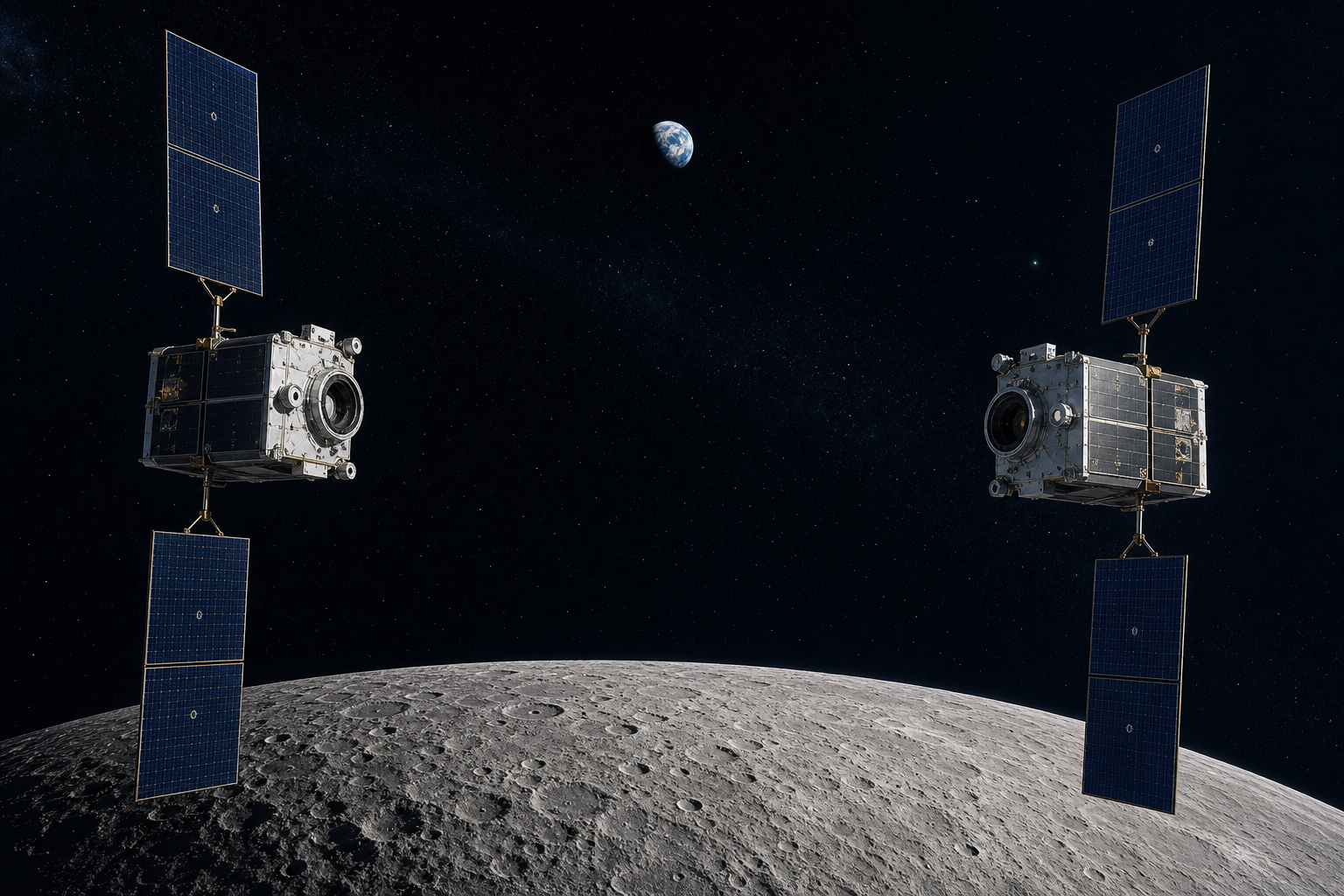
NASA has selected a follow-on mission called CAPSTONE 02 to rehearse a deceptively difficult move near the Moon: bringing two spacecraft together safely when Earth and lunar gravity are both tugging at them. It is targeted for launch in 2027—not a night-sky event or a launch you should plan around yet—but it is a useful preview of the invisible precision future Moon missions will need.
The short version: CAPSTONE 02 will fly two matching spacecraft, each about 400 kilograms (882 pounds), in lunar orbit. They will take turns acting as the spacecraft that approaches and the one being approached, while testing autonomous navigation, rendezvous, close operations, and formation flying. NASA says those demonstrations will help build confidence for future crewed transfers between a vehicle in cislunar space and a lunar lander.

First: this is not the original CAPSTONE mission repeated
The original CAPSTONE—short for Cislunar Autonomous Positioning System Technology Operations and Navigation Experiment—was a much smaller, single-spacecraft demonstration. It validated communications, networking, and autonomous-navigation capabilities in a near-rectilinear halo orbit, a looping path shaped by the combined gravity of Earth and the Moon.
CAPSTONE 02 keeps the learn-by-flying spirit, but changes the question. Instead of asking whether one spacecraft can operate in that unusual lunar neighborhood, it asks whether two spacecraft can find, approach, and work around each other there. That matters because future lunar exploration will involve more than one vehicle: crew vehicles, landers, logistics craft, communications assets, and eventually services that keep them operating.
What does rendezvous mean here?
In spaceflight, rendezvous is not a dramatic collision course. It is a sequence of carefully planned changes in speed and position that lets one spacecraft meet another in the same region of space. Proximity operations means working at relatively close range once they are there. Loitering, in this mission’s context, means formation flying: holding a useful relative position for a period of time.
That is hard near the Moon because the environment is not like a simple circular track around Earth. The two spacecraft will move in three-body orbits, where Earth’s and the Moon’s gravity both matter. A maneuver that looks intuitive on a flat diagram can have a very different result after the gravitational picture changes along the orbit.
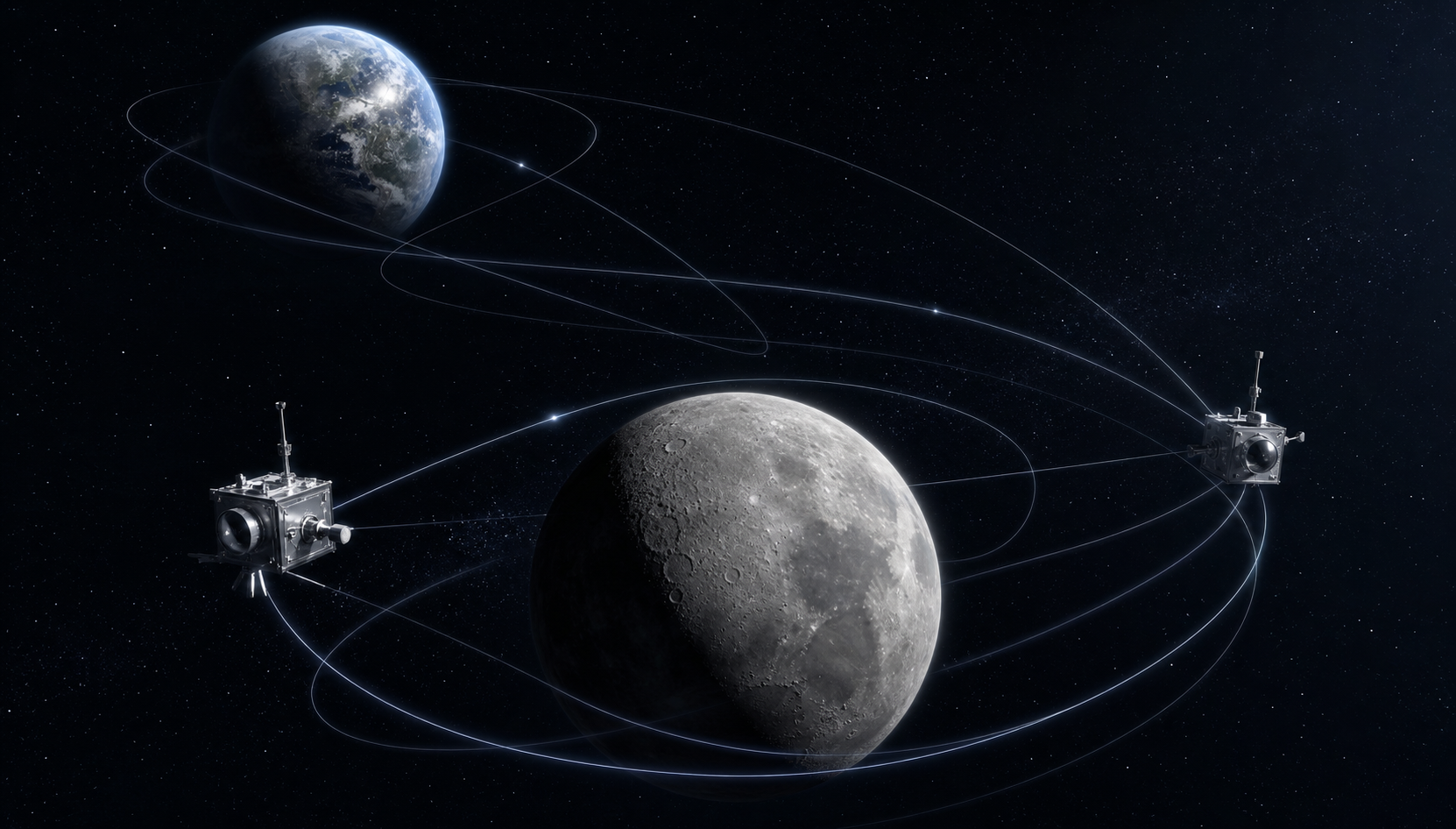
NASA says CAPSTONE 02 will combine ground tracking, optical sensors, and celestial bodies to help one spacecraft locate and rendezvous with the other. It will also carry an optical imaging payload from Lawrence Livermore National Laboratory to support navigation and capture Moon imagery. The agency plans to test three NASA-developed navigation software suites during the mission’s low-energy transfer from Earth to beyond the Moon and then into lunar orbit.
Why use two identical spacecraft?
The twin design is the point, not a spare. Each vehicle can switch between the chaser role—the one doing the approach—and the target role—the one being approached. That lets operators test a wider set of conditions and compare how the systems behave.
Think of it as practicing both sides of a careful handoff. A future crew vehicle approaching a lunar lander will need dependable knowledge of where the other vehicle is and how its own path is changing. NASA says CAPSTONE 02 will apply strategies similar to those planned for Orion’s approach to a lunar lander in deep space. It cannot fully recreate those conditions on Earth, so the rehearsal has to happen in space.
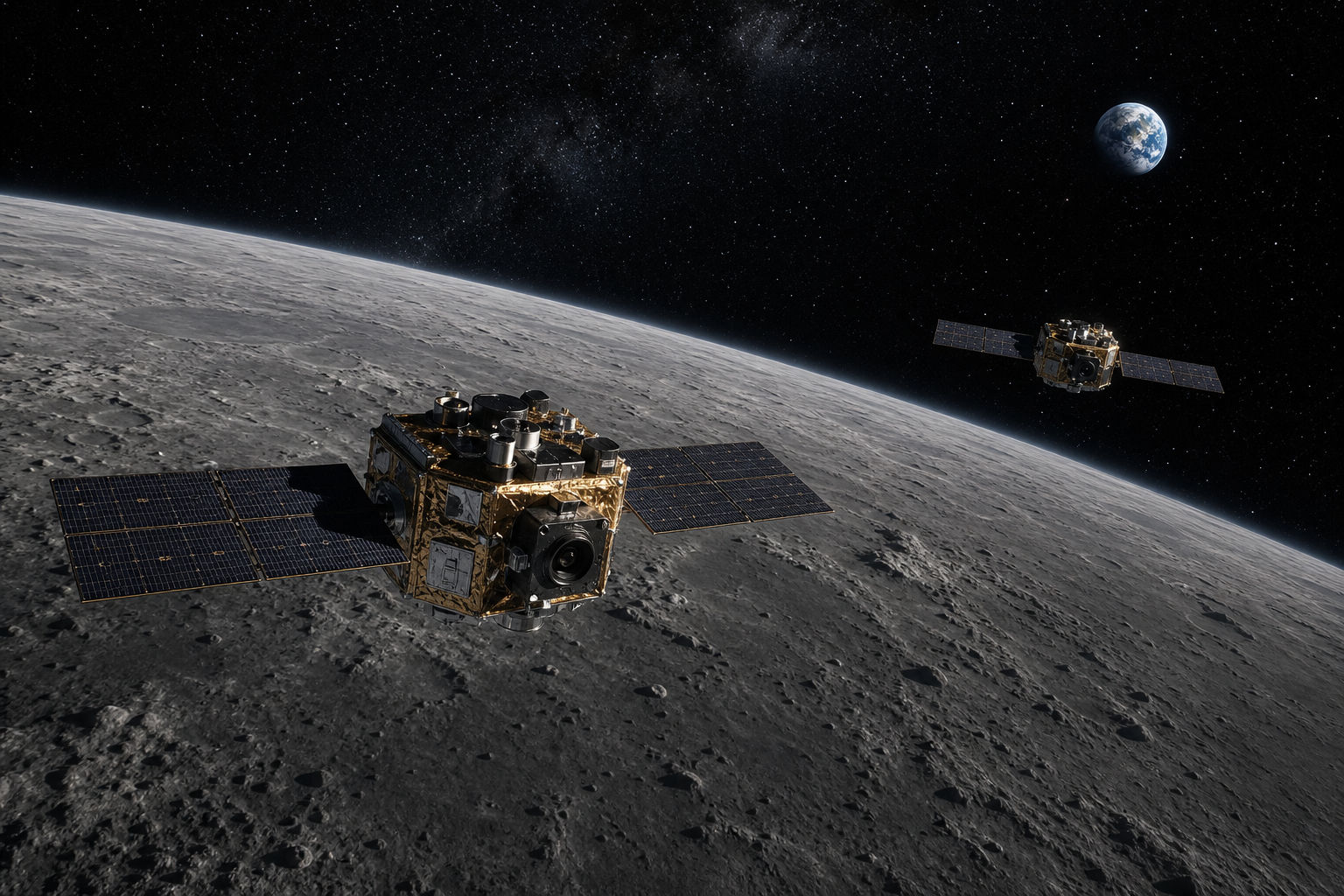
Advanced Space is developing the mission under a NASA contract. Terran Orbital Systems is providing the two spacecraft; Advanced Space says Terran Orbital will also provide mission operations and launch-integration services. The companies describe CAPSTONE 02 as planned to be ready to launch in 2027. No exact launch date, launch provider, launch site, or public local-viewing plan has been announced, so treat more specific claims as speculation.
Why it matters even if you never learn orbital mechanics
The Moon is becoming a place where several spacecraft may need to cooperate—not merely arrive. For people who follow Artemis, that makes CAPSTONE 02 a practical how-will-this-actually-work mission. Autonomy could reduce routine dependence on Earth-based tracking, while relative navigation and inter-spacecraft coordination could make future operations more flexible.
It is also a reminder that the most consequential space tests are not always the loud ones. There may be no spectacle to watch from your backyard, but a pair of small spacecraft carefully measuring their relationship to each other could retire risks that matter for later human lunar missions.
If that makes you want to trade space news with people who will happily entertain a question about three-body orbits, join the Cosmic Match space community. For a more immediate way to share lunar wonder, start with our McDonald Observatory road-trip guide from Austin.
The takeaway
CAPSTONE 02 is a new two-spacecraft lunar demonstration, not a redo of the original CAPSTONE. Its twin roughly 400 kg spacecraft will test rendezvous, proximity operations, role-swapping, formation flying, autonomous navigation, and cislunar communications in the complex Earth-Moon environment. NASA is targeting 2027. The mission’s value is not a promised launch spectacle; it is the flight-tested know-how that future lunar vehicles may use when they need to meet safely far from home.