Did Astronomers Find the First Exomoon—or Something Stranger?
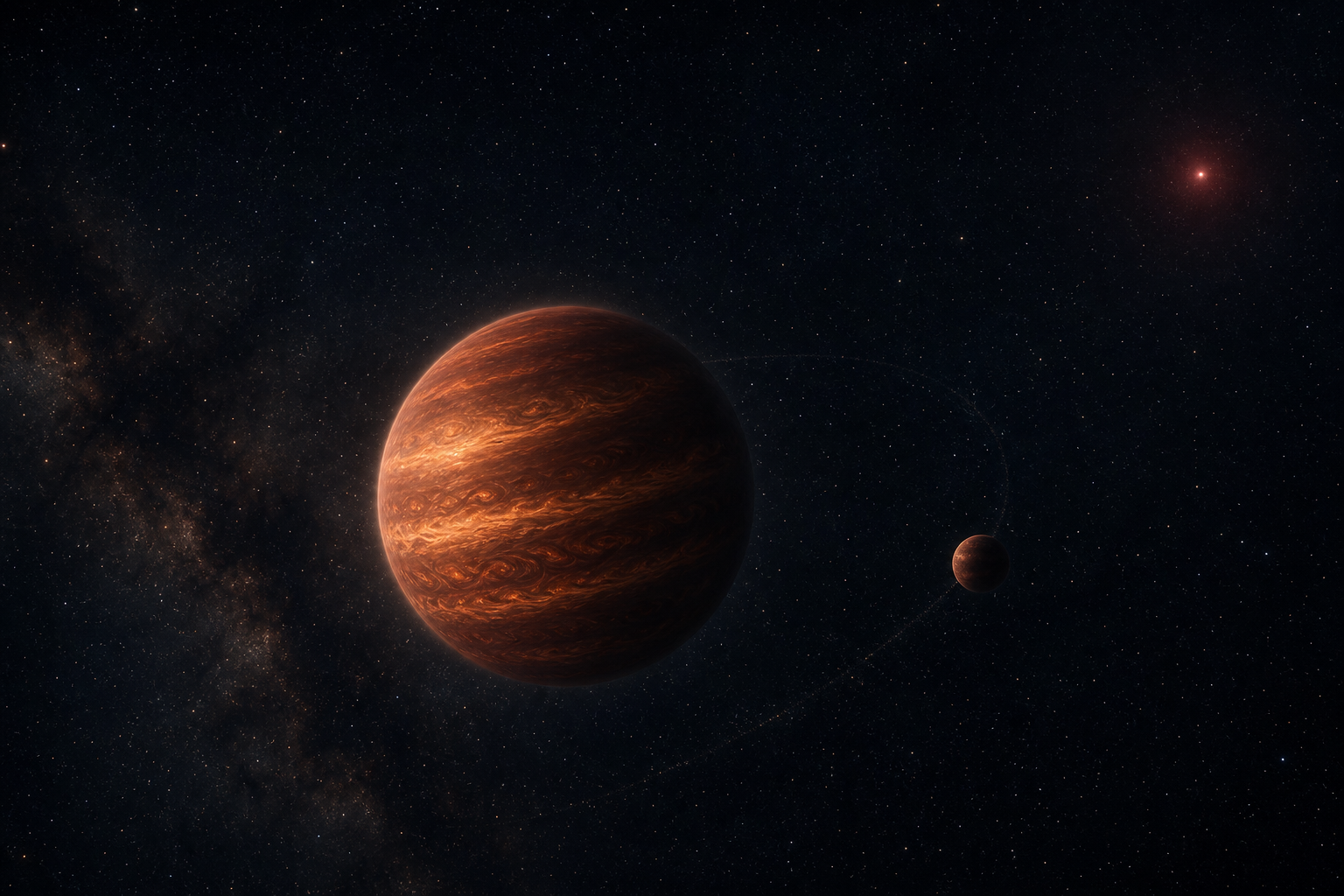
A distant brown dwarf may be wobbling to the pull of a companion nearly as massive as Jupiter—and astronomers are being careful about what to call it.
A paper published July 22 reports evidence for a satellite orbiting CD-35 2722 B, a directly imaged brown-dwarf companion to a young star. If the signal holds up, it would be the clearest radial-velocity evidence yet for a satellite outside our Solar System. But it is not a confirmed exomoon, and its proposed mass makes the word “moon” surprisingly slippery.
The most defensible name right now is the one the researchers use: a planetary-mass exosatellite. It describes what the candidate appears to do—orbit a substellar companion—without pretending the classification debate has already been settled.

What the team found
CD-35 2722 B is not a planet like Jupiter circling its star on a familiar path. It is a brown dwarf: an object more massive than a planet but too light to sustain the hydrogen fusion that powers ordinary stars. It orbits the young M-dwarf star CD-35 2722 at a wide separation, which lets astronomers study its light directly.
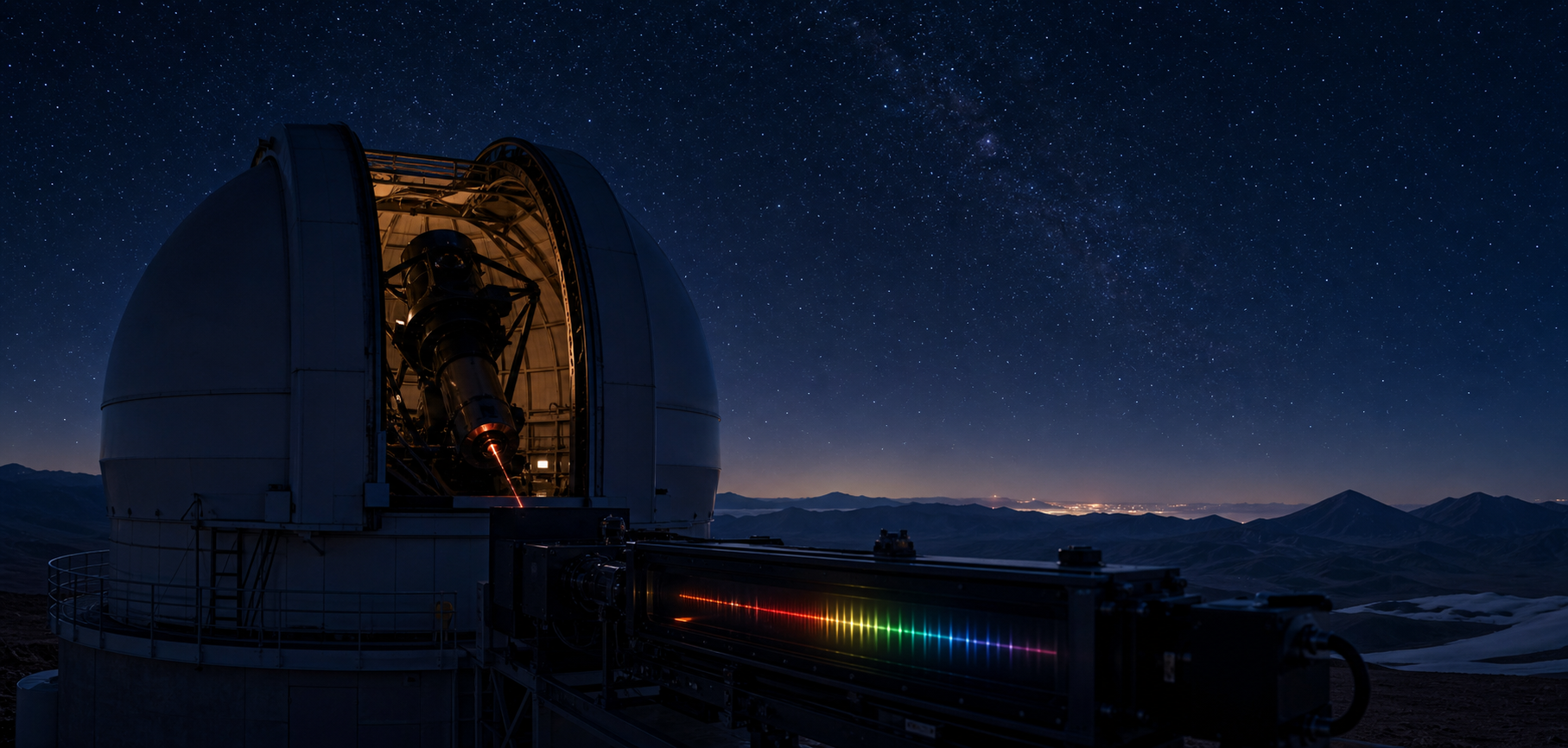
Using the CRIRES+ infrared spectrograph on ESO’s Very Large Telescope, the team repeatedly measured tiny shifts in the brown dwarf’s spectrum. Those shifts are a version of the same radial-velocity technique used to find many exoplanets: as an unseen companion tugs on an object, the object moves slightly toward and away from us. Its spectral lines shift by a minuscule amount in response.
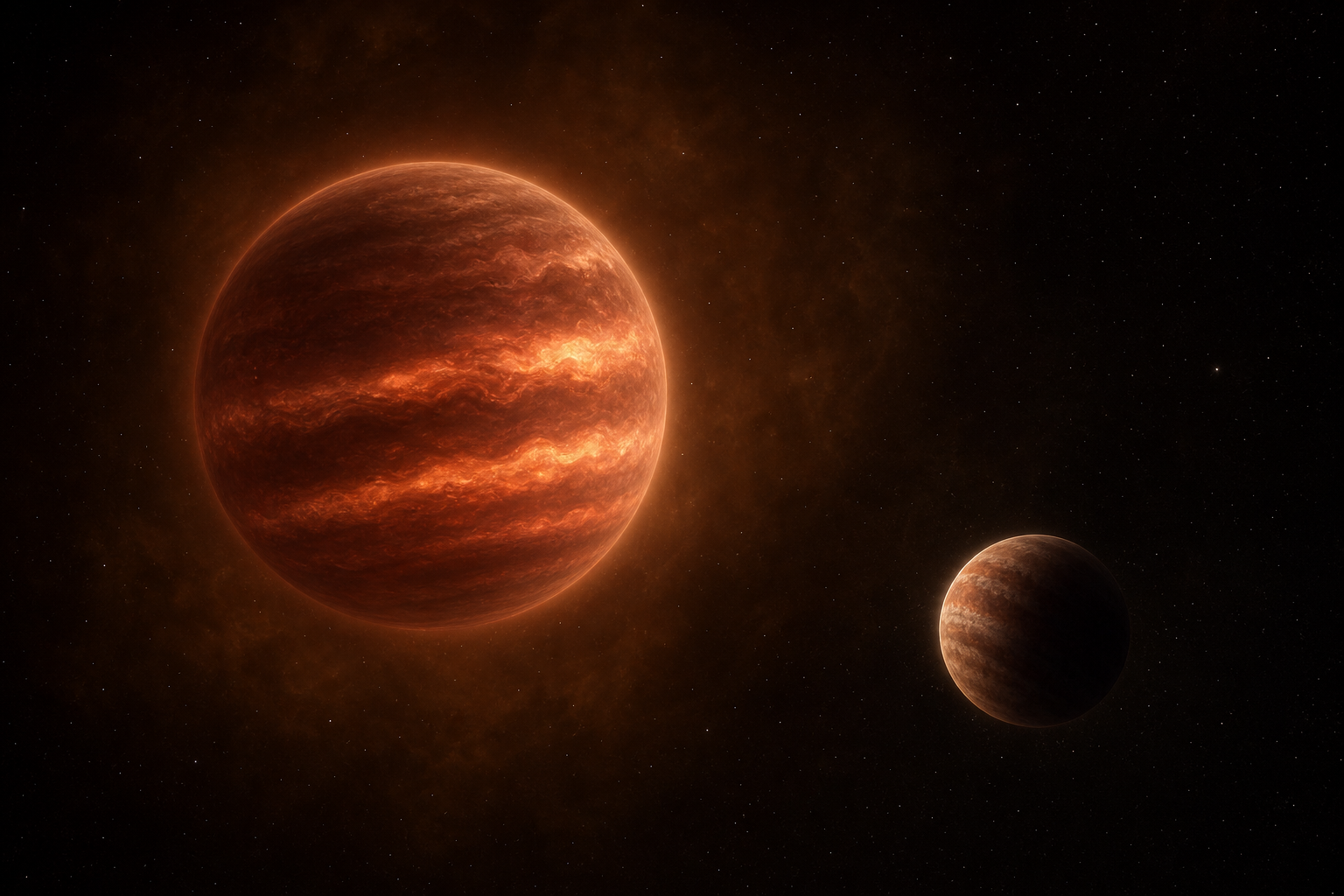
The reported periodic signal fits a companion with a minimum mass of about 0.9 Jupiter masses and an orbit of roughly 170 days. “Minimum” matters. Radial velocity reveals the pull along our line of sight, so the true mass could be higher depending on the orbit’s tilt.
Why “first exomoon” is too strong
No exomoon has been confidently confirmed so far. There have been intriguing candidates, but none has cleared the high bar of independent confirmation and broad scientific agreement. This new result is exciting because it uses a fresh route: measuring the motion of a directly imaged brown dwarf instead of looking for the delicate transit effects of a moon passing in front of a star.
Yet two uncertainties keep the headline from becoming “first exomoon discovered.”
First, the signal itself needs follow-up observations. A periodic radial-velocity pattern can be powerful evidence, but astronomical detections earn confidence through additional measurements, alternative analyses, and time. The Nature paper presents evidence for a best-fitting satellite model; it does not declare an uncontroversial, final detection.
Second, the proposed companion is big—at least roughly Jupiter mass—and it orbits a brown dwarf rather than a conventional planet. The terms moon and exomoon have no universally agreed formal boundary for a satellite of a brown dwarf. That is why “exosatellite” is useful here: it says something important and true about the orbit without smuggling in a classification verdict.
Why this is still a big deal
The result could expand the way astronomers look for worlds within worlds. Most searches for exomoons have focused on transits, where a moon’s presence might add a faint extra dip or nudge the timing of a planet’s transit. That work is extremely difficult: the signals are small, stars are active, and a single interpretation can be hard to prove.
Directly imaged, self-luminous companions open another possibility. A brown dwarf is bright enough in infrared light that high-resolution spectroscopy can track its motion. If a satellite is sufficiently massive and the data are precise enough, the satellite’s pull may emerge as a repeatable wobble.
This does not mean every brown dwarf will reveal a moon-like companion, or that the candidate is a place we will photograph in detail next year. It does mean astronomers now have a promising observational technique to test on more systems—and perhaps on less massive targets as instruments improve.
For a useful contrast in how astronomers extract evidence from distant systems, see our explainer on what an exoplanet helium signal can—and cannot—tell us.
Can you see CD-35 2722 B from Austin, Houston, or Los Angeles?
No. This is not an amateur-observing event, and there is no telescope target or skywatching moment to catch from Austin, Houston, or Los Angeles. The candidate was inferred from repeated, high-resolution infrared observations with a major professional observatory. That distance from the eyepiece is part of the wonder: careful measurements of a tiny spectral wobble can reveal a possible companion in a system far beyond anything visible in a backyard telescope.
The best way to make a news story like this more fun is to share the question it raises: when does a satellite become planet-like enough to deserve a different name? Bring it to your next observing night, or meet other curious skywatchers through Cosmic Match. If you are building your own local astronomy circle, Cosmic Match is a home for the conversations before and after you look up.
What happens next
The right response to this result is not “case closed.” It is “watch this space.” More infrared radial-velocity measurements can test whether the roughly 170-day rhythm persists. Independent teams can probe how robustly the data favor a satellite over other explanations. And the community will keep debating the taxonomy—especially because a candidate near Jupiter’s mass orbiting a brown dwarf stretches the everyday meaning of moon.
For now, CD-35 2722 B offers something rarer and more interesting than a simple superlative: a strong candidate, a new detection pathway, and a reminder that nature does not always arrange itself around our neatest labels.