Webb Has Measured the Farthest Localized Fast Radio Burst—and Its Tiny Host Is a Clue
Webb Has Measured the Farthest Localized Fast Radio Burst—And Its Tiny Host Is a Clue
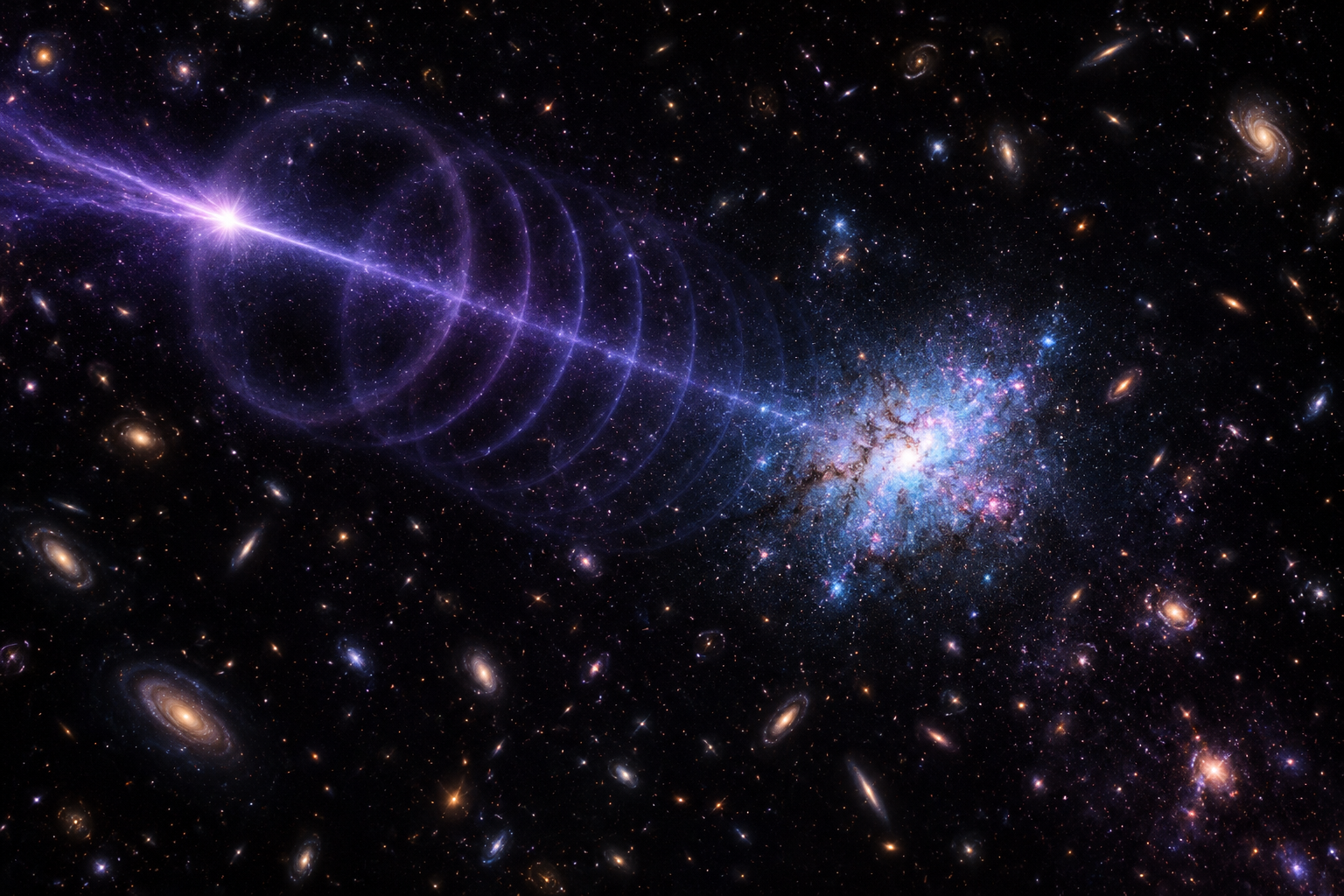
A millisecond flash of radio waves that reached Earth from the universe’s first 3 billion years now has an address. FRB 20240304B is the farthest localized fast radio burst reported so far, at a measured redshift of 2.148—and its host is a small, intensely star-forming dwarf galaxy that Webb could see where ground-based observatories could not.
There is an important division of labor in this result. The MeerTRAP project using South Africa’s MeerKAT radio telescope detected the burst on March 4, 2024 and localized its position. NASA’s James Webb Space Telescope did not detect the radio burst itself. Webb then detected the faint host galaxy at that known position and used its infrared instruments to measure the distance. That combination is why this is such a powerful result.

What is a fast radio burst, and why does this one matter?
Fast radio bursts, or FRBs, are extraordinarily brief flashes of radio emission from beyond the Milky Way. They last milliseconds, but their signals can cross billions of light-years. Astronomers still do not know what produces every FRB. A few sources repeat; many have been seen only once.
FRB 20240304B matters because its confirmed host puts it far deeper into cosmic history than previous localized examples. Webb’s NIRSpec measured a redshift of 2.148, which means we are seeing the host as it was roughly 3 billion years after the Big Bang, during the era astronomers call cosmic noon—when galaxies were forming stars at a furious rate.
That is discovery news, not an observing alert: there is no target to spot from Austin, Houston, or Los Angeles tonight. But it is exactly the kind of cosmic detective story that makes following space science more fun with other curious people. If that sounds like your corner of the universe, join the Cosmic Match space community.
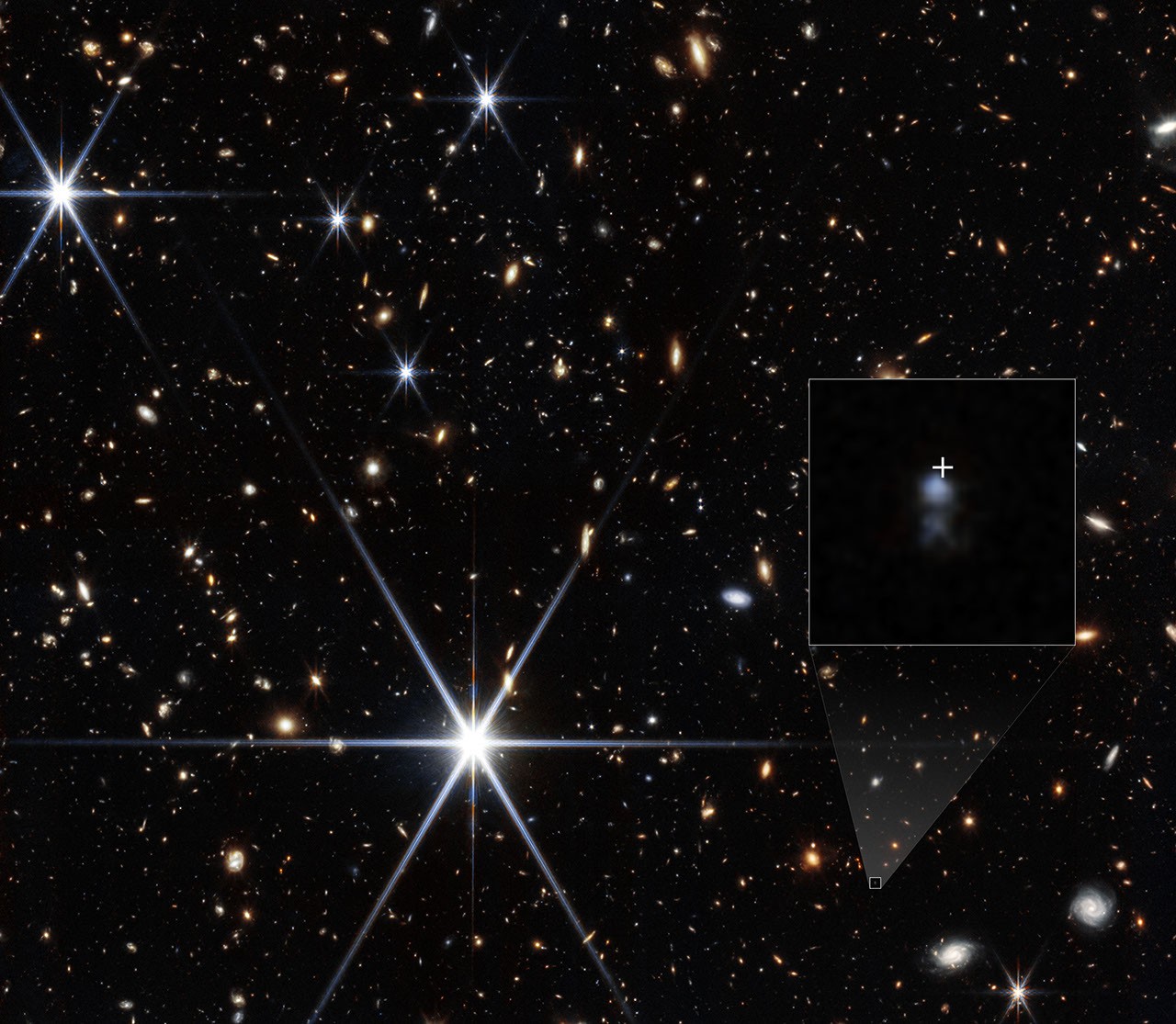
Webb’s NIRCam view of the FRB 20240304B field. Image credit: NASA, ESA, CSA, STScI, Themiya Nanayakkara (USYD); image processing: Joseph DePasquale (STScI).
How did MeerKAT and Webb work together?
The sequence matters. MeerTRAP, an instrument running with the MeerKAT radio array, caught the flash and pinned down its position accurately enough to search for a host. Radio data hinted that it was exceptionally distant. Yet even the largest ground-based telescopes could not see a galaxy at that location.
Webb’s infrared sensitivity changed the picture. Its NIRCam instrument identified a faint galaxy in the radio-localized position. NIRSpec then split the galaxy’s light into a spectrum, allowing the team to measure the redshift rather than rely on an estimate from the burst alone. The peer-reviewed study, “A fast radio burst from the first 3 billion years of the Universe,” appears in Science (DOI: 10.1126/science.adz2675).
This is a useful reminder that “localized” does not mean one telescope did every job. MeerKAT supplied the radio event and location; Webb revealed the nearly invisible galaxy and its distance. Together, they turned a mysterious flash into an event with a cosmic address.
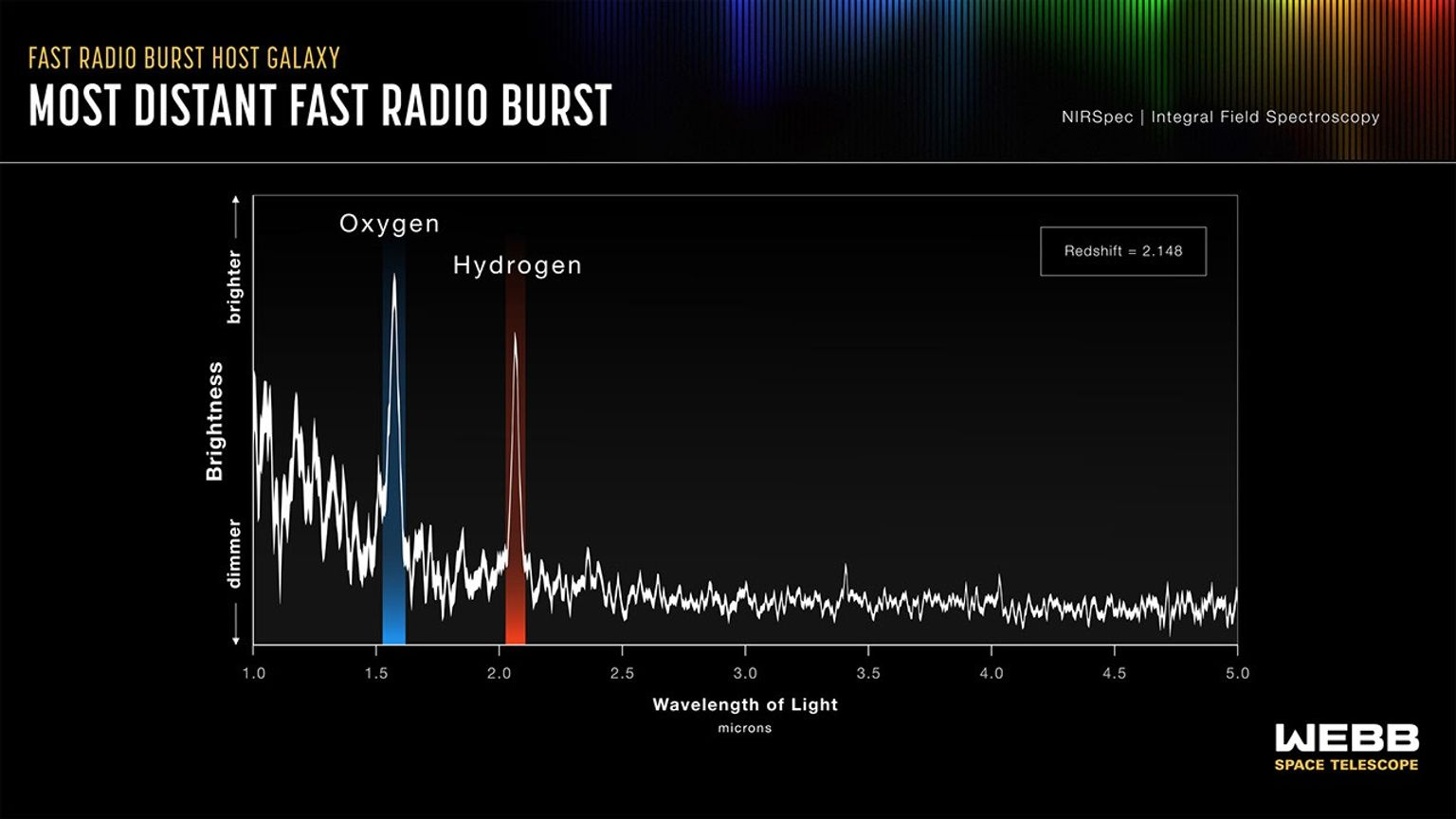
Webb spectroscopy confirms the host’s redshift. Illustration credit: NASA, ESA, CSA, Joseph Olmsted (STScI); science: Manisha Caleb (SIfA).
Why is the host galaxy such a surprise?
The host is not the large, mature galaxy researchers expected. NASA reports that it is a compact dwarf galaxy actively forming stars and about 1,000 times less massive than expected for a typical known FRB host. Its star-formation history suggests most of its stars may have formed within about 30 million years.
That youth matters for the origin question. A merger of two neutron stars can make a powerful transient, but the orbital dance before a merger is generally expected to take billions of years. A young, highly magnetized neutron star—a magnetar—can arise much more quickly after a massive star explodes. The young host therefore favors a young progenitor such as a magnetar for this particular event. It does not prove that magnetars make all FRBs, nor does it close the case on their wider origins.
The burst also carried information about the space between galaxies. According to the NASA Webb release, the signal shows the imprint of two intervening structures: a previously unknown galaxy cluster at redshift 0.3 and the nearby Virgo Cluster. In that sense, an FRB acts a bit like a flashbulb behind cosmic fog: its altered signal can help trace otherwise hard-to-see matter along the way.
What comes next for faraway radio bursts?
MeerKAT may be able to detect and localize several FRBs each year at redshifts above 1, while Webb can characterize the hosts that ordinary optical searches miss. More precisely placed bursts will let researchers test whether young dwarf hosts are rare outliers or an important part of the FRB population.
It is also a great prompt for a community conversation: what part of this discovery gets you—the split-second signal, the hidden dwarf galaxy, or the chance to map matter between galaxies? Bring that question to a local astronomy night or connect with people who share your space curiosity at Cosmic Match. For another example of astronomy becoming a new kind of cosmic messenger, read our guide to how IceCube turned Antarctic ice into a cosmic telescope.
FAQ
Did Webb detect FRB 20240304B directly?
No. MeerKAT/MeerTRAP detected and localized the radio burst. Webb detected the faint host galaxy at that position and measured its redshift with infrared observations.
How far away is FRB 20240304B?
Its host has a measured redshift of 2.148. The light we see left when the universe was about 3 billion years old, so the result reaches much farther back in cosmic time than most localized FRBs.
Does this prove fast radio bursts come from magnetars?
No. The unexpectedly young, star-forming host makes a young magnetar a stronger explanation for this particular burst than a long-delay neutron-star merger, but astronomers have not established a single origin for all FRBs.
Can I see this fast radio burst from Earth?
Not with a backyard telescope or binoculars. FRBs are radio events detected by specialized observatories; this is a story to follow as space science, not a visible sky event.