2026 Eclipse Livestream Watch Party: ESA + NASA for Austin, Houston, and Los Angeles
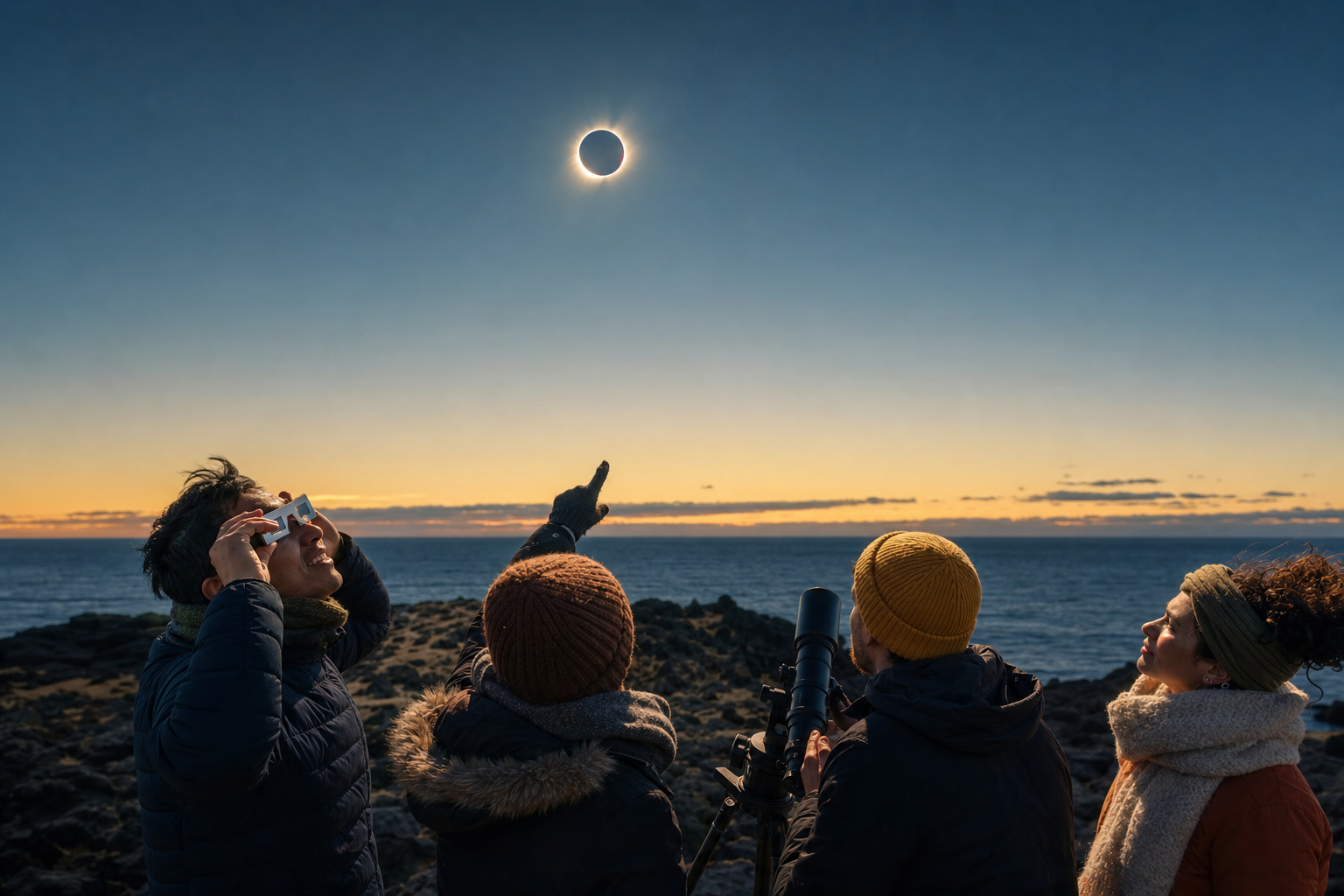
2026 Eclipse Livestream Watch Party: ESA + NASA for Austin, Houston, and Los Angeles
On Wednesday, August 12, 2026, Austin, Houston, and Los Angeles will not see this total solar eclipse in their own skies—but they can still share it in real time. The clearest plan is an indoor watch-along built around ESA’s English livestream from the Observatorio Astrofísico de Javalambre in Spain, scheduled for 12:30–1:45 p.m. CDT in Austin and Houston and 10:30–11:45 a.m. PDT in Los Angeles. NASA will also stream the eclipse separately, beginning at 1:15 p.m. EDT (12:15 p.m. CDT / 10:15 a.m. PDT).
First, the essential reality check: this eclipse is not locally visible from Austin, Houston, or Los Angeles. There will be no solar bite or sudden dimming there. That is exactly why a screen-based gathering—with good company, a map, and an accurate stream plan—is the right way to experience the event locally.

What is the best August 12, 2026 eclipse livestream for a watch party?
For a watch-along in these three cities, make ESA’s planned English broadcast the centerpiece. ESA says it will stream from the Observatorio Astrofísico de Javalambre in Teruel, Spain, on ESA Web TV and ESA’s YouTube live page. The broadcast is scheduled for 19:30–20:45 CEST, which converts to:
| City | ESA broadcast | Javalambre totality begins |
|---|---|---|
| Austin | 12:30–1:45 p.m. CDT | 1:31 p.m. CDT |
| Houston | 12:30–1:45 p.m. CDT | 1:31 p.m. CDT |
| Los Angeles | 10:30–11:45 a.m. PDT | 11:31 a.m. PDT |
At Javalambre, ESA lists totality at 20:31 CEST, lasting 1 minute 21 seconds. The production combines the Javalambre telescope feed with coverage from León and Frómista; it is one English-language ESA broadcast, not three separate feeds.
ESA Web TV’s scheduled listing is the best day-of destination, so have the official ESA Web TV stream page open before guests arrive. The linked YouTube live page is a useful backup if you prefer watching there.
Is NASA Live covering the August 12 eclipse too?
Yes. NASA’s current 2026 total solar eclipse page says NASA Live starts at 1:15 p.m. EDT—12:15 p.m. CDT in Austin and Houston, and 10:15 a.m. PDT in Los Angeles. That is a separate NASA stream, not the same production as ESA’s Javalambre broadcast.
For a simple group plan, start with NASA if your guests are ready early, then switch to ESA by 12:30 p.m. CDT / 10:30 a.m. PDT. Or choose one stream and let the conversation, rather than channel-hopping, lead the day. Confirm both pages again on August 12 in case either organization makes a final programming change.
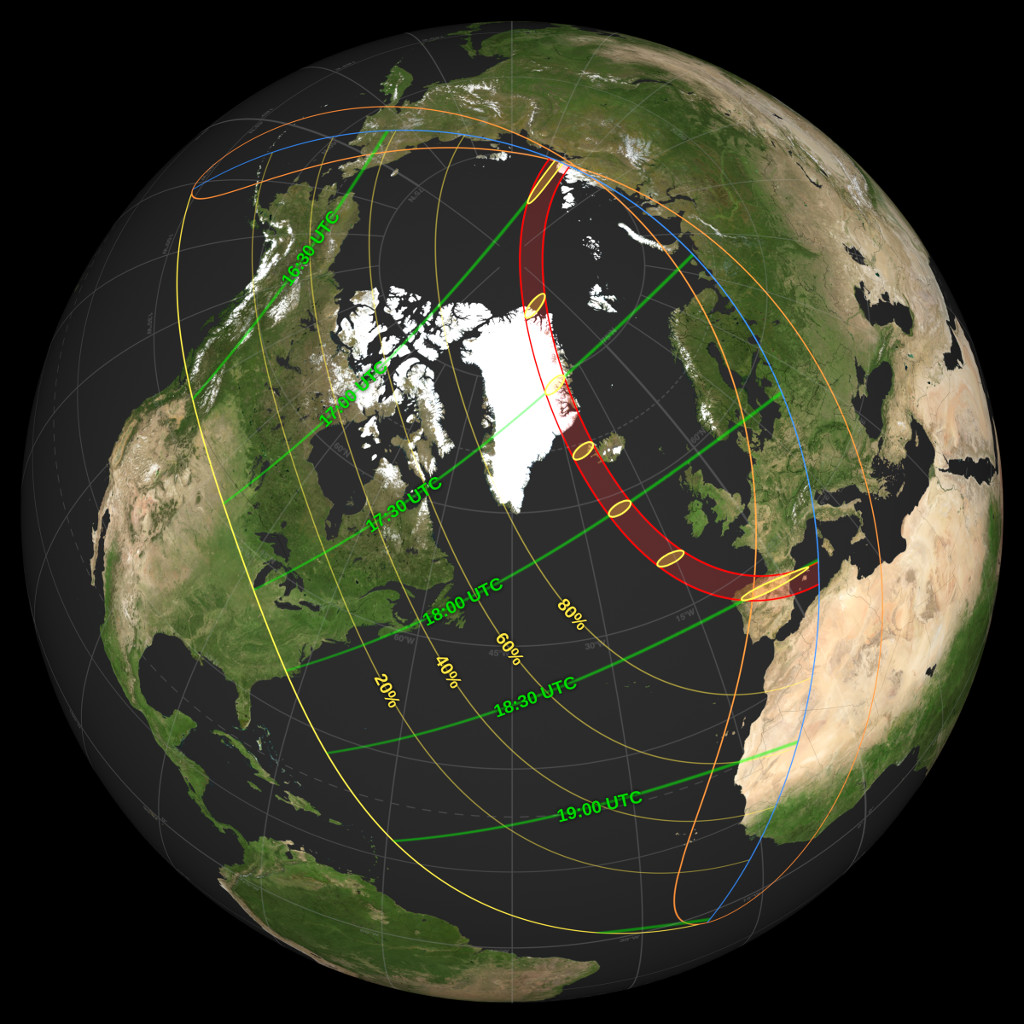
NASA Scientific Visualization Studio’s global map of the August 12, 2026 eclipse path. See the source and credits.
Why can’t Austin, Houston, or Los Angeles see the eclipse outside?
NASA confirms that totality crosses Greenland, Iceland, northern Russia, the Atlantic Ocean, Spain, and a small part of Portugal. Parts of the northern United States will see a partial eclipse, but Austin, Houston, and Los Angeles are outside that footprint. A local gathering should therefore be described as a livestream watch party, not a solar-observing session.
For guests considering a trip, share our August 12 eclipse visibility and travel guide. It covers the path, visibility context, and the safety details that matter for people who will actually be under the Sun.
A low-stress ESA + NASA watch-party run of show
You do not need a planetarium-size production. A living room, apartment common area, library meeting room, office lounge, or friend’s shaded patio works well—provided everyone is there to watch the screen, not the Sun.
- Arrive 20–30 minutes early. Open the ESA Web TV page and NASA Live, test audio, and load NASA’s eclipse map in a second tab.
- Put the time zone in the invite. Say “ESA begins 12:30 p.m. Central in Austin/Houston” or “10:30 a.m. Pacific in Los Angeles.” If you include NASA, label its 12:15 p.m. CDT / 10:15 a.m. PDT start separately.
- Use the map as the opening conversation. Let people point to Greenland, Iceland, or northern Spain and imagine what totality there might feel like.
- Build in the Javalambre moment. At 1:31 p.m. CDT / 11:31 a.m. PDT, pause the snacks and watch for the brief 1 minute 21 seconds of totality in ESA’s feed.
- Leave room for reactions. Some guests will be there for the science; others will come for the shared ritual. Both belong.
An invitation can be this simple:
“August 12 eclipse livestream watch party: ESA’s English Javalambre broadcast starts 12:30 p.m. CT / 10:30 a.m. PT, with NASA Live available from 12:15 p.m. CT / 10:15 a.m. PT. The eclipse isn’t visible locally, so we’re gathering to follow the real path together—bring lunch, questions, or your favorite space fact.”
Make the room welcoming for first-timers
Use the largest screen you have, but a laptop and small speaker are enough for a small group. Turn on captions if available, leave clear paths to seating, and invite remote friends to follow the official stream with a group chat for reactions. Skip decorative eclipse glasses: they are not useful where the event is not visible.
The best conversation prompts are low-stakes:
- If you could stand anywhere on this eclipse path, would you choose Iceland, Greenland, or Spain?
- What space image or sky event first made you stop scrolling?
- What local no-equipment sky activity should this group try next?
If you want more people who are equally happy to bring snacks, a map, or a great question, join the Cosmic Match space community.
What eclipse safety guidance applies to this watch-along?
In Austin, Houston, and Los Angeles, watch the verified stream rather than looking toward the Sun. Normal sunglasses, eclipse glasses, cameras, and binoculars cannot make a non-visible eclipse appear.
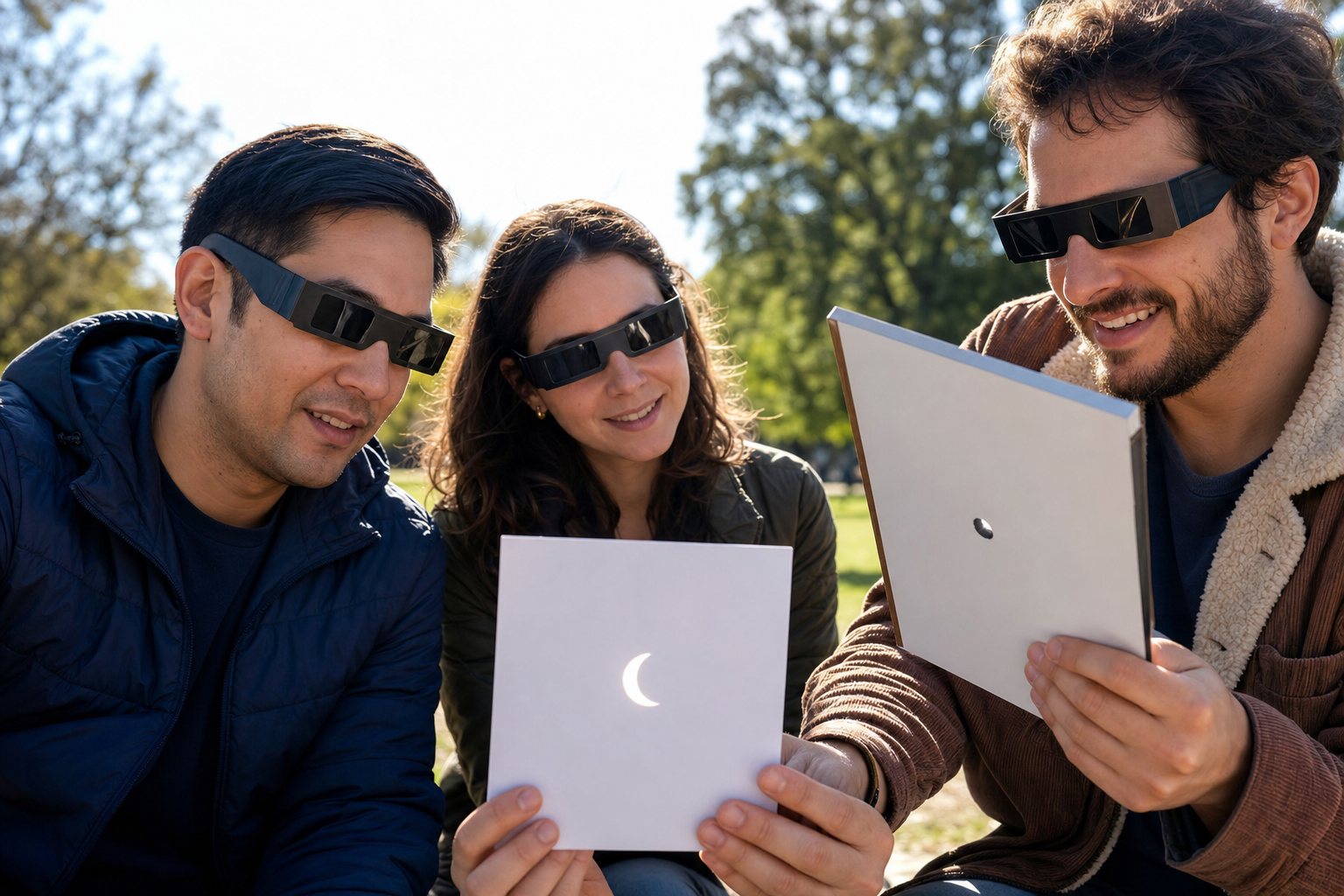
For travelers in the visibility region, follow NASA’s eclipse safety guidance. During partial phases, use compliant eclipse glasses or a handheld solar viewer. Cameras, binoculars, and telescopes need solar filters fitted to the front of the optics; eclipse glasses alone are not enough. A pinhole projector is a safer group-friendly indirect method.
The eclipse may be far from Texas and Southern California, but a shared, well-timed watch party can still make it feel close.
FAQ
When does ESA’s August 12, 2026 eclipse livestream start in Texas and Los Angeles?
ESA’s English broadcast is scheduled for 19:30 CEST: 12:30 p.m. CDT in Austin and Houston, and 10:30 a.m. PDT in Los Angeles. It is scheduled to run until 20:45 CEST / 1:45 p.m. CDT / 11:45 a.m. PDT.
What time is totality at ESA’s Javalambre feed?
ESA lists totality at Javalambre beginning at 20:31 CEST: 1:31 p.m. CDT in Austin and Houston, and 11:31 a.m. PDT in Los Angeles. It is expected to last 1 minute 21 seconds.
Will the August 12, 2026 eclipse be visible from Austin, Houston, or Los Angeles?
No. Those cities are outside the eclipse visibility footprint. A local event should use the official livestreams rather than outdoor solar viewing.
Is it safe to look at the Sun during the watch party?
No. Because the eclipse is not visible locally, use the livestream. Anyone traveling into the eclipse path should follow official solar-viewing guidance and use proper protection during partial phases.