A 5.6-Trillion-Pixel Map Puts Nearly 4 Billion Cosmic Objects in Your Browser
The new DESI Legacy Imaging Surveys release lets anyone inspect the largest 2D map of the universe from a browser: 5.6 trillion pixels, nearly four billion celestial objects, and about three-quarters of the sky. Open the Legacy Survey Sky Viewer, zoom into a patch of sky, and you are looking at a deep photographic map built from 13 years of work—not a simulation and not a 3D distance map.
That last distinction is worth keeping. The imagery helped DESI choose targets; DESI’s separate spectroscopic survey measures light to construct a three-dimensional view. This post is your low-pressure way in: no telescope, no install, and no need to know every faint smudge before you start.
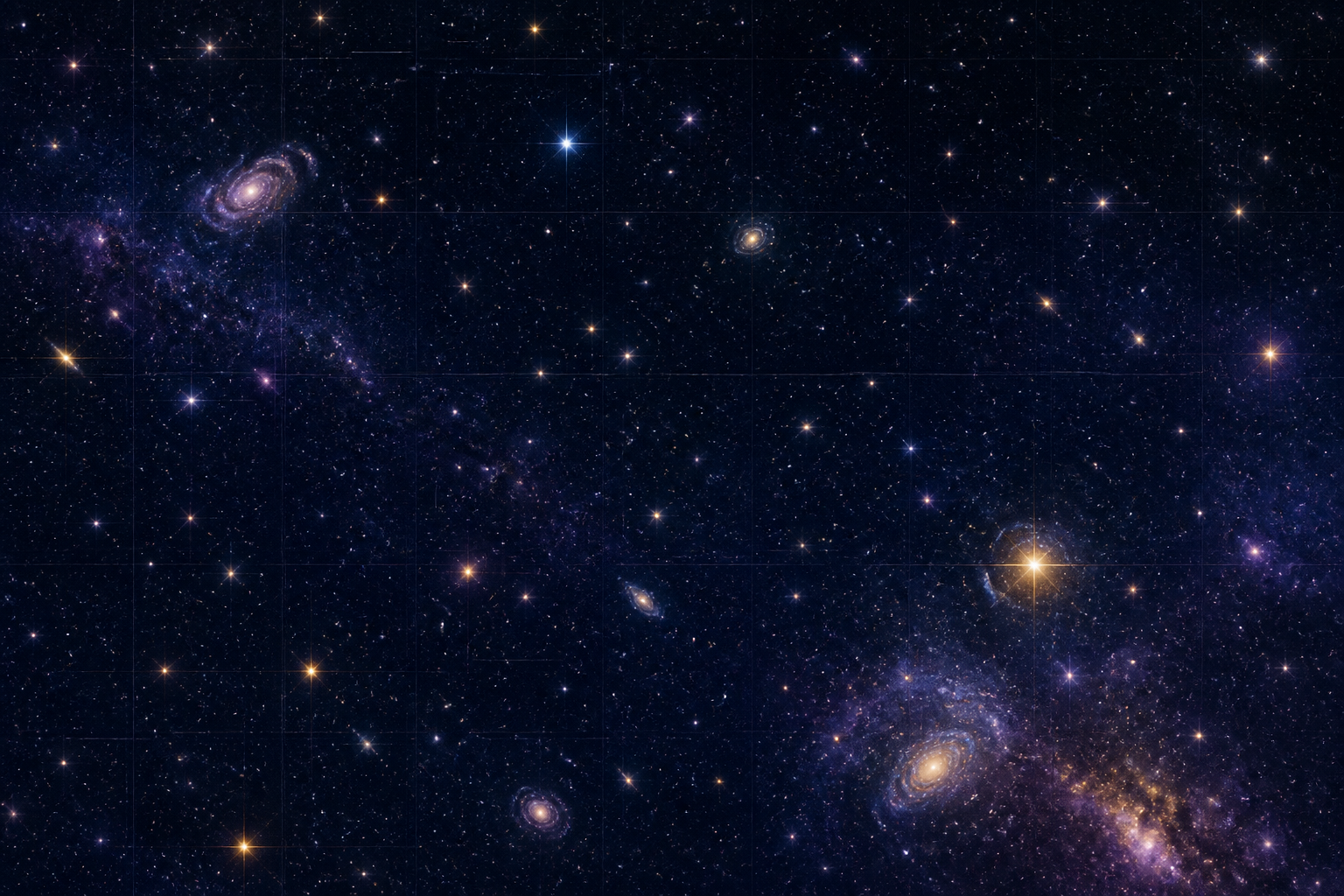
What is the largest 2D map of the universe?
It is the final public release from the DESI Legacy Imaging Surveys: a 5.6-trillion-pixel map containing nearly four billion objects, from familiar Milky Way stars to galaxies, asteroids, and more distant oddities. According to NSF NOIRLab’s release, it spans about three-quarters of the sky and was assembled over 13 years.
“2D” means the map records an object’s position on the sky and how bright it appears in different images—the way a very deep photograph does. It is enormous, but it is still a view across the celestial sphere. It does not give you a measured distance for every dot simply by zooming in.
The final release combines 263,407 exposures from three ground-based surveys, Berkeley Lab explains. That is why the experience feels more like exploring a vast atlas than opening a single pretty image.
How can you explore the Legacy Survey Sky Viewer?
Start at the free Legacy Survey Sky Viewer. It works anywhere you can open a modern web page, whether you are winding down in Austin, Houston, Los Angeles, or somewhere far from dark skies. There is no local observing window to chase—the map is available online.
Try this 10-minute first visit:
- Search a familiar name. Enter a bright star, a galaxy name, or a Messier object you have heard about. Starting with something known makes the scale less intimidating.
- Zoom one step at a time. The satisfying moment is noticing that a seemingly empty patch gains faint points and tiny extended shapes.
- Pan, then zoom back out. You are training your eye to feel the difference between a single object and a field full of objects.
- Compare sharp and fuzzy. Bright, sharp points are often foreground stars; many small, softer patches are galaxies. Treat that as a visual clue, not a promise of identification.
- Save a question. “Why is that object stretched?” is a perfect place to begin a conversation with other curious sky people at Cosmic Match.
Is this the same as DESI’s 3D map of the universe?
No—and getting this right makes the release more interesting, not less.
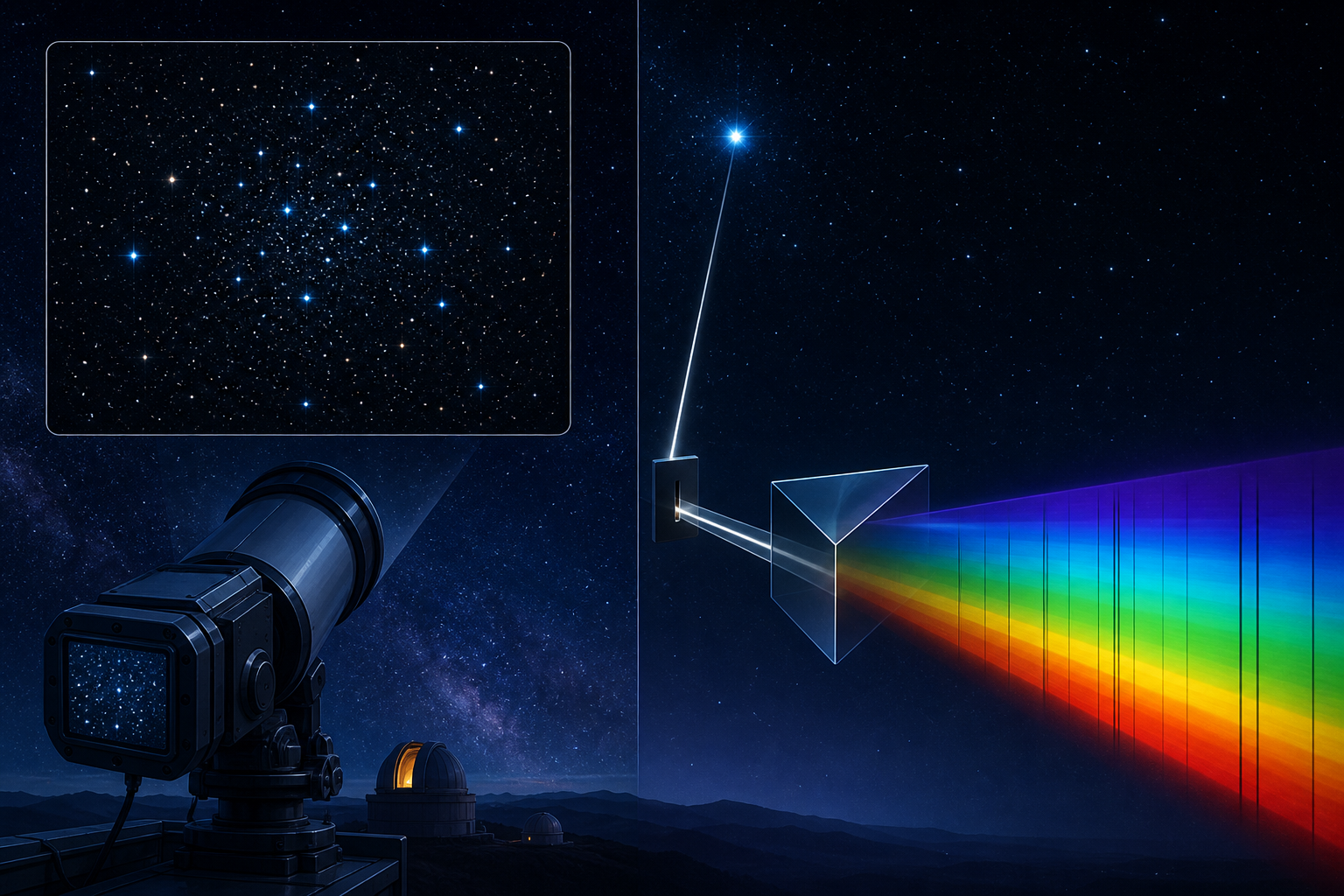
The Legacy Surveys map is a 2D imaging map. Think of it as a remarkably detailed picture of where objects appear and how bright they look. Its job was partly to help DESI choose promising targets across the sky.
DESI, the Dark Energy Spectroscopic Instrument, then measures those targets’ light as spectra. Spectral features can reveal a galaxy’s redshift, which scientists use to infer distance and build a 3D spectroscopic map. In plain English: imaging tells you where to point; spectroscopy adds the distance dimension.
So the public viewer is fantastic for visual exploration, but it does not present measured 3D galaxy positions for every object. Berkeley Lab’s overview puts it neatly: the 2D map is the foundation that enabled DESI’s 3D survey. Keep those two products distinct whenever you share the news.
Why does a giant imaging map matter to beginners?
Because it turns a headline-scale data release into something you can actually use. Instead of taking “four billion objects” as an abstract number, you can zoom until the sky stops feeling empty. That is a real astronomical skill: learning to notice structure, density, and difference before you know all the names.
It also shows how modern survey astronomy works. No one telescope handed us this finished picture in one night. More than 160 scientists contributed to collecting the data, while a 20-person team produced the final dataset, according to NSF NOIRLab. The public result is an invitation to look closely—and a reminder that shared infrastructure makes scientific wonder more accessible.
If you recently explored Rubin’s 3.2-gigapixel COSMOS image, notice the family resemblance without treating the projects as interchangeable. Rubin’s release is a deep coadd in one famously rich field; the Legacy Surveys release is a broad 2D sky map assembled from multiple surveys. Both are wonderful browse-worthy windows on the sky, but they answer different questions.

What should you look for first in the viewer?
Try choosing a target based on mood rather than expertise. A bright nebula, an edge-on galaxy, or a crowded star field all reward slow zooming. If you are not sure where to start, search a well-known object, inspect its surroundings, and follow the visual trail outward.
A few gentle ground rules keep the experience fun:
- A tiny dot is not automatically a star; the viewer contains many kinds of objects.
- A fuzzy oval may be a galaxy, but a label or catalog lookup is better than a confident guess.
- Image color and brightness are useful visual tools, not a direct representation of what your eyes would see through a backyard telescope.
- The best first goal is observation, not mastery: describe one thing that changes when you zoom.
Want to turn that discovery into a shared ritual? Open the viewer alongside someone who loves the night sky, trade targets, and compare what each of you notices. You can create a free Cosmic Match profile to meet others who will happily spend ten minutes arguing over the most intriguing fuzzy patch.
The quick takeaway
The DESI Legacy Imaging Surveys release is the largest 2D map of the universe: 5.6 trillion pixels, nearly four billion objects, three-quarters of the sky, and 13 years of observations and processing. Its public Sky Viewer makes that scale explorable right now.
Use it as a visual sky atlas. Then remember the important boundary: the Legacy Surveys provide the 2D imaging foundation, while DESI spectroscopy measures distances for its separate 3D map. Knowing the difference lets you appreciate both the picture and the science behind it.
FAQ
Do I need a telescope to use the Legacy Survey Sky Viewer?
No. The viewer is a public online experience; a phone, tablet, or computer with an internet connection is enough. A larger screen simply makes close exploration more comfortable.
Does the 5.6-trillion-pixel map show objects in 3D?
No. It is a 2D imaging map of positions and brightness on the sky. DESI’s separate spectroscopic measurements are what enable a three-dimensional galaxy map.
How much of the sky does the Legacy Surveys map cover?
The final release covers about three-quarters of the sky and catalogs nearly four billion celestial objects, according to NSF NOIRLab.
What are the 263,407 exposures?
They are the individual telescope images combined from three ground-based surveys to build the final Legacy Surveys dataset. One exposure is a measurement; the map is the carefully processed result of many of them.