Neptune’s Inner Moons May Be Rubble From Ancient Icy Worlds—What Webb Found
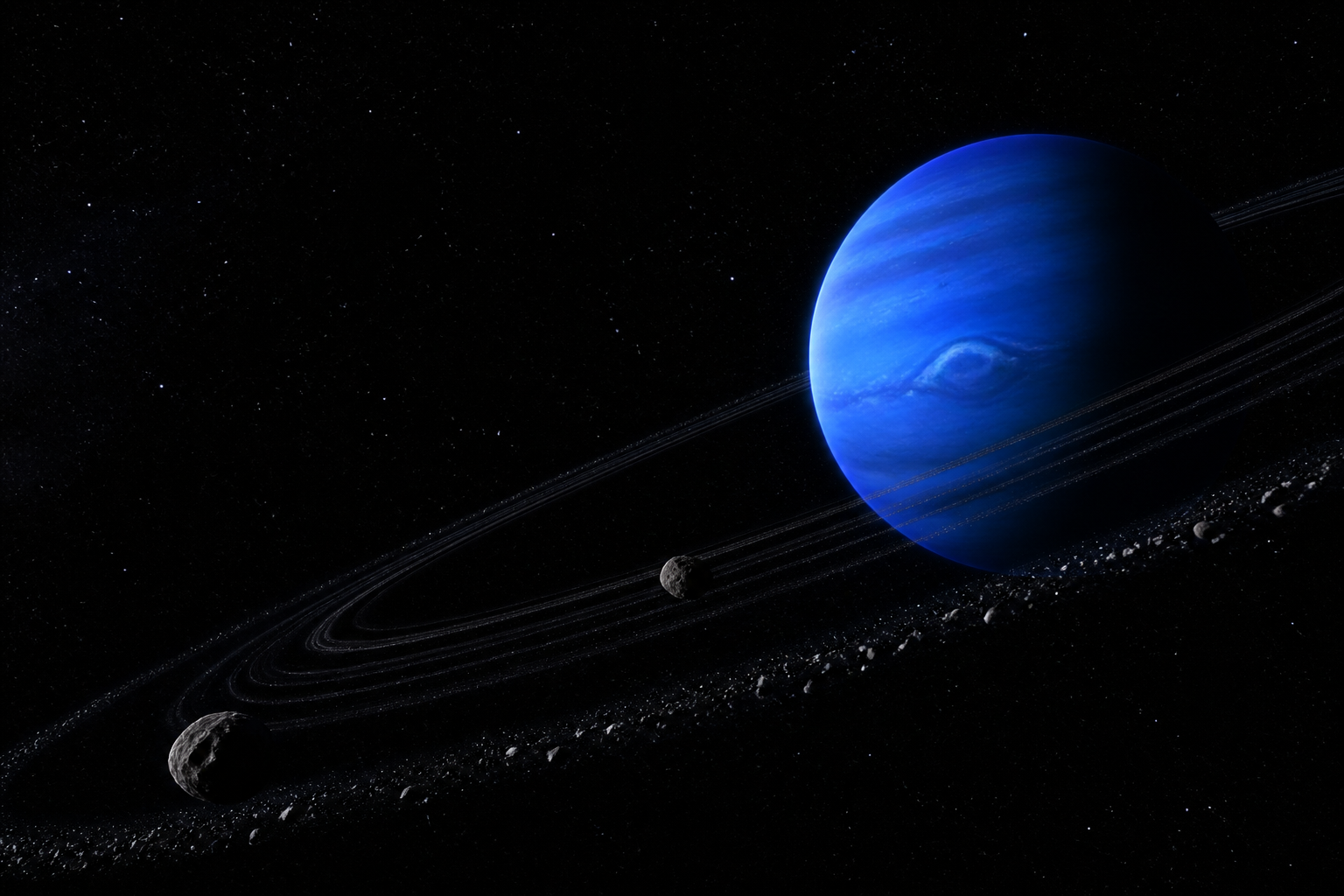
Webb has found a mineral clue in Neptune’s crowded inner system that looks less like a present-day ocean story and more like ancient solar-system archaeology. New near-infrared spectra show a sharp feature associated with magnesium-rich phyllosilicate clays on Larissa, Galatea, and Neptune’s rings. Those materials most likely formed long ago, inside a larger icy parent body where rock and liquid water could react. They are not evidence that these small moons have liquid water today.
That distinction is the exciting part. At Neptune’s distance, these tiny, dark moons are hard to study from Earth. Webb’s data let scientists read a chemical trace that may have survived a violent reshuffling of the system—possibly when Neptune captured its giant moon Triton. The research team favors the idea that the material came from ancient regular moons broken apart and then reassembled, while keeping another explanation in view: a large, differentiated Kuiper Belt object could have been tidally torn apart near Neptune.
What did Webb actually find on Neptune’s inner moons?
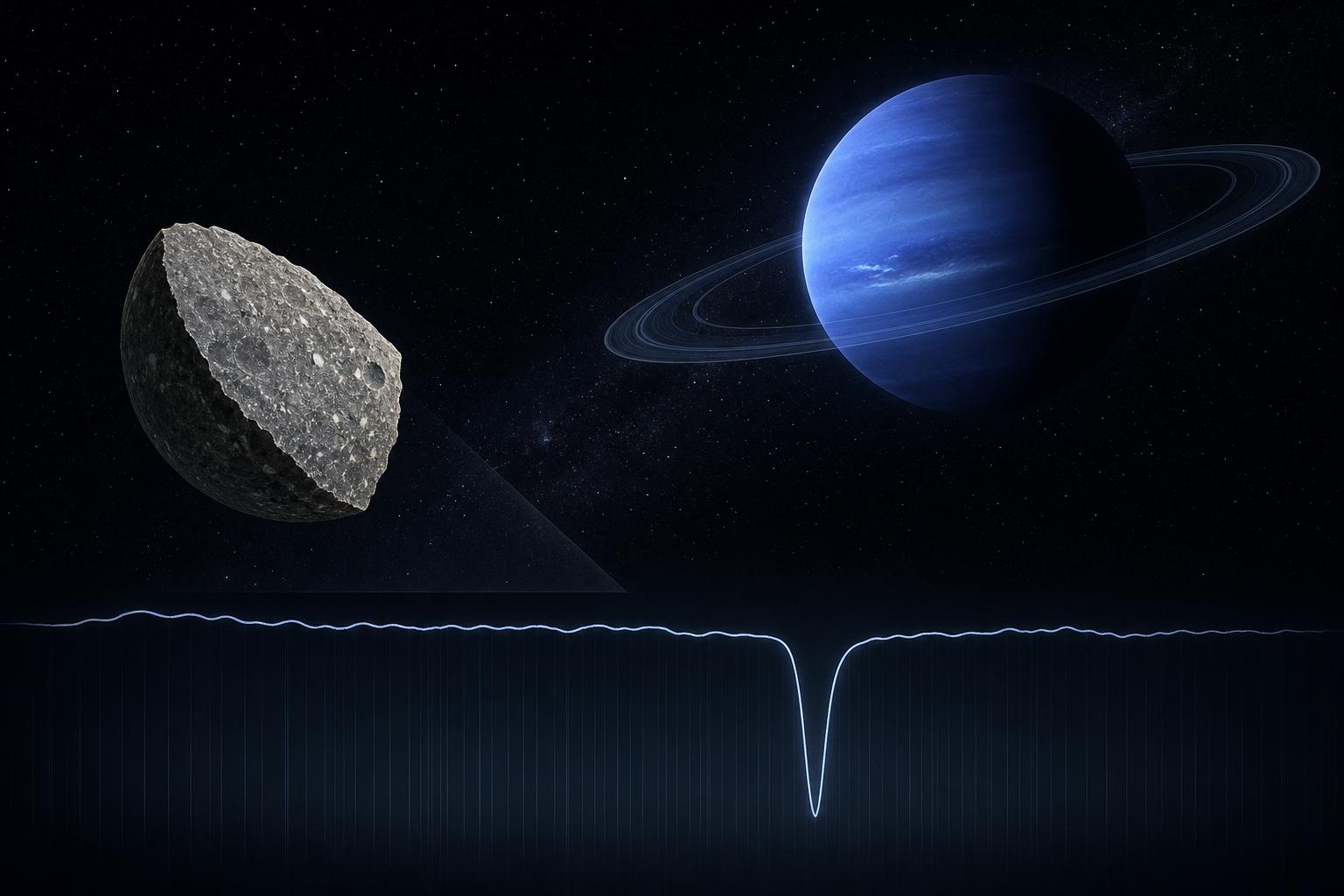
Using Webb’s NIRSpec instrument, the team observed Proteus, Larissa, Galatea, and Neptune’s faint rings. All of them show a deep, broad feature near 3 micrometers, but Larissa, Galatea, and the rings have an extra, sharp absorption at 2.72 micrometers. That is the key: its shape matches magnesium-bearing phyllosilicates—layered minerals often called clays.
Proteus matters here because it was observed too, but it does not show the same strong 2.72-micrometer signature. The result is not “all of Neptune’s inner moons contain clay.” It is a specific compositional pattern on Larissa, Galatea, and ring material.
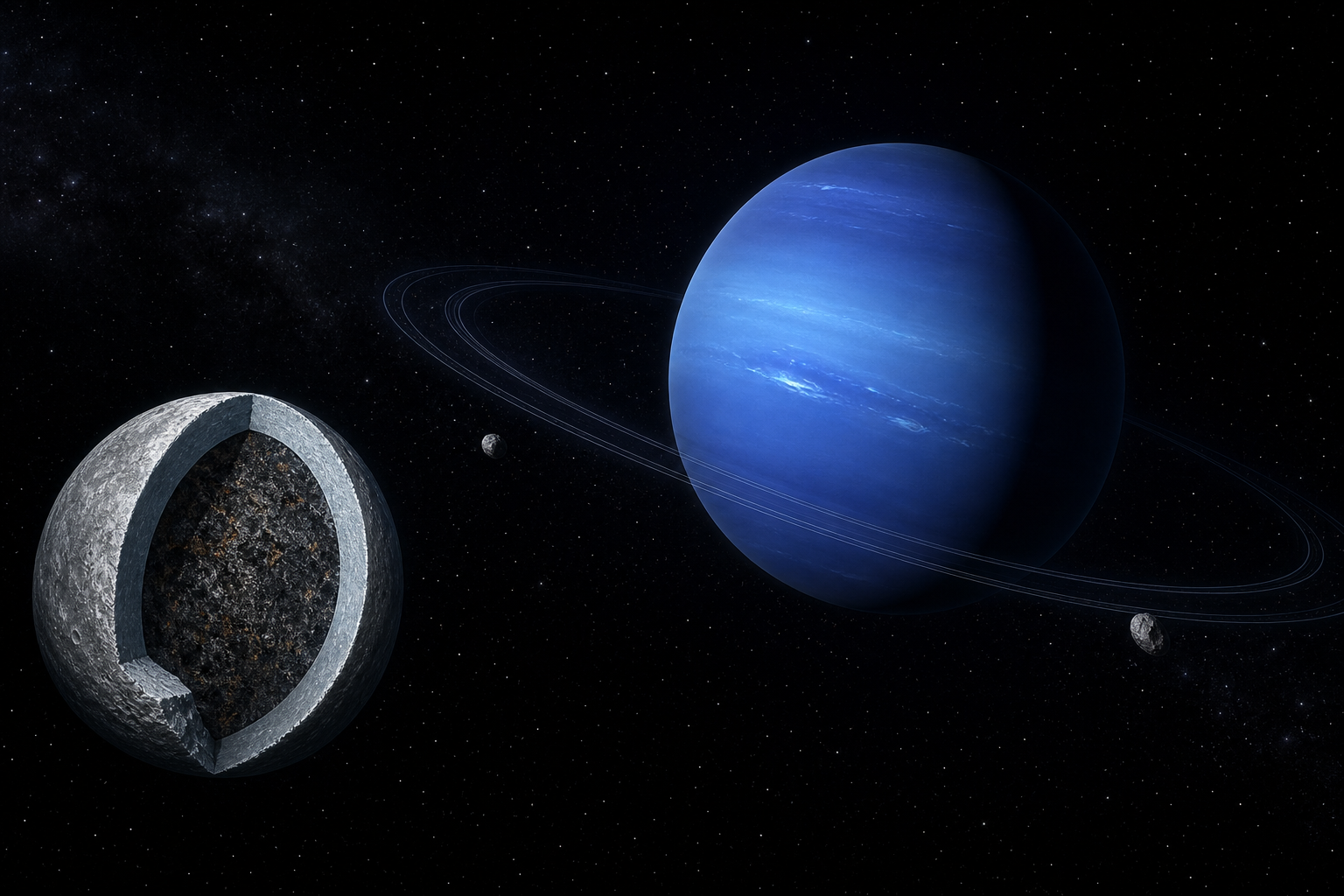
The signal is unusual in the outer solar system. The researchers compare it with altered carbonaceous meteorites and with worlds such as Ceres, where minerals record water-rock chemistry in a parent body’s past. Their preprint describing the Webb observations is a detailed look at the spectra; an earlier conference abstract independently lays out the same 2.72-micrometer finding.
Why do clay minerals point to an ancient, larger world?
Phyllosilicates do not simply appear because a cold moon happens to be near ice. They form when rock interacts with liquid water for a substantial time under the right chemical and thermal conditions. The current surfaces around Neptune are frigid, so the minerals are best understood as a stored record of a warmer interior in the past.
The important word is larger. Larissa and Galatea are small inner moons. A bigger, differentiated precursor could have retained heat and supported liquid-water alteration in its interior before later events exposed and scattered that material. In the team’s interpretation, the present moons and rings may have reaccreted from debris carrying that interior material.
That is a useful reminder that a small world’s surface can preserve a history written somewhere else. It is similar to why researchers pay attention to mineral clues on small bodies such as asteroid 44 Nysa: composition can tell a story that shape alone cannot.
Did Neptune’s moons have liquid water—or have it now?
The evidence supports neither a present ocean nor a habitable environment on Larissa or Galatea. It points to past aqueous alteration inside a precursor body. That is a narrower, more scientifically useful claim.
The distinction matters because spectroscopy identifies mineral fingerprints, not a live liquid-water reservoir. The paper also reports no clear water-ice signatures in the relevant spectra, despite the deep broad OH absorption. Scientists are still working out what combination of hydrated materials produces the full pattern.
How could Triton have reshaped Neptune’s moon system?
Triton is Neptune’s outlier: it is huge compared with the planet’s other moons and travels in a retrograde orbit, opposite Neptune’s rotation. That unusual orbit is a major reason scientists think Triton was captured from the Kuiper Belt. A capture energetic enough to alter Triton’s orbit could have disrupted an earlier system of regular moons.
The research team’s favored scenario is that destruction: ancient, larger moons were broken up during Triton’s capture, and only roughly 1% of the debris was retained in a disk that later formed the small inner moons and rings. That approximate figure is a modeling result from the team, not a precision measurement of today’s ring mass.
It is not the only viable story. A Pluto-size Kuiper Belt object passing too close to Neptune could also have been tidally shredded, delivering processed interior material. The mineral data narrow the conversation, but they do not yet choose the final origin story on their own.
Why is this a big deal if we cannot see these moons from a backyard telescope?
This is a discovery to follow, not an observing target. Larissa and Galatea are far too faint and close to Neptune’s glare for typical backyard observing. The approachable part is the method: astronomers use light as a forensic tool. A narrow dip in reflected infrared light can tell us which materials are present, then planetary scientists connect those materials to plausible histories.
Webb has already shown how much texture Neptune’s rings can reveal in its near-infrared portrait of the planet. The new spectra add chemistry to that picture. If you want to keep unpacking discoveries with people who enjoy the “wait, how do we know that?” part, join the Cosmic Match space community and bring your best question to the next conversation.
What comes next?
More laboratory measurements under outer-solar-system conditions could help identify the broad hydrated material and test how these spectra change with temperature and grain size. Better dynamical models can also ask whether the Triton-disruption or tidally shredded-Kuiper-Belt-object path more naturally produces the system we see now.
For now, the honest headline is wonderfully strange: Webb may be looking at rubble that once sat deep inside an ancient icy world. The clay signature is not a shortcut to “water today.” It is a durable clue that Neptune’s small inner moons may be fragments of a far bigger, warmer, and much more eventful past.
FAQ
Which Neptune moons showed the clay-mineral signature?
The strong 2.72-micrometer phyllosilicate feature appears on Larissa, Galatea, and Neptune’s rings. Proteus was observed in the same study but does not show the same strong signature.
Does this mean Neptune’s inner moons have water today?
No. The minerals indicate long-ago water-rock alteration inside a larger precursor body; they do not show liquid water on Larissa or Galatea today.
Can I see Larissa or Galatea with a telescope?
Not with ordinary backyard equipment. They are very faint and sit close to bright Neptune, so this result comes from Webb spectroscopy rather than visual observing.