Asteroid 44 Nysa May Be Three Worlds—But Scientists Aren’t Calling It Proven
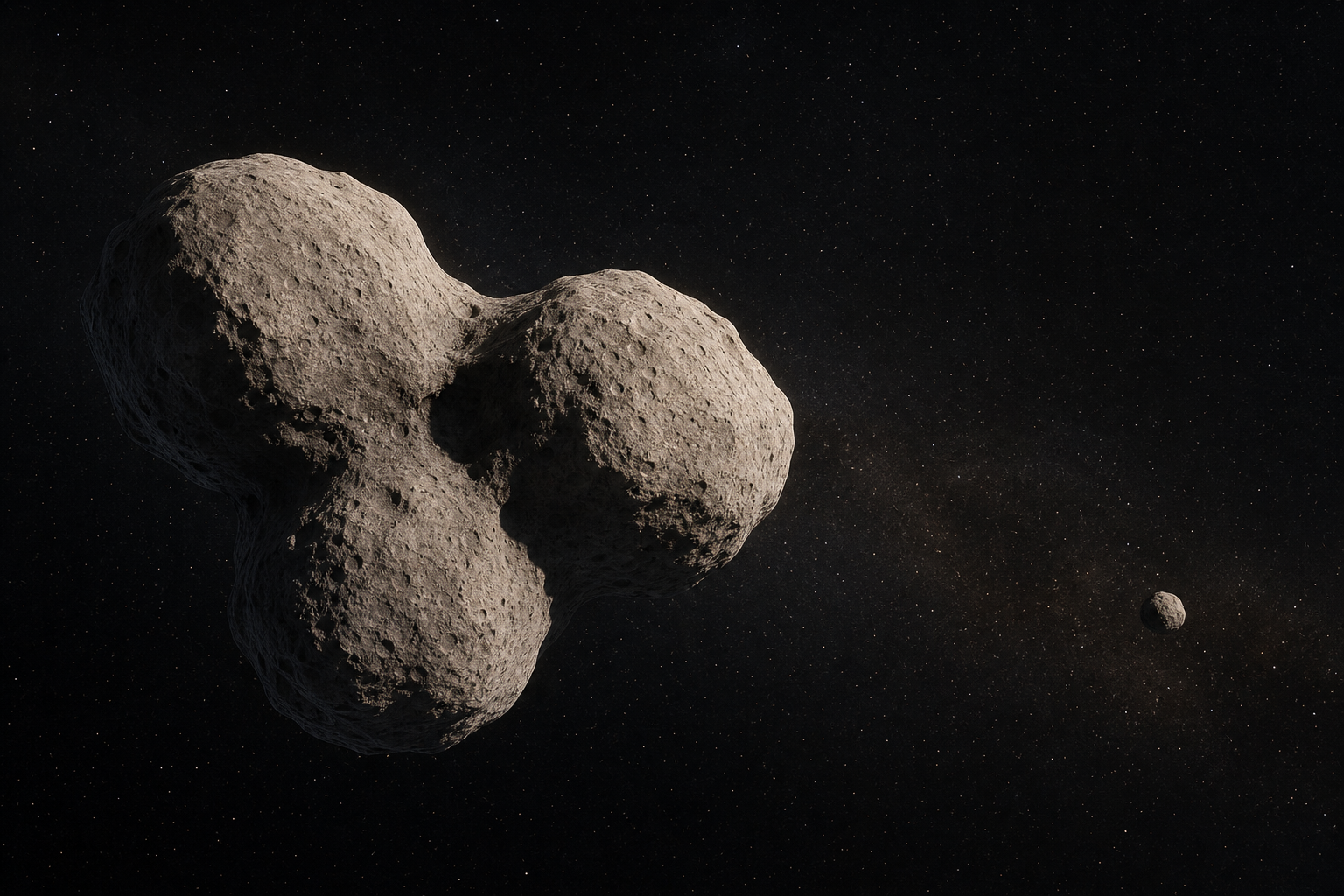
A world in the asteroid belt may have a shape that sounds like it belongs in a cosmic cartoon: three rocky lobes joined together, plus a tiny moon. But the most interesting part of the new work on asteroid 44 Nysa is not a declaration that astronomers have found “three worlds.” It is the careful uncertainty.
A new research paper favors the idea that Nysa is a contact-trinary: three components touching one another. Yet the researchers also keep another explanation on the table: one single, extremely irregular body with deep indentations. That distinction matters. The images are remarkable, but science earns confidence by showing what the data can—and cannot—separate.
What researchers think they found
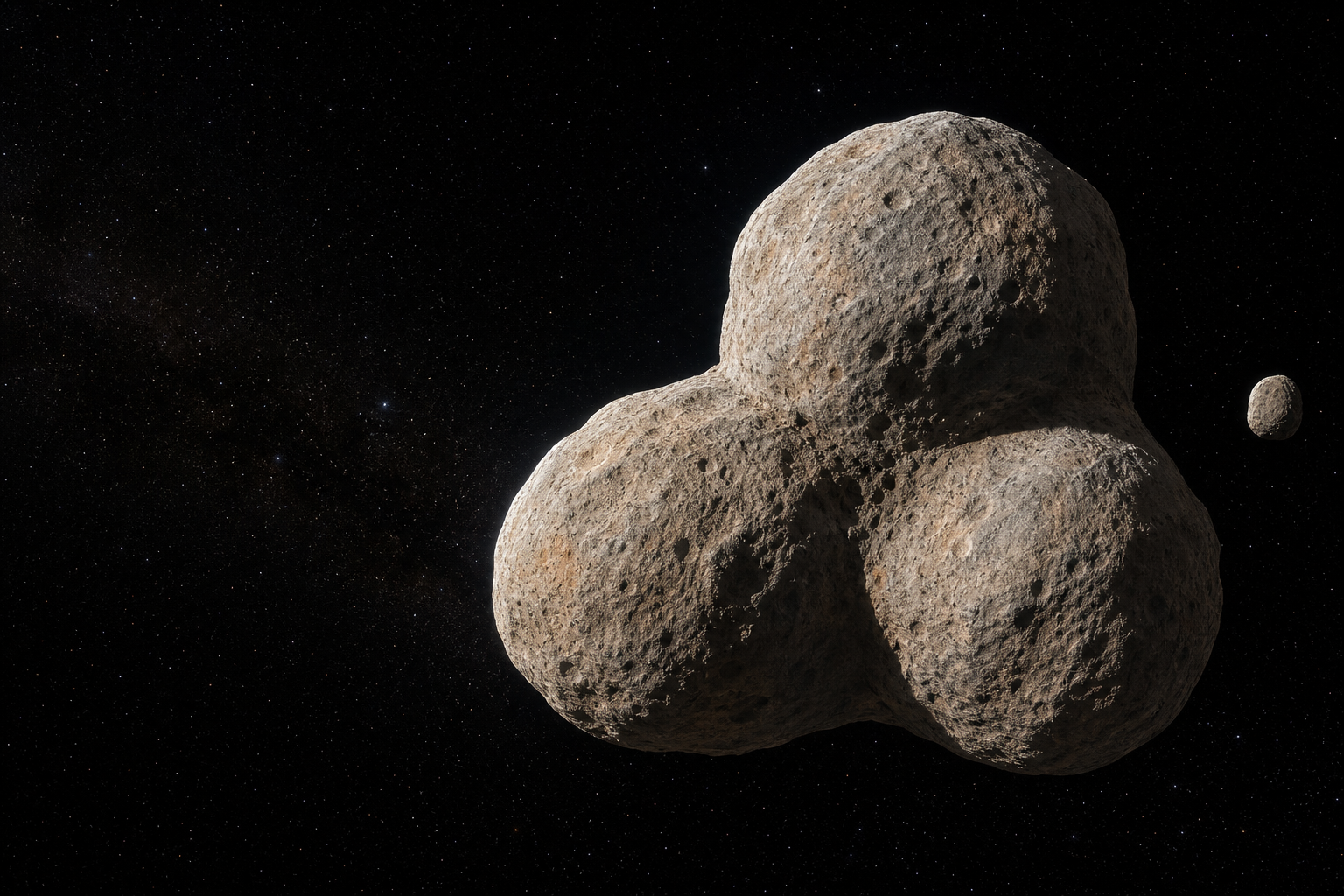
Nysa is a large, bright E-type asteroid in the main belt between Mars and Jupiter. In a paper submitted July 28, an international team reports high-resolution observations from the Large Binocular Telescope in Arizona and ESO’s Very Large Telescope in Chile. Their best explanation for Nysa’s unusual outline is a primary body roughly 75 kilometers across made from three connected lobes.
That is the key word: connected. A contact binary is two bodies that have come together and remain joined. A contact-trinary would be the three-part version. Rather than three little asteroids flying in formation, picture a snowman made of rock after billions of years of impacts, spins, and gentle gravitational rearranging.
The paper’s conclusion is deliberately more cautious: Nysa is most likely a binary system with either a contact-trinary or a highly irregular, coherent primary. Lowell Observatory’s summary of the result uses the same either/or framing. That is a feature of the story, not a footnote.
Why the alternative still fits
From far away, even powerful telescopes do not hand us a crisp spacecraft selfie. Earth’s atmosphere blurs the view; bright objects create glare; and an asteroid looks different as it turns. The team combined adaptive-optics images, image processing, and light-curve information—how Nysa’s brightness changes as it rotates—to build a shape model.
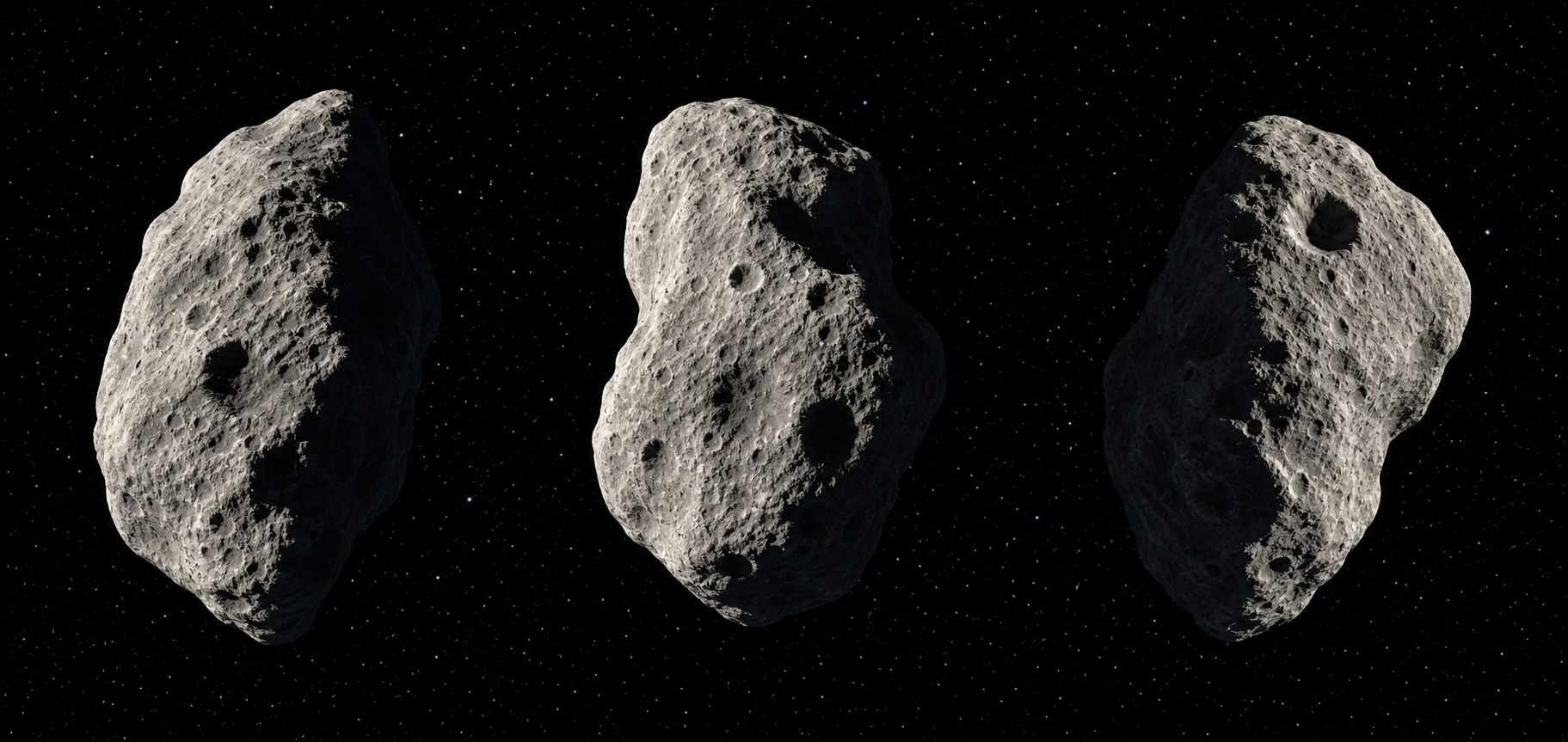
The images reveal valleys and distinct surface features. One interpretation is that the valleys are neck-like connections between lobes. But deep valleys on one coherent, oddly shaped asteroid can create a similar visual impression. The observations favor the joined-lobes picture; they do not yet rule out the single-body picture.
This is a useful beginner lesson in how astronomy works. A compelling image is evidence, not the final word. Scientists look for independent angles, repeat observations, and measurements that can make competing explanations predict different outcomes. Nysa rotates about once every 6.42 hours, so watching it across its rotation is especially valuable.
A tiny moon makes the mystery better
The researchers also report a faint satellite, temporarily named S/2026 (44) 1. It was detected in data from two observing campaigns after specialized processing helped peel away Nysa’s bright halo. The team estimates that moon at roughly one kilometer across.
It appeared at projected separations of at least 170 kilometers from Nysa in the observations. “Projected” is important: that is the on-sky separation we see from our viewpoint, not a fully determined orbital distance. The moon’s orbit still needs more tracking.
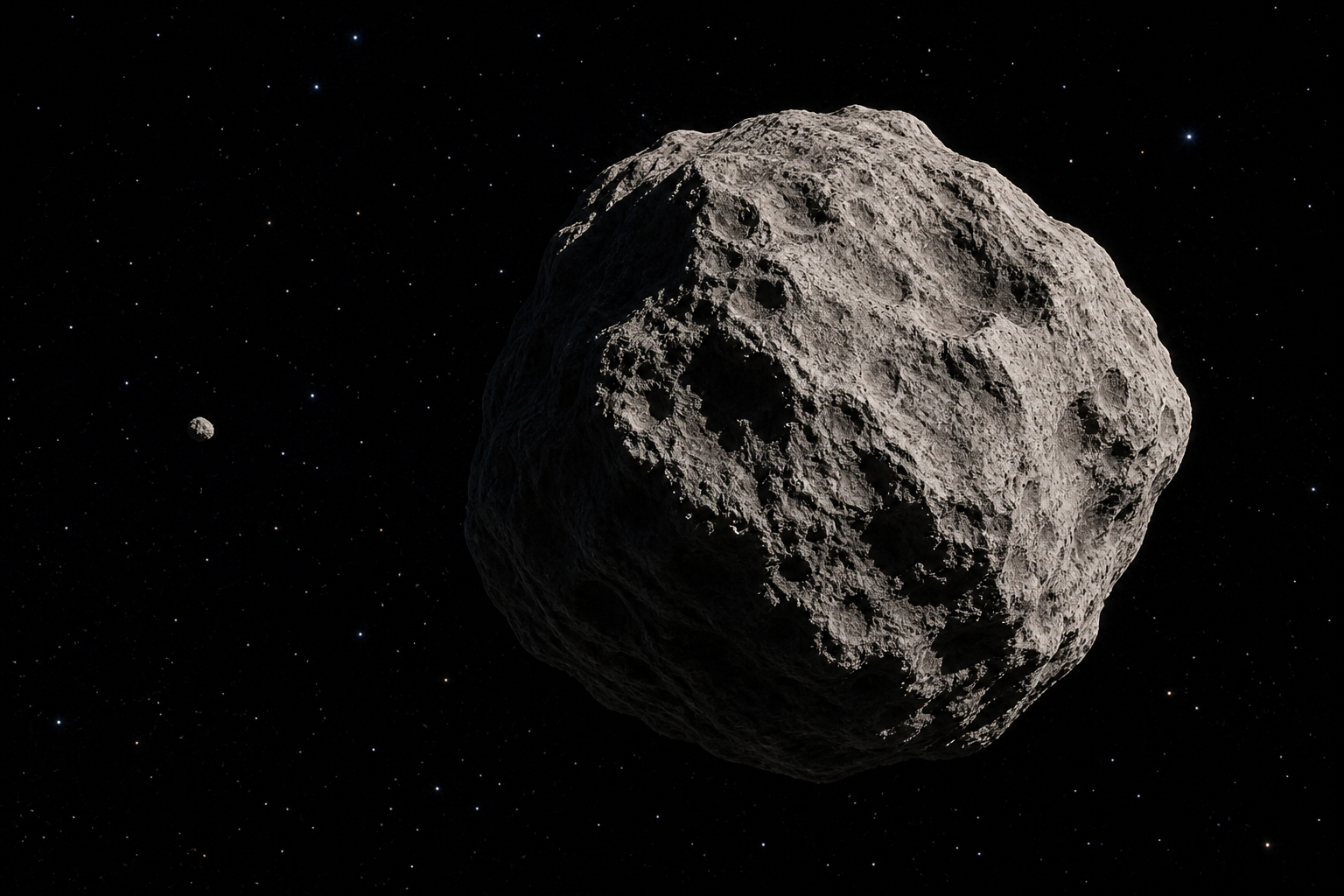
Why care about such a small companion? A moon can act like a cosmic measuring tape. Once astronomers establish its orbit, they can calculate Nysa’s mass more precisely. Combine mass with a better volume estimate and you get density—a clue to whether the asteroid is solid, fractured, or a loose reassembled pile of fragments.
How could a shape like this form?
The team discusses a few possibilities. Long ago, a collision may have broken a parent body apart; slowly moving pieces could then have reaccumulated and stuck together. Another possibility is a dramatic hit-and-run encounter involving a larger body. Neither origin story is settled.
That uncertainty is exactly why Nysa is exciting. Its form could preserve evidence from an early, much rougher solar system. Astronomers are not just collecting strange shapes; they are testing how small worlds survive collisions, merge, and evolve.
What happens next—and what you can do with this story
More observations of the moon and Nysa’s changing appearance should help test the two big interpretations. If future data consistently support three joined components, Nysa could become the clearest known example of a three-lobed contact world. If not, it may still prove extraordinary: a single body carved into a shape unlike anything else we know.
This is not an asteroid you can expect to spot naked-eye from Austin, Houston, or Los Angeles. It is a research result, not a local observing alert. Still, it is a terrific conversation starter for a Cosmic Match community skywatch: what would convince you that an odd silhouette is one world rather than several joined together?
If you enjoy the detective work behind space discoveries, you might also like our beginner-friendly look at how a lunar rendezvous mission tests navigation or our guide to separating a big sky headline from the experience you can actually have in Austin, Houston, or Los Angeles. Join free at cosmicmatch.io to meet people who love asking the next good question about the universe.
Sources
- Minker et al., “Unmasking (44) Nysa: Evidence for a trilobate structure”
- Lowell Observatory: 44 Nysa may be the first-known three-lobed world
- Space.com independent coverage
- Universe Today independent coverage
FAQ
Is 44 Nysa confirmed to be three separate asteroids?
No. The leading interpretation is a single primary body with three connected lobes, but researchers still consider a deeply indented, highly irregular single body a viable alternative.
Can I see asteroid 44 Nysa without a telescope?
No. This is a research result from professional observations, not a naked-eye viewing event; the article explains the discovery rather than announcing a local observing opportunity.
Why does Nysa’s tiny moon matter?
Once astronomers measure the moon’s orbit, it can help determine Nysa’s mass and density, which may reveal how solid or loosely assembled the asteroid is.
Related: How Webb found clay minerals on Neptune’s inner moons—a new example of how spectroscopy can uncover a small world’s hidden history.