August 2, 2026 G2 Geomagnetic Storm Observed: What It Means
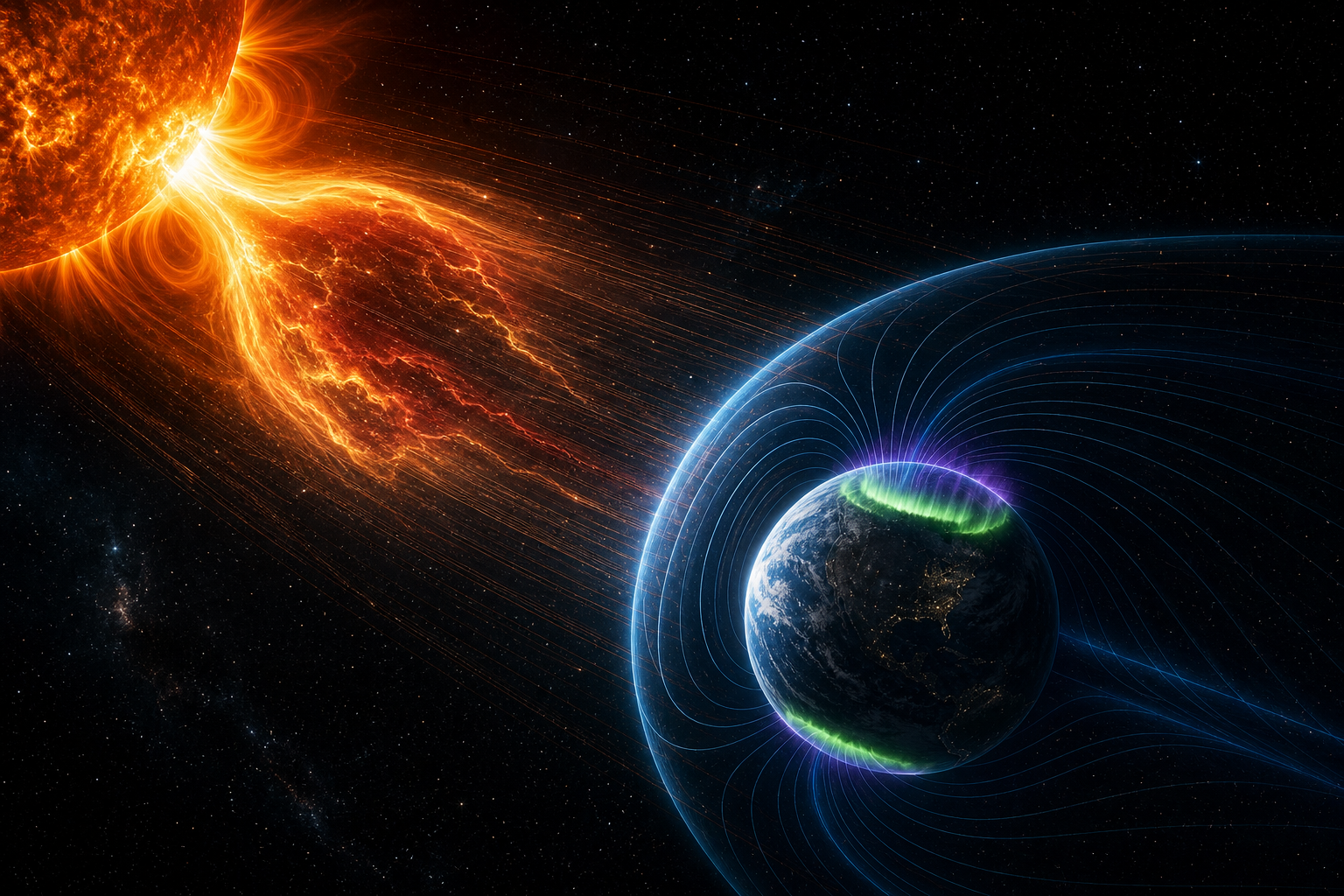
Update — August 2, 2026, 18:01 UTC (13:01 CDT / 11:01 PDT): NOAA recorded a coronal-mass-ejection arrival as a geomagnetic sudden impulse at 12:29 UTC, then observed G1/Kp 5 at 17:12 UTC and G2/Kp 6 at 17:59 UTC. This article has been updated from a forecast watch to an observed-event report. NOAA’s active G2 alert says aurora may be seen as low as New York to Wisconsin to Washington state—not Austin, Houston, or Los Angeles.
NOAA has now observed the August 2, 2026 G2 geomagnetic storm. That is a real, moderate disturbance in Earth’s magnetic field, not just a forecast. It is also not a local aurora alert for Austin, Houston, or Los Angeles. The most useful takeaway is simple: the CME arrived, the G2 threshold was reached, and the official visibility guidance remains far north of our three launch cities.
The earlier forecast context still matters. NOAA’s 3-Day Forecast, issued at 12:30 UTC on August 2, anticipated a G2 peak in the 15:00–18:00 UTC interval from the July 30 CME. The observed G2 alert followed at 18:01 UTC, with the Kp 6 threshold reached at 17:59 UTC. Forecasts describe what may happen; alerts document a threshold that did happen.
What changed from the original G2 storm watch?
The original version of this post described a NOAA G2 forecast. NOAA’s alert feed now provides the observed timeline:
- 12:29 UTC: NOAA recorded a geomagnetic sudden impulse, consistent with the CME’s arrival.
- 17:12 UTC: NOAA recorded Kp 5, a G1 (Minor) geomagnetic-storm threshold.
- 17:59 UTC: NOAA recorded Kp 6, a G2 (Moderate) geomagnetic-storm threshold.
- 18:01 UTC: NOAA issued the G2 alert confirming that threshold.
Those timestamps are NOAA observations, not an estimate from Cosmic Match. At the time of this update, NOAA’s G2 alert is active. Its stated area of impact is primarily poleward of 55° geomagnetic latitude, and its aurora wording is “as low as New York to Wisconsin to Washington state.”
What does a G2 geomagnetic storm mean?
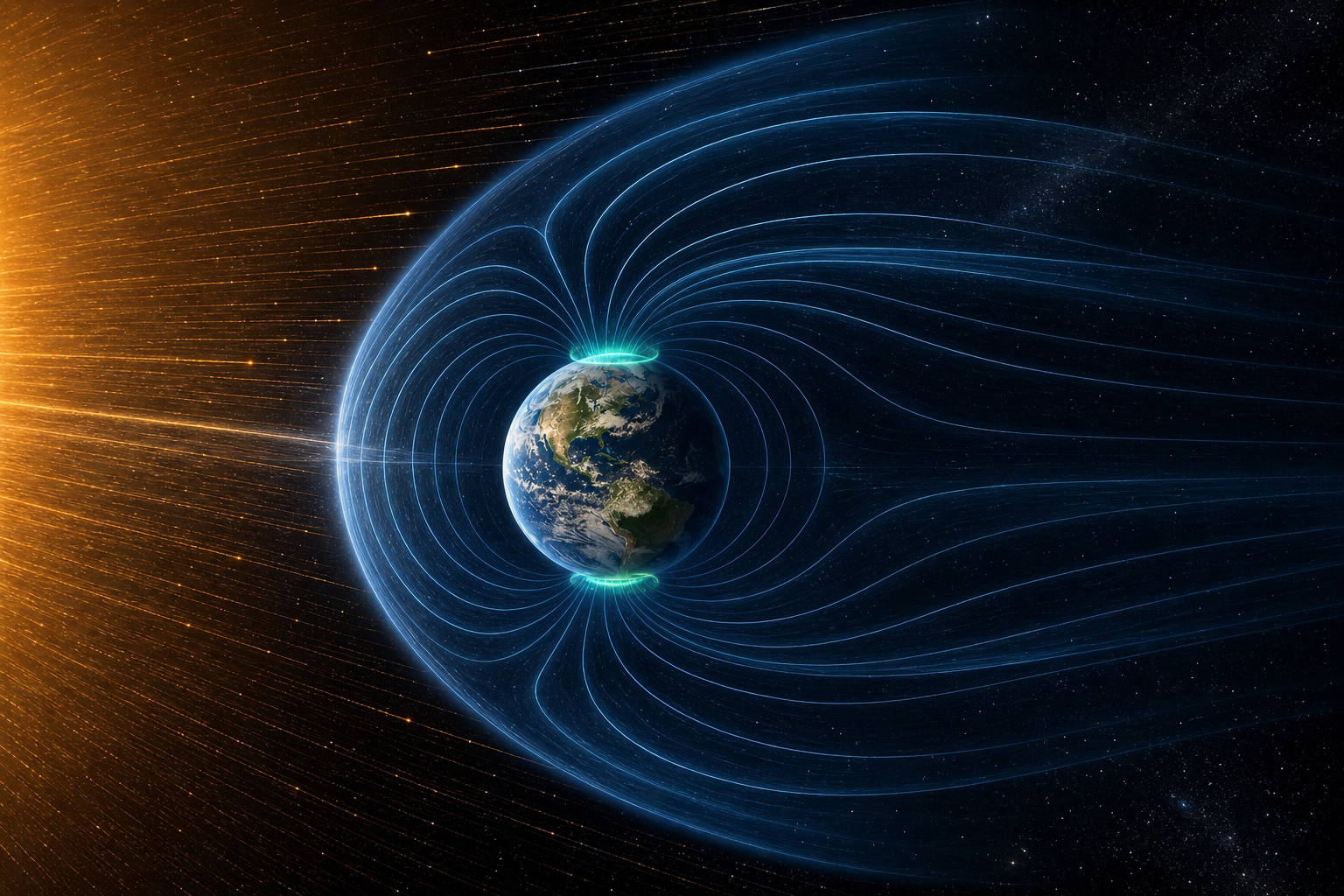
A G2 is a moderate level on NOAA’s five-step geomagnetic-storm scale. It means the solar wind and Earth’s magnetic field have coupled strongly enough to produce a Kp 6 interval. It does not mean every place in the United States will see an aurora, and it does not turn ordinary local weather or night-sky visibility into a spectacle.
NOAA lists possible G2 effects including high-latitude power-grid fluctuations, satellite-orientation irregularities, increased drag on low-Earth-orbit satellites, and higher-latitude HF-radio fading. For most people, daily life will feel normal. For skywatchers, the key variables are still latitude, darkness, cloud cover, a clear horizon, and the storm’s real-time behavior.
Why G, S, and R scales should not be mixed up
Space-weather labels describe different phenomena:
- G = geomagnetic storm. This is the scale relevant here: G1 was observed at 17:12 UTC and G2 was observed at 17:59 UTC.
- S = solar radiation storm. This is a proton-radiation scale, separate from geomagnetic activity. NOAA’s current 3-Day Forecast says no S1-or-greater radiation storm was observed in the prior 24 hours and gives a 5% S1-or-greater chance for August 2.
- R = radio blackout. This is an X-ray-driven radio-impact scale. NOAA’s current forecast reports no radio blackouts observed in the prior 24 hours and gives a 25% chance of R1–R2 conditions on August 2.
A G2 observation is significant space weather, but it is not evidence of an S-scale radiation storm or an R-scale radio blackout. Keeping the scales separate makes official updates much easier to read.
Can you see the aurora from Austin, Houston, or Los Angeles tonight?
No—NOAA’s current G2 wording does not support an aurora-viewing claim for Austin, Houston, or Los Angeles. The agency’s stated southern reach is New York to Wisconsin to Washington state. That is the responsible boundary for this event, even though a G2 label can make for tempting social posts.
That does not make the storm less interesting. It is a great night to follow the data and share the science with people who get why a Kp chart can be exciting. Join the conversation and meet fellow stargazing enthusiasts at Cosmic Match, or plan an ordinary-but-still-lovely local observing session with our summer stargazing picnic guide.
How should beginners follow this observed event?
Start with the source, not a reposted graphic. Read NOAA SWPC’s live alerts feed for the alert’s issue time, observed threshold, and active status. Then compare it with the 3-Day Forecast, which gives the forecast context and separate G, S, and R outlooks.
If you are outside NOAA’s potential aurora zone, resist a last-minute drive based on a headline alone. For Austin, Houston, and Los Angeles, tonight is better framed as hands-on space-weather literacy: watch the official status, learn what Kp records, and enjoy your regular sky plans. You can also compare notes on the Southern Delta Aquariids and Alpha Capricornids while they remain active.
Bottom line: the August 2 G2 geomagnetic storm is observed, not merely forecast. NOAA’s data supports a G2/Kp 6 event and a northern U.S. aurora range—not an aurora alert for Austin, Houston, or Los Angeles.
NOAA products checked for this update: alerts feed at 2026-08-02 18:01 UTC (G2 alert issued; Kp 6 threshold at 17:59 UTC) and 3-Day Forecast issued 2026-08-02 12:30 UTC. The CME-arrival sudden impulse was observed at 12:29 UTC; the G1/Kp 5 threshold was observed at 17:12 UTC.
FAQ
Was the August 2, 2026 G2 geomagnetic storm observed?
Yes. NOAA recorded Kp 6, corresponding to G2 (Moderate), at 17:59 UTC and issued an alert at 18:01 UTC.
Does G2 mean the aurora is visible everywhere in the United States?
No. NOAA’s active G2 wording places the potential southern reach roughly from New York to Wisconsin to Washington state; visibility also depends on local conditions.
Is a G2 storm the same thing as a solar radiation storm or radio blackout?
No. G measures geomagnetic activity, S measures solar radiation storms, and R measures radio blackouts; NOAA reports each on its own scale.