Swift’s Rescue Spacecraft Is in a Spin. Here’s How LINK Is Trying to Recover
Swift’s Rescue Spacecraft Is in a Spin. Here’s How LINK Is Trying to Recover
There is a new complication in NASA’s effort to extend the life of the Neil Gehrels Swift Observatory: the small spacecraft sent to reach it is dealing with an attitude-control problem of its own.
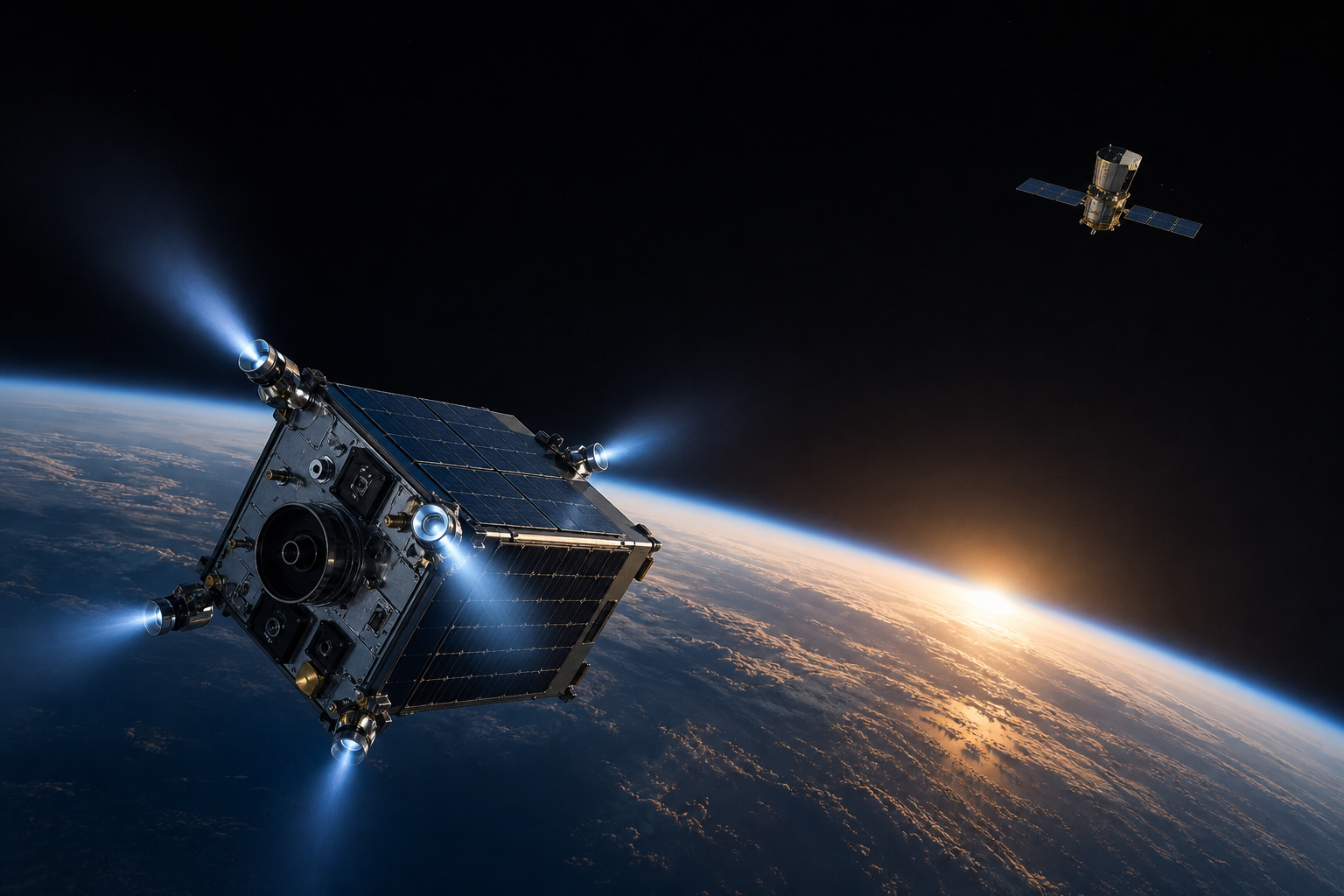
Katalyst Space says its LINK servicing spacecraft entered a multi-axis spin after problems emerged in its attitude-control system. The company has not declared the mission lost. Instead, its team says it is working to slow the spacecraft’s body rates using an unusual backup approach: steering its gimbaled electric-propulsion thrusters to produce the corrective forces it needs.
That is a serious detour, not a verdict. The intended rendezvous with Swift is delayed while LINK is stabilized, and details from the ongoing investigation remain preliminary. But the recovery effort is also a compelling look at what real spacecraft operations can demand when the nominal plan breaks.

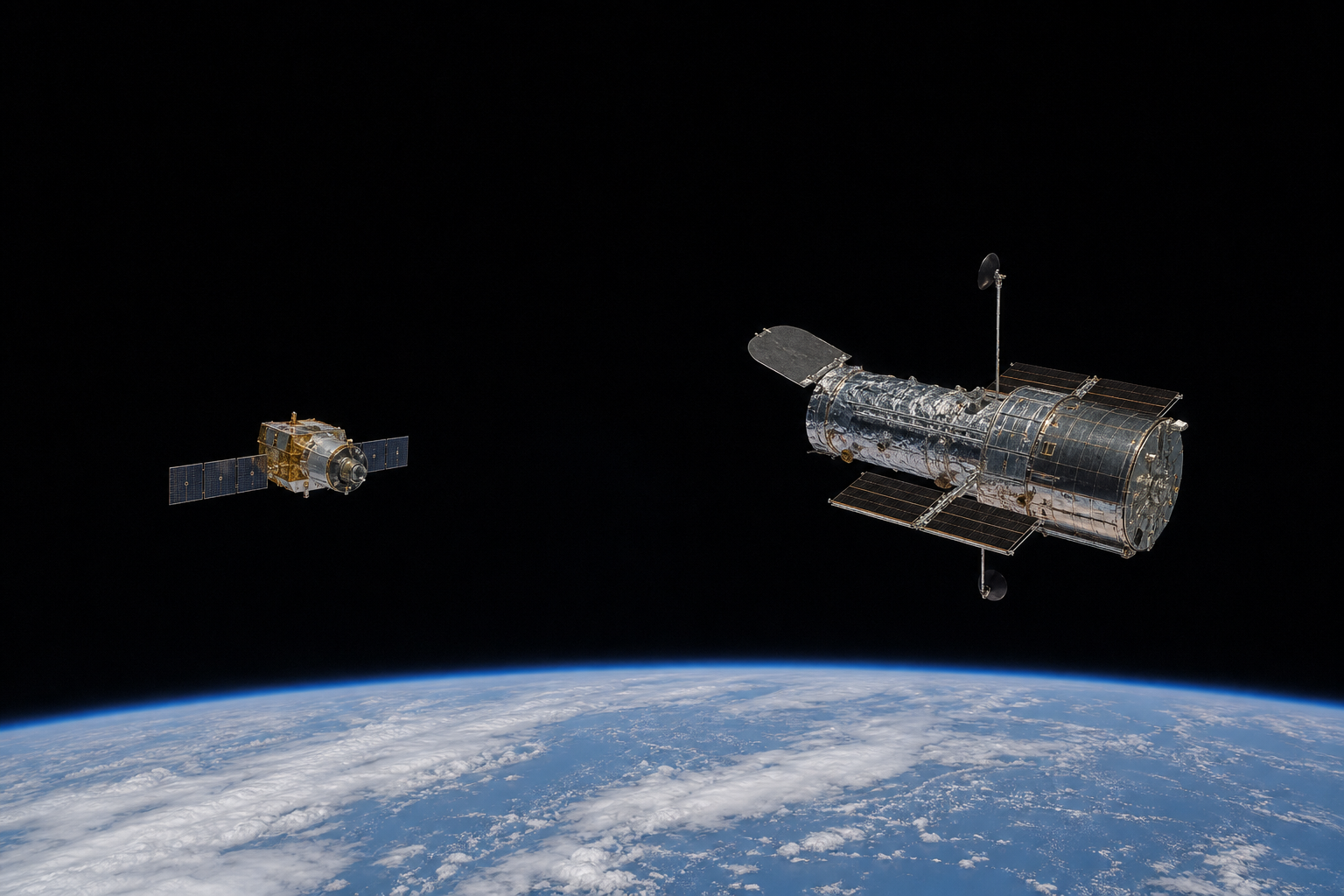
For the backstory, read our earlier update, Swift Rescue Mission Is Alive in Orbit. What Happens Next. NASA’s mission page says Katalyst was contracted to rendezvous with the observatory and raise it to a higher orbit, helping extend its scientific life. Swift, launched in 2004, studies some of the universe’s most energetic events; its orbit has been decaying faster as solar activity increases atmospheric drag.
What happened to LINK?
Katalyst’s mission update, subsequently reported by SpaceNews and the Associated Press, says LINK had been in a multi-axis spin for more than 72 hours. The spin temporarily interrupted communications and triggered a reset of the spacecraft bus—the core platform that handles power, computing, and communications.
The early diagnosis is not a final root-cause report. According to the reporting, two of LINK’s three reaction wheels were not operable, while its cold-gas reaction-control thrusters had only partial functionality. Those are normally the tools a spacecraft uses for small, precise changes in orientation.
In plain language, “attitude” does not mean altitude. It means which way the spacecraft is pointing and how quickly it is rotating. A vehicle can be safely in orbit yet be unable to carry out a delicate rendezvous if it cannot reliably aim its antennas, instruments, solar arrays, or propulsion system.
That distinction matters here. LINK is meant to approach an aging observatory without crew aboard either vehicle. Before that can resume, operators need to know that LINK can point predictably, communicate consistently, and perform maneuvers without adding unwanted rotation.
Why a spin makes rendezvous so hard
Picture trying to thread a needle while standing on a slowly turning office chair. Now imagine the needle and thread are both moving around Earth at several kilometers per second. That is not a perfect analogy, but it captures why a spacecraft’s rotation rate matters.
Rendezvous is built on measured, repeatable control. Navigation sensors must produce useful data; antennas must remain pointed for communications; and every burn has to change the orbit or orientation in the expected direction. A spinning spacecraft can lose communication margins, compromise sensor readings, and turn a planned maneuver into a riskier one.
Katalyst has said that communications, propulsion, and robotics subsystems remain functional. That is why the team is pursuing recovery rather than treating the situation as mission-ending. Still, being functional is not the same thing as being cleared for proximity operations. The practical objective now is to get LINK into a stable enough state to finish its checkout and resume the planned approach safely.
The recovery path: using propulsion to manage attitude
Reaction wheels are internal spinning devices that let a spacecraft rotate without expelling propellant. Cold-gas thrusters, by contrast, give short bursts of force. Both are familiar ways to manage attitude.
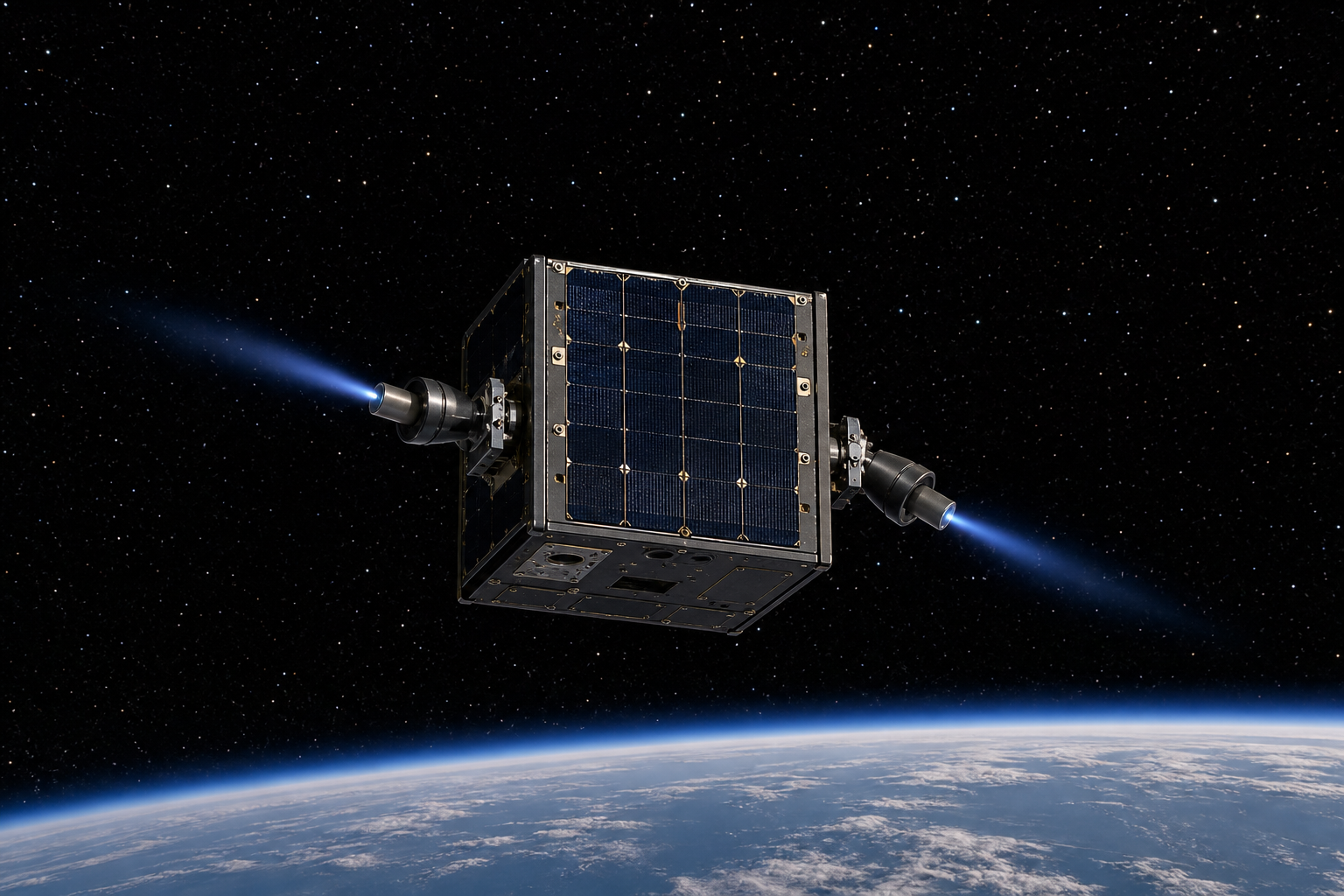
LINK’s reported workaround uses a different capability already on the spacecraft: its gimbaled electric-propulsion thrusters. “Gimbaled” means the thruster can be tilted. By directing thrust slightly off the spacecraft’s center of mass, operators can create torque—the turning effect needed to reduce a spin.
This is not the same as casually firing an engine until the spacecraft settles down. Engineers have to account for the direction and rate of rotation, available power, propellant and thermal limits, communications windows, and the fact that the same propulsion system will ultimately be needed for mission maneuvers. Katalyst has reported that its burns were having the intended effect on LINK’s body rates, which is encouraging but not yet a declaration of recovery.
SpaceNews also reported that LINK had previously completed two electric-thruster burns that raised its orbit by roughly two kilometers. That tells us the propulsion system had already demonstrated useful operation in orbit. The current work asks it to take on a more improvised control role.
What has to happen before LINK can chase Swift again
The next steps are less cinematic than a capture sequence, but they are the ones that protect both spacecraft. A sensible recovery sequence would include:
- Reduce and characterize the spin. Teams need the vehicle’s body rates low enough for reliable pointing and to understand how they change over time.
- Restore dependable communications and power margins. A stable link to the ground and healthy solar-array pointing are foundational before more ambitious maneuvers.
- Confirm the remaining control toolkit. Operators need to know exactly what reaction-wheel, cold-gas, and electric-propulsion authority they can count on.
- Re-plan the rendezvous timeline. Only after LINK can operate predictably should the team resume the staged approach, survey, and eventual servicing work near Swift.

NASA has said Swift’s orbit is gradually lowering because of atmospheric drag, accelerated by solar activity. SpaceNews reported Swift at about 350 kilometers and cited an earlier NASA threshold of 300 kilometers for starting reboost activity. That timetable should not be read as a promised reentry date: the important immediate fact is that recovery work on LINK is active and the schedule for rendezvous is being reassessed.
Why this is a people-and-engineering story
It is tempting to treat a spacecraft anomaly as a binary: success or failure. Real mission operations rarely work that way. A recovery can be a careful series of small tests, updated models, quiet decisions, and hours of coordination between flight dynamics, propulsion, software, power, navigation, and communications teams.
This is the human side of robotic spaceflight. The spacecraft may be far above Earth, but its path forward depends on people turning incomplete telemetry into careful, reversible actions. For anyone who enjoys the operational details behind space headlines, this is the part worth following—especially because no one has promised an outcome yet.
That shared curiosity is exactly what makes a good space community. If you want a place to swap the next mission update with other people who notice the engineering, join the spaceflight community at Cosmic Match. It is free to participate and built for conversations that go beyond the launch clip.
What this means for Swift
Swift’s science is valuable enough that NASA contracted a commercial team to attempt this servicing mission in the first place. A successful reboost could extend the observatory’s operating life and demonstrate a practical way to care for spacecraft already on orbit. But that goal comes after safe stabilization.
The mission has not been declared lost, and it would be premature to say it is recovered. The appropriate middle ground is this: Katalyst has described a credible active path to reduce LINK’s rotation using gimbaled electric propulsion, and the company says key subsystems are still functioning. The team now has to show that this path produces a spacecraft stable enough for rendezvous.
Bottom line
The Swift reboost mission attitude control failure is a major challenge, but not an announced end to the mission. LINK’s recovery work has shifted the immediate priority from approaching Swift to slowing its own rotation and rebuilding a reliable attitude-control plan.
For now, watch for a concrete update on stabilization, communications, and the revised route back to rendezvous. If the recovery succeeds, the mission may still become an important example of commercial on-orbit servicing. If it does not, the effort will still be a vivid lesson in just how much precision lies behind the phrase “spacecraft rescue.”
Sources
- Katalyst Space mission update
- SpaceNews: Swift reboost mission encounters attitude-control problems
- NASA: Swift Boost mission page
- Associated Press: NASA Swift telescope rescue update
Update (Aug. 21, 2026): NASA and Katalyst have since cancelled LINK’s planned capture and boost of Swift. Read the latest status and what rendezvous work may still be attempted.