Cloud-9 May Be a Starless Galaxy. The Strongest Evidence Is What Astronomers Still Can’t See
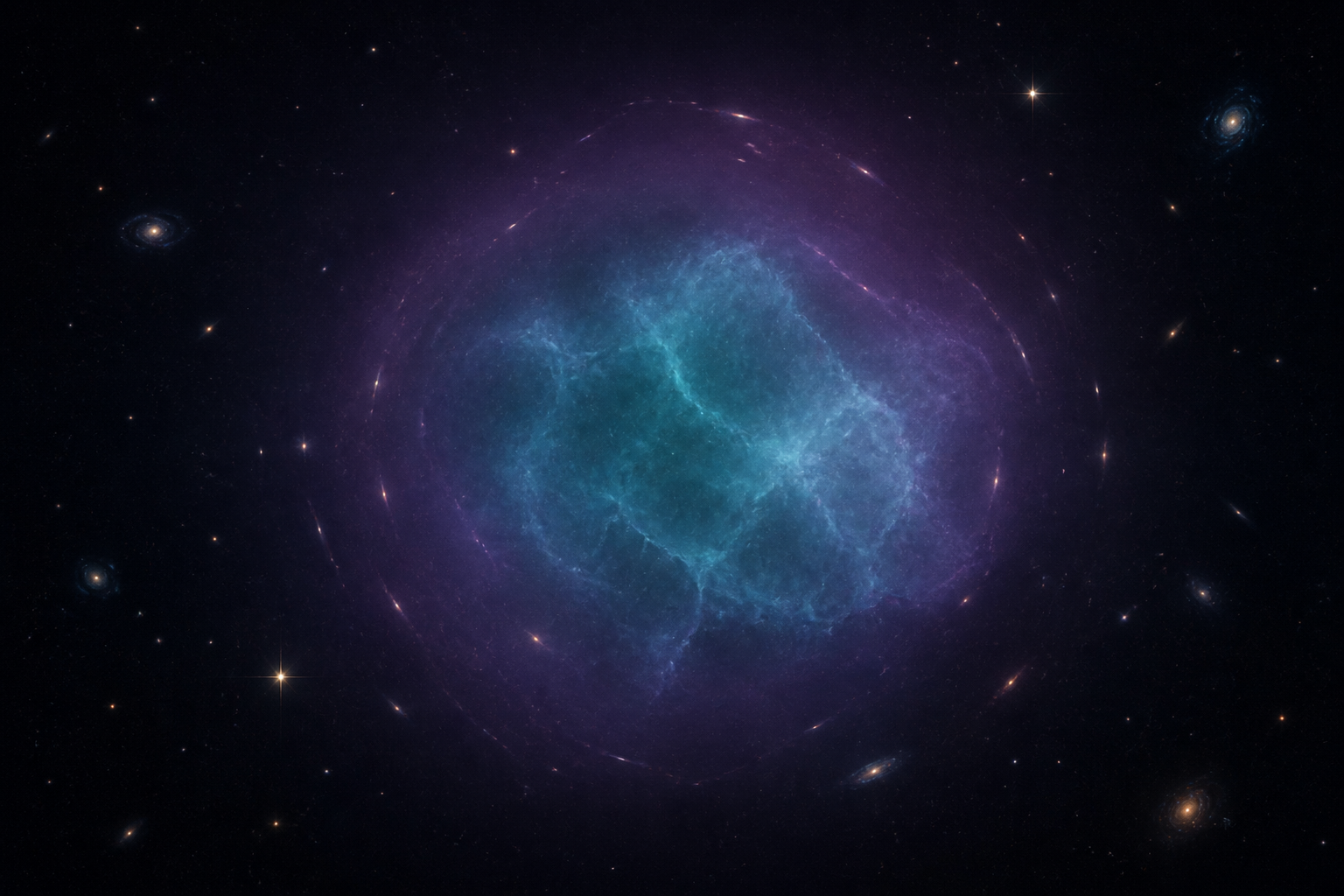
Cloud-9 may be the closest thing astronomers have found to a galaxy that never made stars — but the important new result is more careful than that headline. Ultra-deep observations with the Gran Telescopio Canarias found no stellar light in its central region and lowered the allowable stellar mass to about 16,000 Suns. That is powerful evidence, not a final verdict: Cloud-9 remains a starless-galaxy candidate.
The story gets interesting because two kinds of observations are doing two different jobs. Optical images set a tougher limit on any stars that might be there. Radio observations trace neutral hydrogen gas and suggest that a compact gas core is gravitationally confined within a larger, environmentally shaped envelope. Put together, they make Cloud-9 a remarkable laboratory for asking how small galaxies can fail to light up.

What did the new Cloud-9 observations actually find?
The new ultra-deep imaging study used HiPERCAM on the 10.4-metre Gran Telescopio Canarias. It reached surface-brightness limits of 31.4 mag/arcsec² in g and 31.0 mag/arcsec² in r — roughly ten times deeper than earlier deep imaging of this patch of sky.
Within Cloud-9’s central 1 × 1 arcminute region (about 1.3 × 1.3 kiloparsecs at the assumed distance), the team detected no stellar emission. If the system contains an old, metal-poor stellar population, the non-detection limits its stellar surface density to about 0.01 solar masses per square parsec and its total stellar mass to no more than about 16,000 solar masses.
That wording matters. “No detected stellar emission” does not mean “we have proved that not one star exists.” It means the observations found no light down to an unusually faint threshold, and any unseen stellar population has to fit beneath that threshold. The result also complements earlier constraints based on counting resolved stars.
Why can a non-detection be strong evidence?
In astronomy, a well-measured absence can be a result. Imagine turning up the sensitivity on a smoke detector: if it still does not register smoke, you have learned more about how little smoke could be present. The GTC images do that for starlight in Cloud-9.
The new study does not take a picture of dark matter, and it does not establish that Cloud-9 is a confirmed zero-star galaxy. What it does establish is a much stricter ceiling on the visible stellar material that could be hiding there. That is why the authors call it a candidate and why the most accurate takeaway is that the case has strengthened.
This is also a useful reminder that science news can be thrilling without being absolute. The strongest claim is often the one that spells out exactly what an instrument can rule out — and what a future observation still needs to test.
What do the radio observations add to the picture?
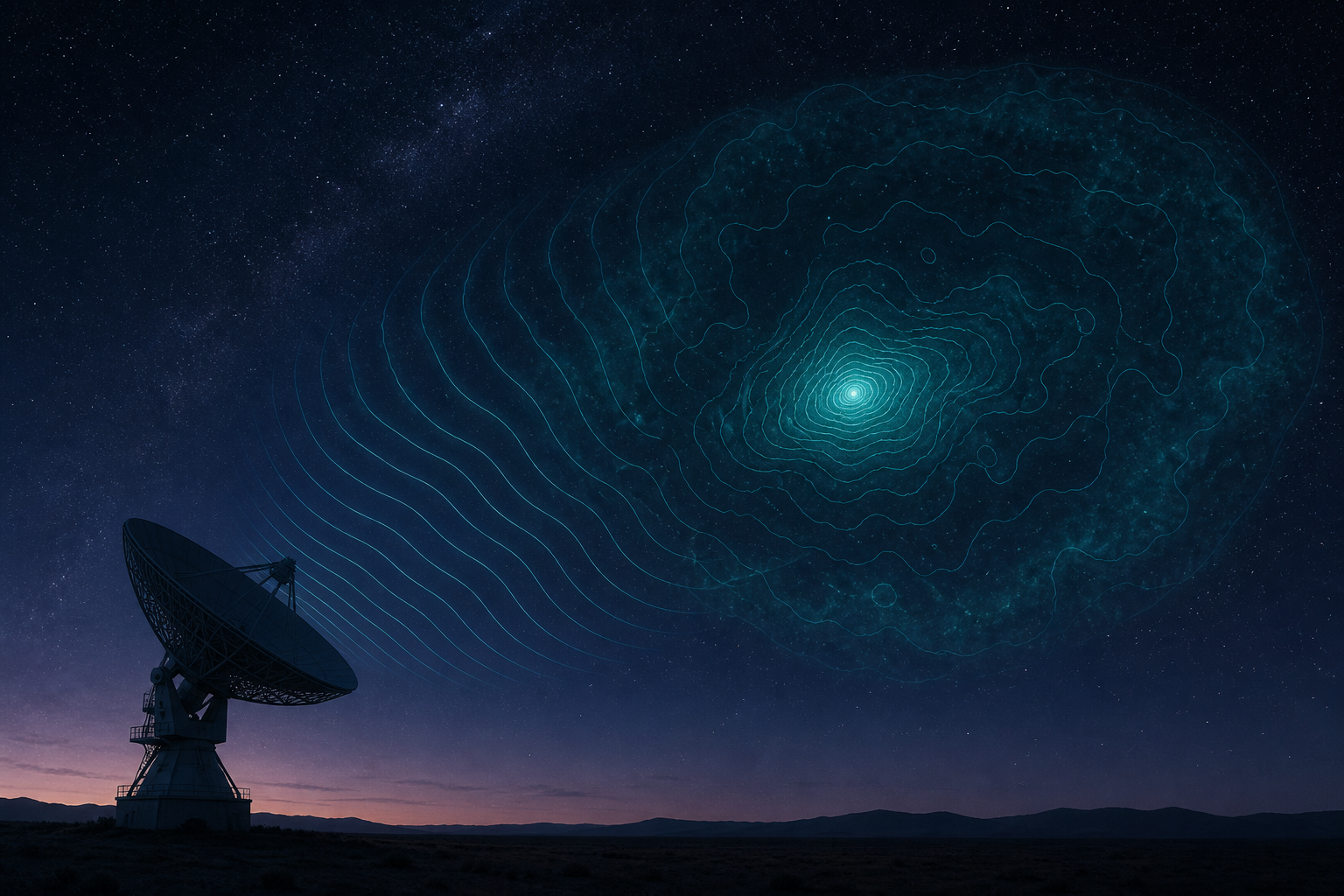
A separate, peer-reviewed radio study in Monthly Notices of the Royal Astronomical Society maps Cloud-9’s neutral hydrogen, or H I. Using FAST data together with Very Large Array observations, the researchers found a two-part structure: a compact, kinematically quiet core within a broader diffuse envelope.
At an assumed distance of 4.66 megaparsecs, the study measures about 1.79 million solar masses of H I gas. Its large-scale velocity pattern is not interpreted as orderly rotation; instead, the outer gas appears consistent with environmental interaction near the galaxy M94. Yet the compact core is difficult, in the authors’ interpretation, to explain as an unbound cloud made only of the detected gas. They conclude that Cloud-9 is most naturally understood as a dark-matter-dominated system undergoing environmental interaction.
That conclusion belongs to the radio analysis, not to the optical non-detection alone. The two results complement each other: one says “very little stellar light is allowed”; the other examines whether the gas has enough gravitational support to stay together.
Could Cloud-9 be something other than a starless galaxy?
Possibly. The radio paper itself discusses environmental effects and a stripped, reionization-limited H I cloud scenario. More broadly, astronomers must distinguish a dark-matter-dominated gas system from alternatives such as tidal debris or transient gas structures. The compact core plus diffuse envelope makes the simplest alternatives less satisfying, but it does not end the investigation.
That is why “candidate” should stay attached to Cloud-9. Follow-up work can refine its distance, map its gas in more detail, test models of its interaction with M94 and push the stellar limits still further.
Why this strange little cloud matters
Our leading models predict that many low-mass dark-matter haloes may never form enough stars to become familiar glowing galaxies. Finding a convincing nearby example would help test that idea on small scales — the scales where galaxies either ignite or remain almost entirely dark.
Cloud-9 is not an observing target for backyard telescopes. Its story is still a great reason to share the kind of cosmic question that rewards patience: what can the universe contain when there is gas and gravity, but almost no light? If that question makes you want to swap space news with people who get it, join the Cosmic Match astronomy community and bring your favorite “wait, how can that exist?” discovery. You can also catch up on NASA’s Roman Telescope and the dark universe, another mission built to uncover what ordinary visible light leaves out.
FAQ
Is Cloud-9 confirmed to be a galaxy with no stars?
No. Cloud-9 is a starless-galaxy candidate. The latest optical work found no stellar emission in the measured central region and set a much tighter upper limit on any stellar population, but it does not prove the absolute absence of stars.
Did astronomers directly see dark matter in Cloud-9?
No. Dark matter is not directly imaged here. The dark-matter-dominated interpretation comes from the radio study’s analysis of the gas structure and its likely gravitational confinement.
Can I see Cloud-9 with a telescope?
No practical amateur viewing guidance exists for Cloud-9. Its evidence comes from professional ultra-deep optical imaging and sensitive radio observations, not a visual target accessible to backyard equipment.
For a newer survey-scale look at how neutral hydrogen and star formation can evolve differently, read why star formation is slowing despite an atomic-hydrogen reservoir.