Lyrids Meteor Shower 2026: Best Viewing Spots in Austin and Texas
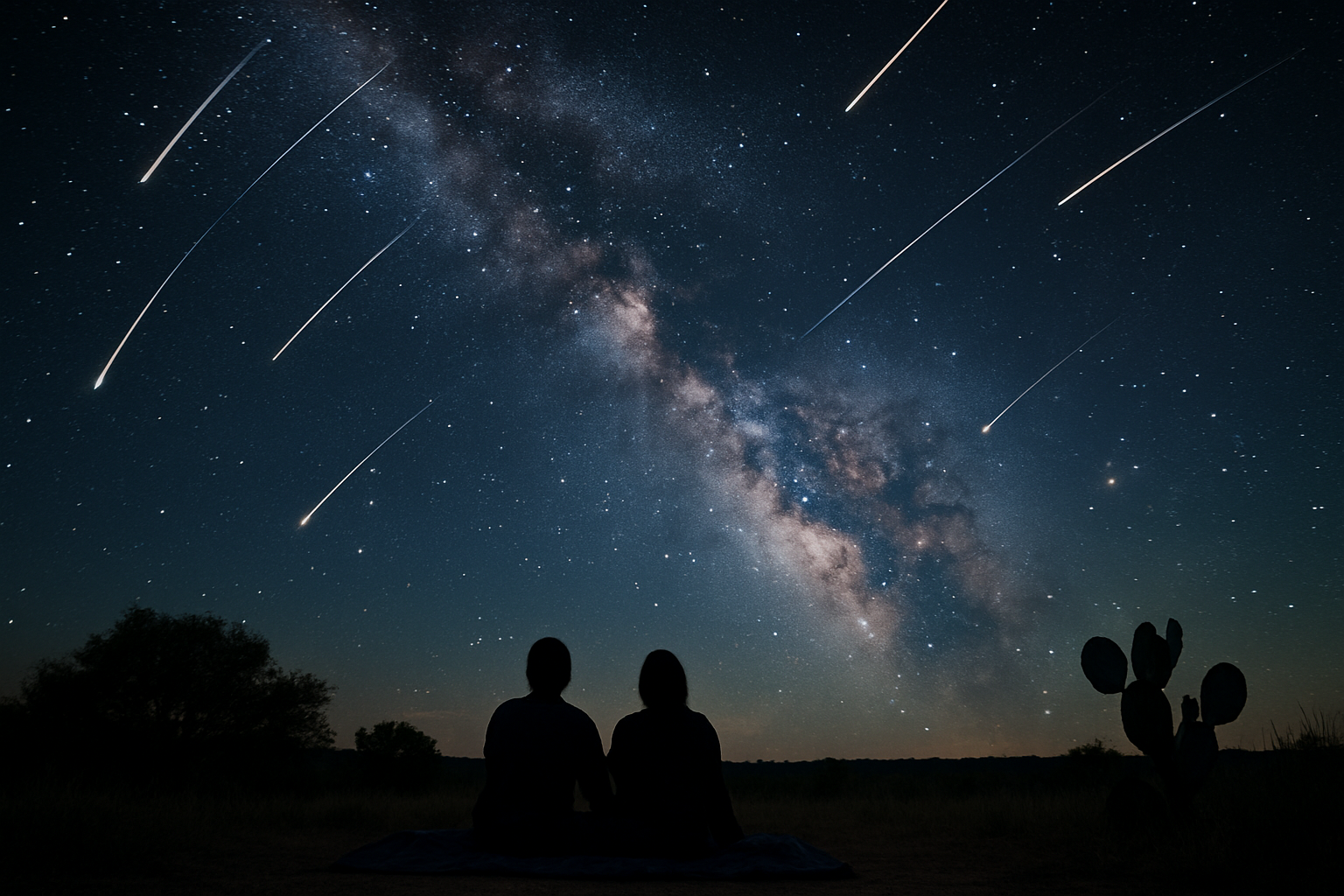
The Lyrids Meteor Shower 2026: Best Viewing Spots in Austin and Texas
Every April, Earth sweeps through a trail of ancient dust left behind by a comet that last passed close to the Sun before the American Civil War. The result is the Lyrids meteor shower — one of the oldest on record, observed by Chinese astronomers as far back as 687 BC, and still one of the most reliable shows in the spring sky.
In 2026, the Lyrids peak the night of April 21 into the predawn hours of April 22. If you are in Austin or anywhere in Texas, conditions this year are favorable: a thin waxing crescent moon sets well before midnight, leaving genuinely dark skies during the best viewing hours.
Here is everything you need to know — from the astronomy behind the shower to the best dark sky spots in Texas to make the most of it.
What Are the Lyrids?
The Lyrids get their name from the constellation Lyra, home to the brilliant star Vega — the radiant point from which the meteors appear to stream. The shower itself is caused by debris shed by Comet C/1861 G1 Thatcher, a long-period comet with an orbit of roughly 415 years. Every April, Earth passes through the cloud of dust and rock this comet left behind, and those particles burn up in our atmosphere at speeds around 49 km/s, producing the streaks of light we see.
At peak, you can expect 15–20 meteors per hour under dark skies — occasionally more. The Lyrids are known for periodic outbursts that can briefly push rates to 100+ per hour, though these are unpredictable. Shower meteors tend to be moderately fast and sometimes leave brief glowing trains in the sky.
When and Where to Look
Peak nights: April 21–22, 2026 Best viewing window: After midnight local time through predawn Radiant direction: Northeast — look toward Lyra, near the bright star Vega
The key is patience and darkness. Find a spot with a clear northeastern horizon, lie back on a blanket, and give your eyes 20–30 minutes to fully dark-adapt. You do not need a telescope or binoculars — meteor showers are always a naked-eye experience.
2026 Moon Phase: Conditions Look Good
A thin waxing crescent moon in 2026 sets within a few hours of sunset, well before peak meteor activity begins after midnight. That means minimal moonlight interference during the best hours of the shower — about as good as conditions get for the Lyrids.
Best Viewing Spots Near Austin
Austin's light dome limits in-city viewing, but you do not need to drive far to find genuinely dark skies. These are the best options within a few hours:
Enchanted Rock State Natural Area (Fredericksburg)
Distance: ~2 hours west Why go: The granite dome sits in deep Hill Country darkness with Bortle Class 4–5 skies. The open summit gives a 360-degree view with no trees blocking the horizon — one of the best meteor-watching sites in Central Texas. Reserve in advance: tpwd.texas.gov/state-parks/enchanted-rock
Pedernales Falls State Park
Distance: ~1 hour west Why go: Solid dark skies and easy access for Austin residents who cannot commit to a long drive. Primitive camping is available — combine meteor-watching with an overnight. Book at: tpwd.texas.gov/state-parks/pedernales-falls
Colorado Bend State Park
Distance: ~2 hours northwest Why go: One of the most consistently dark parks within range of Austin, with minimal light pollution in any direction. Set up on the open meadows for an unobstructed view. Book at: tpwd.texas.gov/state-parks/colorado-bend
Lost Maples State Natural Area
Distance: ~2.5 hours west Why go: Rugged canyon terrain blocks stray light from distant towns. Hike to an open ridge before dark for some of the best Lyrid conditions in the Hill Country. Book at: tpwd.texas.gov/state-parks/lost-maples
Reveille Peak Ranch (Burnet)
Distance: ~1 hour northwest Why go: This private dark-sky preserve hosts regular star parties with loaner equipment — ideal for a structured astronomy date or anyone new to the hobby. Info at: reveillepeakranch.com
For a deeper breakdown of these sites and more, see our full guide to best stargazing spots near Austin, TX.
Best Viewing Spots Across Texas
If you are willing to make a road trip of it, Texas has some of the darkest skies in the continental United States.
McDonald Observatory (Fort Davis, West Texas)
The McDonald Observatory sits at 6,791 feet in the Davis Mountains — far from any major city — with Bortle Class 2–3 skies. Their public Star Party nights are some of the best astronomy outreach events in the country, and the area offers exceptional transparency for meteor watching.
Big Bend National Park
Big Bend is a certified International Dark Sky Park and one of the least light-polluted places in the lower 48. Combine a Lyrids night with a desert hike and you have a trip worth building a full weekend around. Bring layers — spring nights in the Chihuahuan Desert drop sharply after sunset.
Guadalupe Mountains National Park
Guadalupe Mountains NP shares the same West Texas sky as Big Bend with equally exceptional darkness. The high desert plateau makes the Milky Way feel close enough to touch on a clear moonless night.
Palo Duro Canyon State Park (Amarillo)
Palo Duro Canyon offers a different kind of dark-sky experience: dramatic canyon walls that block stray light and frame the sky above in a way that feels almost theatrical. The wide plateau rim gives excellent northeastern exposure for Lyrid-watching.
What to Bring
A good meteor shower night requires almost no equipment — but the right gear makes a real difference:
- Blanket or reclining camp chair — lying flat is far more comfortable than craning your neck for two hours
- Red flashlight — white light destroys night vision; red-mode headlamps preserve it
- Warm layers — Texas spring nights cool down fast; dress 10–15°F warmer than the afternoon forecast
- Thermos with a hot drink — practical and atmospheric
- Insect repellent — spring in the Hill Country means bugs; do not skip this
- SkySafari or Stellarium app — use night mode to locate Lyra without killing your dark adaptation
- Offline maps downloaded — many of these parks have minimal or no cell service
Astrophotography: Catching Meteors on Camera
Meteors are fast, but a camera on a tripod with a long exposure can catch them. Here are the core settings to start with:
| Setting | Recommended Value |
|---|---|
| Aperture | f/2.8 or wider |
| ISO | 1600–3200 |
| Shutter speed | 15–30 seconds |
| Focus | Manual, set to infinity |
| Framing | Wide-angle lens, include a foreground element |
Point your camera toward the radiant in Lyra, use an intervalometer to shoot continuous frames, and review in the morning. Catching a meteor takes volume — plan to shoot 50–100 frames for a realistic chance at a keeper. Include something in the foreground (a silhouetted tree, a tent, a person) and you have a photograph worth keeping.
Make It a Date Night
There is something singular about watching meteors with someone. No screen, no agenda — just a blanket under a dark sky, two people pointing at the same streak of light.
The Lyrids are close to ideal for a first astronomy date: no equipment required, accessible spots within an hour of Austin, and a guaranteed show as long as skies cooperate. Pack the thermos, drive to Enchanted Rock or Pedernales Falls, and let the universe do the heavy lifting.
If you are still looking for someone to share these skies with, Cosmic Match was built for exactly that — a dating app for people who actually care whether the Lyrids produce an outburst this year. Find someone who wants to find out.
For more ideas on planning a memorable astronomy-themed evening, see our full guide to stargazing date ideas in Texas.
The Lyrids peak the night of April 21 into April 22. Check your weather forecast, reserve your campsite, and get out of the city. The skies over Texas are waiting.
For more events on the 2026 sky calendar — meteor showers, star parties, planetary conjunctions — see our complete guide to astronomy events in Austin TX 2026.