Stargazing Date Ideas in Texas: A Guide for Two
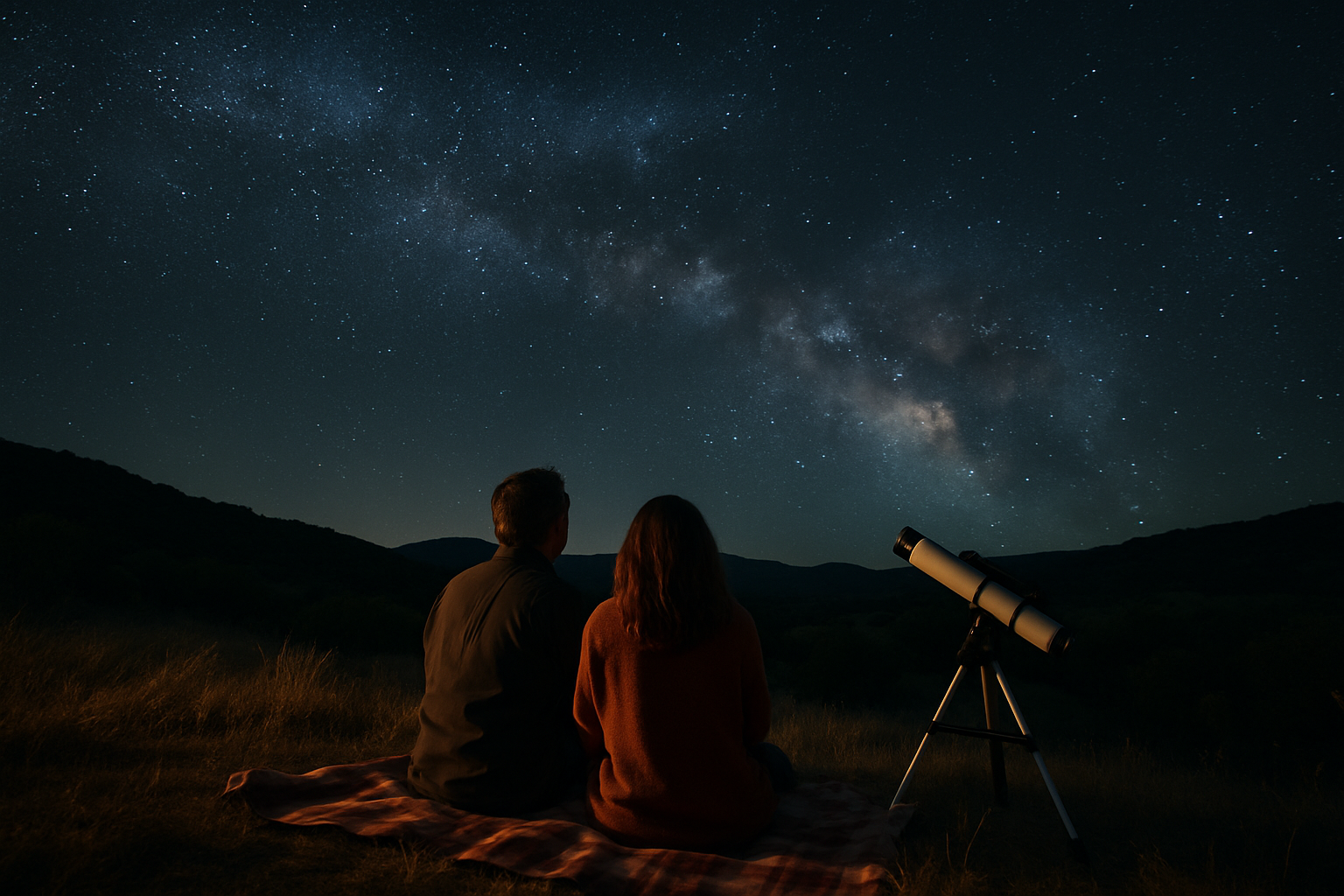
There are good dates, and then there are dates under a genuinely dark sky — the kind where you can see the Milky Way, where you both go quiet for a moment because the scale of what you are looking at is genuinely hard to process, and where two hours pass without either of you noticing.
Texas, for all its sprawling urban light pollution, is actually home to some of the best dark sky destinations in the country. If you and whoever you are hoping to impress have even a passing interest in the night sky, here is how to plan an astronomy date that lands.
If you are still scoping out what the Austin sky scene looks like, our guide to the best stargazing spots near Austin, TX has the full breakdown.
Why Stargazing Makes Such a Good Date
Before the logistics: stargazing is underrated as a date format, and here is why.
It requires almost zero planning pressure. You do not need reservations, a dress code, or a conversational agenda. You just need a blanket, a thermos, and a destination. The sky provides the spectacle.
It creates genuine shared wonder — one of the most reliable conditions for human bonding. Watching a meteor streak across the Milky Way together is the kind of moment that sticks. It also naturally creates the right conditions for real conversation: you are side by side rather than across a table, there is no background noise to compete with, and there is enough going on overhead that silence never becomes awkward.
And if your date is also a space enthusiast? You already have a shared language. The nerdy enthusiasm does not need to be explained or apologized for. That is a rare thing.
Stargazing Date Ideas Near Austin
Option 1: Reveille Peak Ranch Star Party (Burnet — ~1 hour from Austin)
Best for: First dates, people who do not own a telescope, anyone who wants some structure
Reveille Peak Ranch hosts regular star parties with loaner telescopes and guided viewing. The built-in programming takes the pressure off you to entertain — the sky and the staff do that. The drive is short enough to not feel like a commitment, and the site is dark enough to actually see deep-sky objects.
Bring: a blanket or camp chairs, snacks, and layers. The Hill Country gets cold after sunset even in spring.
Option 2: Pedernales Falls State Park (Stonewall — ~1 hour from Austin)
Best for: Couples who want solitude, campers, more experienced sky-watchers
 Photo: Travis Witt (Liveon001) / CC BY-SA 3.0
Set up along the Pedernales River after dark at Pedernales Falls State Park. The sound of the water, the absence of crowds on a weeknight, and the surprisingly dark skies make this feel more intimate than any organized event. If you bring a telescope or even a decent pair of binoculars, you can pick out the Andromeda Galaxy on a good night.
This one works especially well as an overnight — camp in, stargaze late, wake up for sunrise over the river. Ambitious for a first date, but perfect for an established relationship or a very promising second or third outing.
Option 3: Enchanted Rock at Dusk + Stars (Fredericksburg — ~2 hours from Austin)
Best for: Adventurous types, hikers, anyone who wants a double feature of sunset and stargazing
 Photo: K B / CC BY 2.0
Hike up the dome at Enchanted Rock State Natural Area for sunset, then stay as the sky darkens. Enchanted Rock is one of the most visually dramatic places in Texas at any time of day — at night, with the stars coming out above the granite and the Hill Country stretching in every direction, it earns a kind of quiet majesty.
Reservations required — book through Texas Parks & Wildlife. This is worth the advance planning.
Option 4: Your Own Backyard (With the Right Setup)
Best for: Early in a connection, when a 2-hour drive feels like too much commitment
Not every stargazing date needs to be an expedition. If one of you has a telescope — or even a decent pair of 10x50 binoculars — setting up in a backyard away from streetlights can still produce genuinely memorable views. Saturn's rings. Jupiter and its moons. The Orion Nebula. The Pleiades.
Pair it with takeout or a home-cooked meal, and you have an evening that costs almost nothing but delivers a lot.
If your backyard plan includes buying a first scope, start with our practical guide to the best beginner telescope for city stargazing before you spend money on gear.
The West Texas Upgrade (For When Things Are Going Well)
If you have been together long enough that an overnight road trip sounds like fun rather than a risk, West Texas is the destination.
 Photo: Vincent Lock / CC BY 2.0
McDonald Observatory Star Parties (Fort Davis)
 Photo: Zereshk / CC BY-SA 3.0
The McDonald Observatory runs public Star Party programs several nights per week. You look through actual research-grade telescopes. Expert staff narrate what you are seeing. The skies at altitude in Far West Texas are among the darkest in the continental United States. It is worth the 5-6 hour drive from Austin by any reasonable calculation.
Stay in Fort Davis or Marfa. Make a weekend of it. This is the kind of trip that becomes a shared memory that lasts.
And while you are planning that West Texas adventure, check out our calendar of astronomy events in Austin TX for 2026 — you might find the perfect meteor shower or star party to build a trip around.
What to Bring on a Stargazing Date
- Blanket or reclining camp chairs — lying on your back to look up is much more comfortable than craning your neck
- Red-mode headlamps — white light kills night vision; red light preserves it
- Layers — seriously, bring more than you think you need
- Thermos with something warm — coffee, tea, hot chocolate, whatever fits the vibe
- Snacks — a few hours under the stars goes by faster than expected
- A sky chart app — Stellarium (free) or SkySafari on red-night-vision mode
- Binoculars — even a basic 10x50 pair transforms what you can see
Finding Someone to Share the Sky With
All of this assumes you already have someone to bring. If you are still looking for a fellow space enthusiast in Austin — someone who will actually appreciate the difference between a good and a bad seeing night, who texts you about upcoming meteor showers, who knows what the Bortle scale is — that search is its own challenge.
Cosmic Match exists for exactly this. It is a dating app built for the astronomy and astrophotography community: people who are serious about the night sky, who find space genuinely fascinating rather than abstractly cool, and who want to meet someone who gets it.
Profiles include your astronomy interests, equipment, favorite objects to observe, and what you are looking for in a sky-watching partner. The compatibility scoring actually accounts for this stuff. AI-powered icebreakers are seeded from shared space interests, which means first conversations tend to be real ones.
The stargazing date ideas above are better with the right person. We can help you find them.
Clear skies — and good company.
Coming up: The Lyrids meteor shower 2026 peaks April 21–22. See our complete guide to the best viewing spots in Austin and Texas.
If you want a more structured telescope night, our guide to observatory date nights in Austin, Houston, and Los Angeles covers public observatory programs, planetarium options, and practical planning tips.