Candidate Sibling Supernova Remnants? What Fermi Found Behind the Jellyfish Nebula
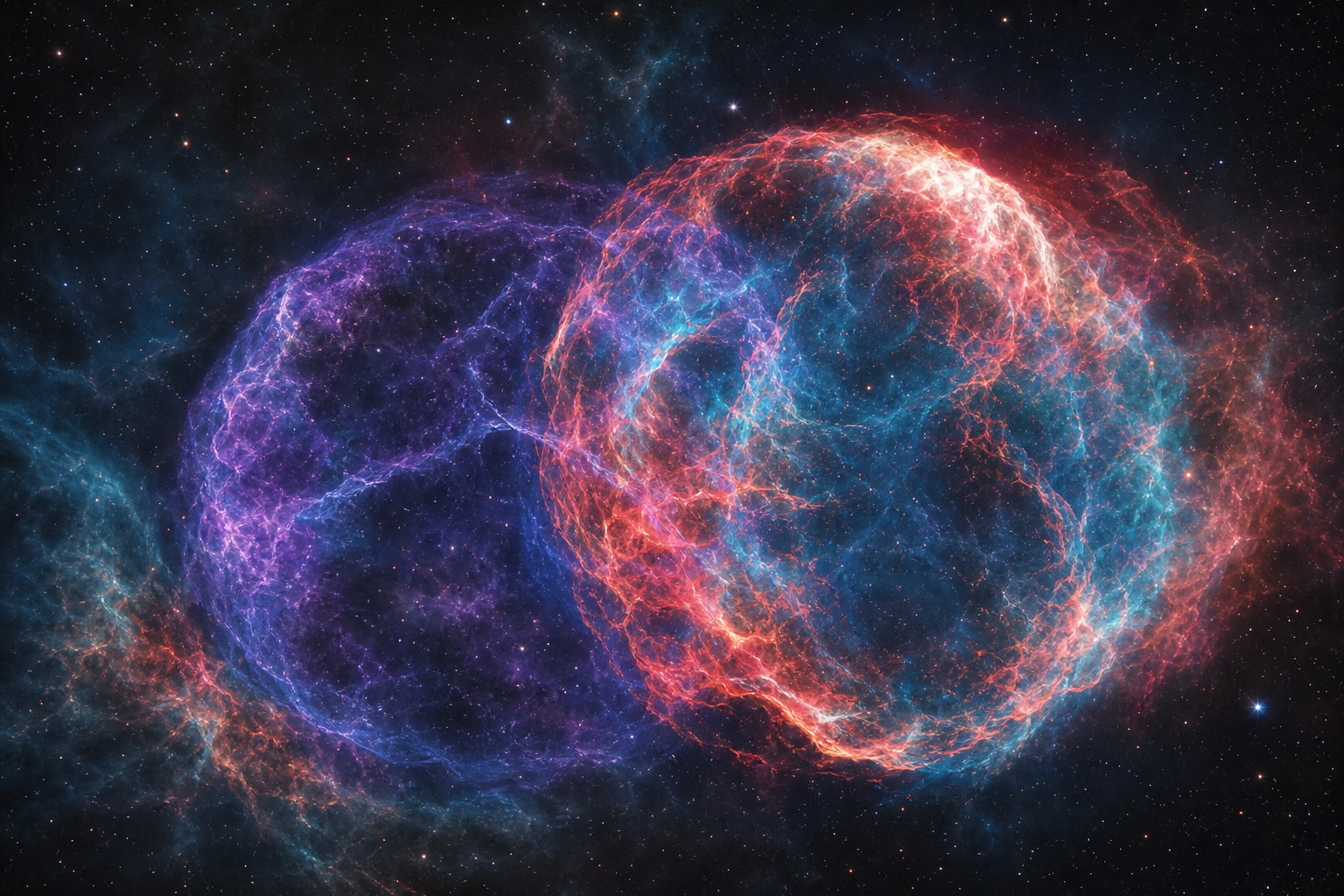
Two expanding clouds of stellar debris are giving astronomers a remarkable cosmic detective story. Behind the bright Jellyfish Nebula, researchers have found evidence that a fainter overlapping remnant may be its long-ago sibling: the remains of a second massive star that once shared a binary system with the first.
The important word is candidate. Nobody observed two supernovas going off, and this is not something to watch tonight from Austin, Houston, or Los Angeles. Instead, a new peer-reviewed study reconstructs a possible shared history from the debris still glowing tens of thousands of years later. Sixteen years of NASA Fermi Large Area Telescope data helped reveal gamma rays from the fainter remnant, G189.6+3.3, which had been difficult to separate from the much brighter IC 443—the Jellyfish Nebula.
The result is exciting precisely because it is careful: several independent clues line up, but the binary-origin story still needs deeper follow-up observations.
The short version
IC 443 and G189.6+3.3 are supernova remnants: expanding structures of gas and energized particles left after massive stars die. They appear to overlap on the sky. The new work finds that G189.6+3.3 interacts with the same surrounding gas-cloud complex as IC 443, supporting the idea that they are at a common distance rather than merely aligned by chance.
The team then combines that shared-cloud evidence with distance estimates, age ranges, and binary-star simulations. Their conclusion is not “we watched sibling supernovas explode.” It is that IC 443 and G189.6+3.3 are a strong candidate for two separate supernovas from a former binary system.
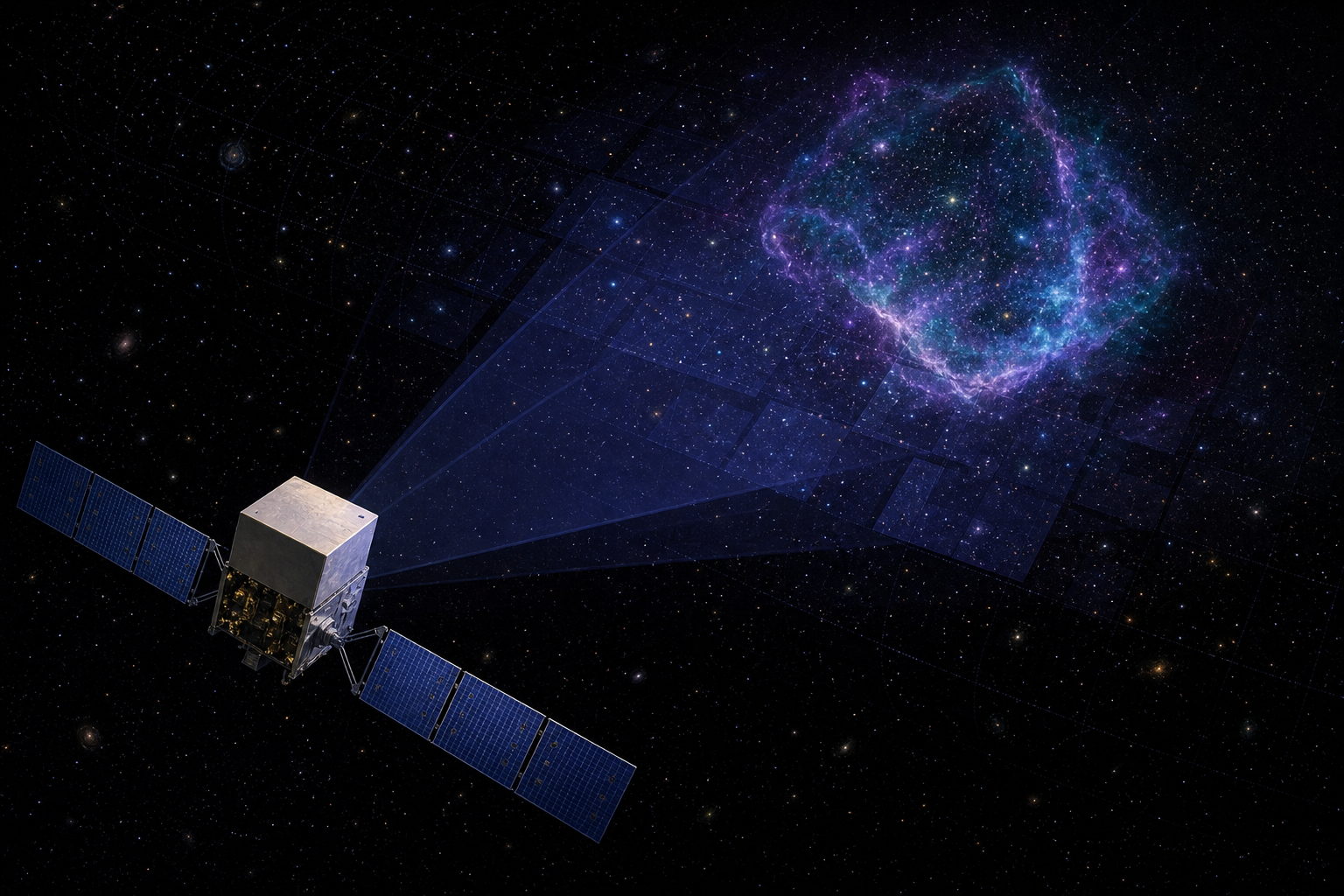 An illustration of long-baseline gamma-ray observations. Fermi’s data reveal a remnant that is faint beside the Jellyfish Nebula; this is not a live view of an explosion.
Why the faint remnant matters
IC 443 is one of the Milky Way’s best-known gamma-ray supernova remnants. Its brightness has made its neighborhood hard to untangle. G189.6+3.3 is fainter and partly overlaps it, so a simple look at the region can blend signals from different structures.
Using 16 years of Fermi-LAT observations, the research team identifies extended GeV gamma-ray emission that matches the known X-ray shell of G189.6+3.3. That is an important step in establishing the faint object as a remnant in its own right—not just spillover from IC 443.
The paper also finds two different gamma-ray environments within G189.6+3.3. In its northern region, gamma rays line up with a filament and dense gas in a way consistent with energetic protons interacting with material. Farther south, the signal is more consistent with accelerated electrons in a lower-gas environment. For a beginner-friendly translation: the remnant is not a uniform bubble. Its particles and light change depending on what part of the local interstellar environment the shock wave reaches.
The shared-cloud clue
The strongest bridge between the two remnants is a nearby ionized-gas cloud called S249. The paper reports evidence that G189.6+3.3 is interacting with S249; previous work already connected IC 443 to that same cloud. Multiple wavelengths help make that case: gamma rays, X-rays, optical filaments, infrared dust structure, and molecular-gas observations all point to a real physical neighborhood.
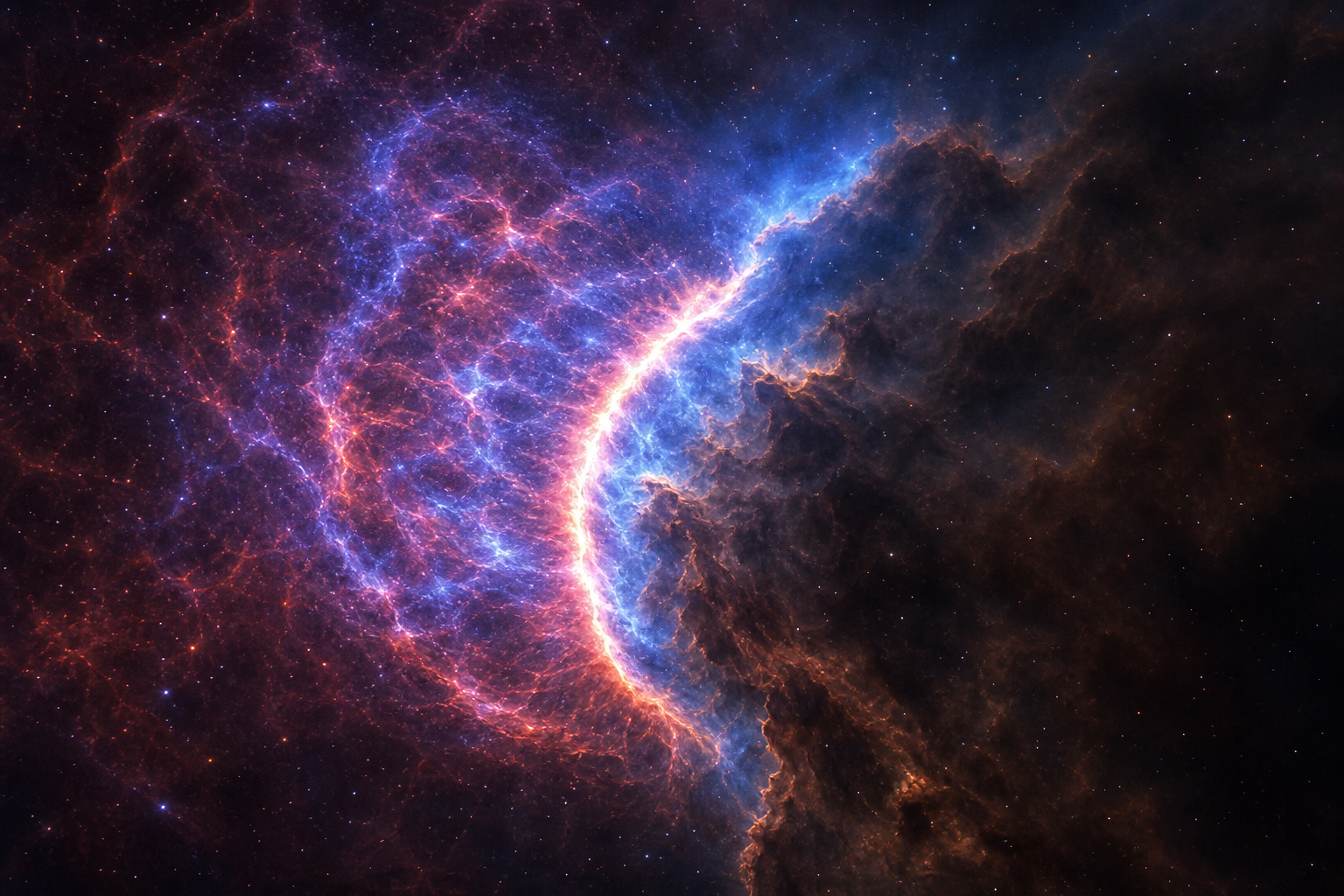 A conceptual view of a supernova shock interacting with dense interstellar gas—the type of shared environmental clue used to compare the two remnants.
That matters because objects that merely overlap in a flat sky image can be very far apart in three dimensions. The shared interaction gives astronomers a reason to place G189.6+3.3 and IC 443 at roughly the same distance: about 1.8 kiloparsecs, or nearly 6,000 light-years away.
That is still far too distant and faint for a local naked-eye observing plan. The news here is archival, multiwavelength astronomy—not a new point of light in the evening sky.
Could two former companion stars produce this layout?
The candidate story becomes more plausible when time and distance are added. The study estimates G189.6+3.3 to be about 20,000 to 110,000 years old. Literature estimates place IC 443’s most likely age nearer 8,000 to 9,000 years. The inferred delay between the two explosions is therefore on the order of 20,000 to 100,000 years, while their projected explosion centers are roughly 9 to 15 parsecs apart (about 30 to 50 light-years).
That arrangement can arise in a binary system. In the proposed scenario, two massive stars begin gravitationally bound. The more massive star explodes first, and the companion may be sent moving through space. After tens of thousands of years, the companion itself explodes. The two remnants then expand until they partly overlap.
The authors simulated one million massive binary systems and found that interacting binaries can naturally produce combinations of separation and delay like the IC 443/G189.6+3.3 system. That does not prove this exact pair had that past. It does show that the reconstructed geometry is physically reasonable rather than a cosmic coincidence with no viable pathway.
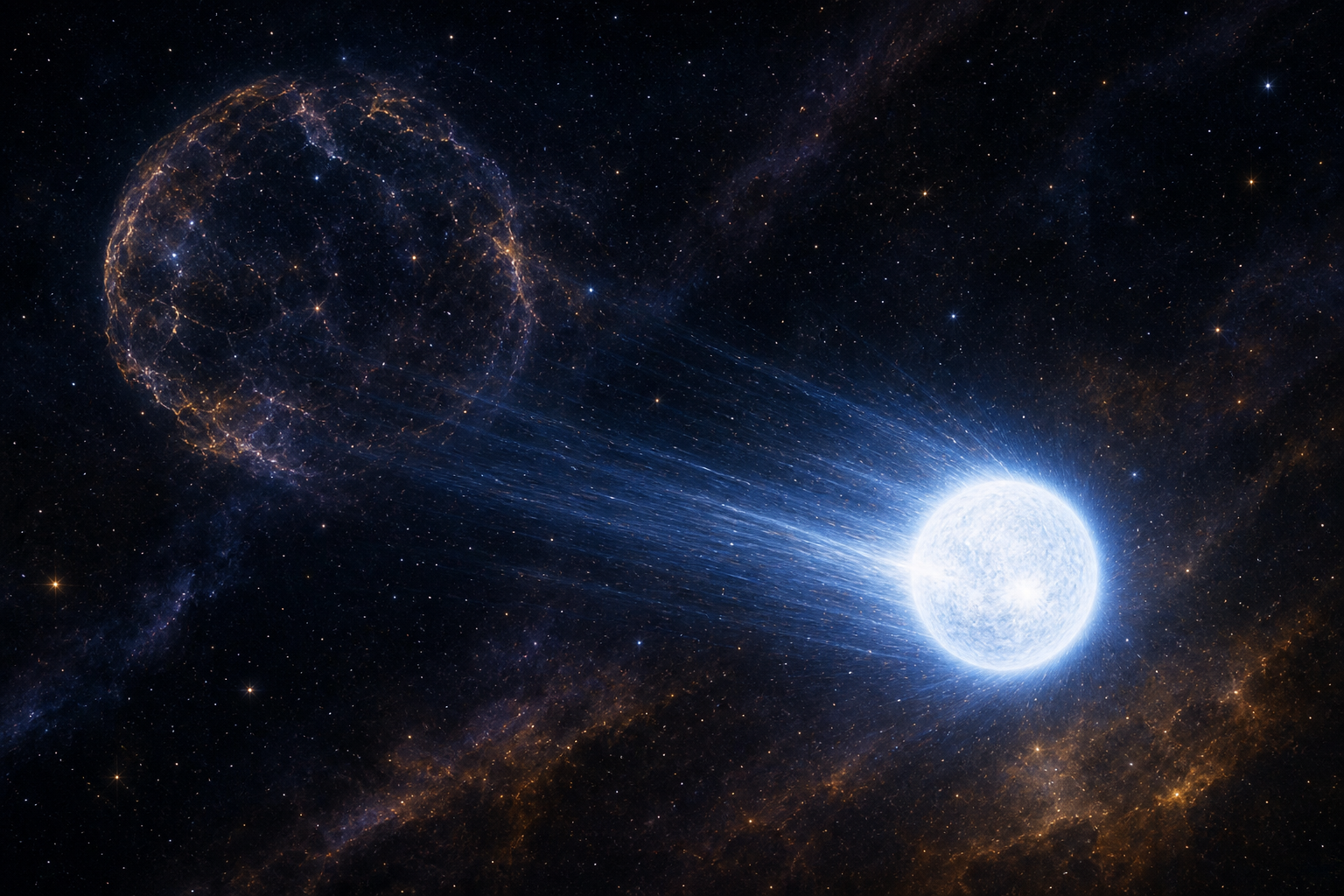 A conceptual illustration of the proposed sequence: after a first supernova, a companion star may travel before its own later supernova. It is a model for the candidate history, not an observed event.
What would make the case stronger?
Science rarely closes a case with one kind of measurement. The researchers describe the binary connection as compelling support for a hypothesis, and they also name the work still needed: deeper X-ray and optical spectroscopy, improved molecular-gas maps, and more sensitive gamma-ray observations. Those observations could refine the shock conditions, environmental composition, distances, and the relationship of any compact remnants such as neutron stars.
That uncertainty is not a letdown. It is the useful part of the story. A candidate pairing gives astronomers a focused laboratory for learning how massive binaries evolve, how supernova shocks energize particles, and how remnants can hide inside one another’s glow.
For more approachable explainers, explore Space Science & Cosmology, including our LHS 1140 b helium-signal explainer. You can also see why a bright planet sometimes surprises first-time observers in our guide to Saturn before dawn, or try a low-equipment sky session with the Summer Triangle from a city balcony.
The best space conversations often start with a headline and continue with, “What did the researchers actually measure?” If that is your kind of question, join the Cosmic Match space community and sign up to meet fellow astronomy enthusiasts.
Sources
- Michailidis et al., “Shared cloud interactions unveil a candidate binary-system supernova pair with no known analogue,” Nature Communications (2026)
- NASA: “Fermi Mission Uncovers Possible Sibling Supernova Remnants”
- Stanford Report: research-team context and proposed sequence
Related reading: Betelgeuse B: why ESO’s new direct image is strong evidence—but not final confirmation.