The Milky Way’s First Convincing Microblazar, Explained
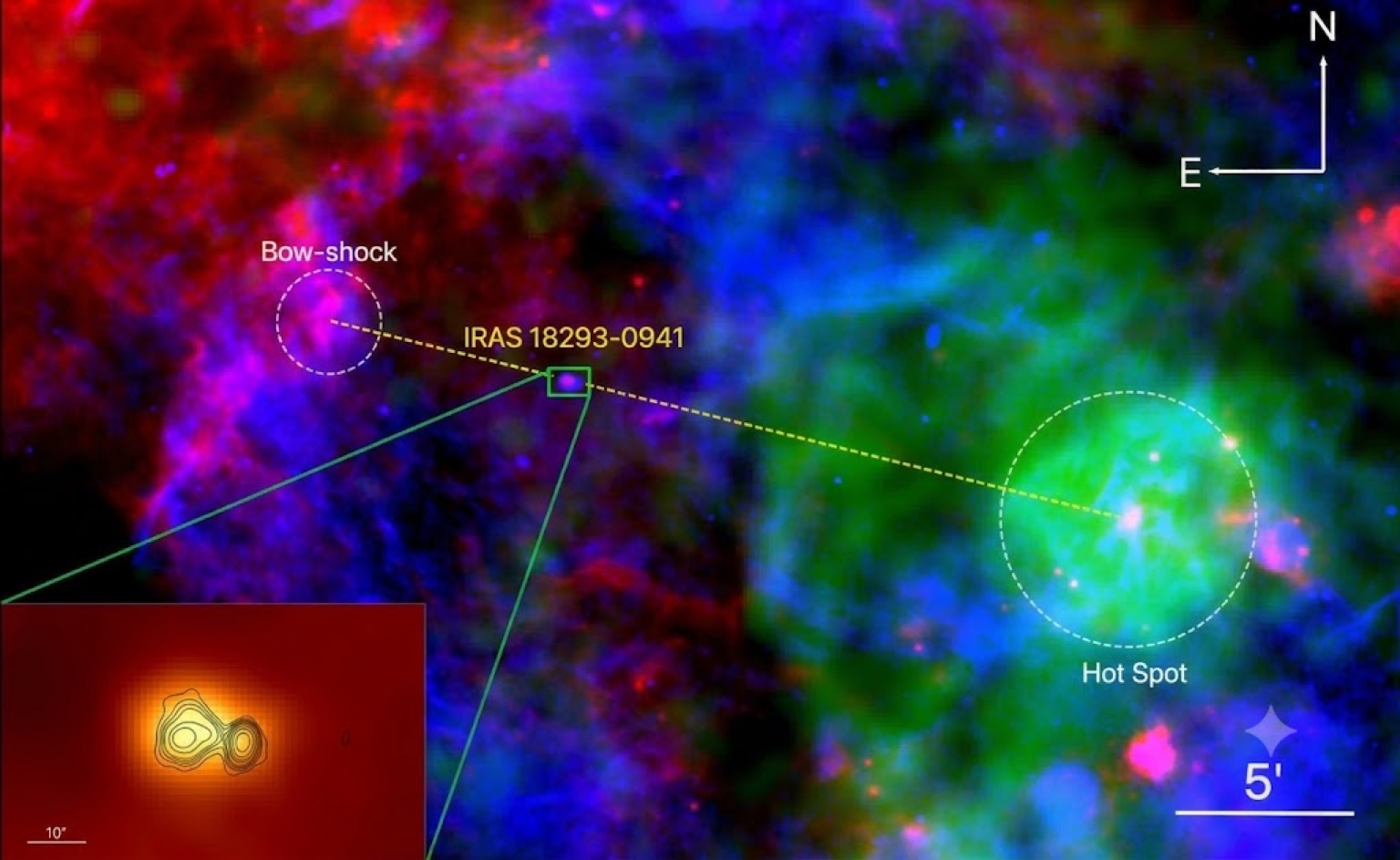
Astronomers have reported the first convincing microblazar in the Milky Way: IRAS 18293−0941, a binary system roughly 12,000 light-years away. The case rests on a persistent one-sided radio jet, an 11.38-day binary orbit seen nearly face-on, and precise positions that connect the jet to the stellar system. The possible link to an ultra-high-energy particle source is an exciting, model-supported association—not a proven identification.

Jet–environment interaction around IRAS 18293−0941. Credit: Martí et al. 2026, CC BY 4.0, adapted only by resizing from the authors’ arXiv paper.
What is a microblazar?
A blazar is a black-hole system with a jet that happens to point close to our line of sight. Material in that jet travels at a substantial fraction of light speed, so relativistic Doppler boosting makes the approaching side appear unusually bright. Most familiar blazars are powered by supermassive black holes in distant galaxies.
A microblazar is the smaller Galactic analogue: a stellar-mass compact object feeding from a companion star and launching jets. Astronomers have predicted that our galaxy should contain them for decades, but a bright radio streak alone is not enough. A convincing case must show that the jet belongs to a Galactic binary, that it persists, and that the geometry really is close to face-on.
Why is IRAS 18293−0941 the first convincing candidate?
The system contains a hot, massive star and a compact object described by the team as a black-hole candidate. Material stripped from the star builds an accretion flow; a fraction is expelled in two opposing jets. Long-term optical monitoring found a 11.38 ± 0.01-day modulation, consistent with the binary orbit. The small amplitude and lack of eclipses indicate a low orbital inclination.
Radio observations supply the key visual evidence. The European VLBI Network resolved a collimated, one-sided jet that lines up with larger-scale radio structure. “One-sided” does not mean the system fires just one jet. The jet moving away from us is expected to look much dimmer because of relativistic beaming. Gaia’s stellar position and the radio position agree, which rules out a chance background active galaxy masquerading as part of the binary.
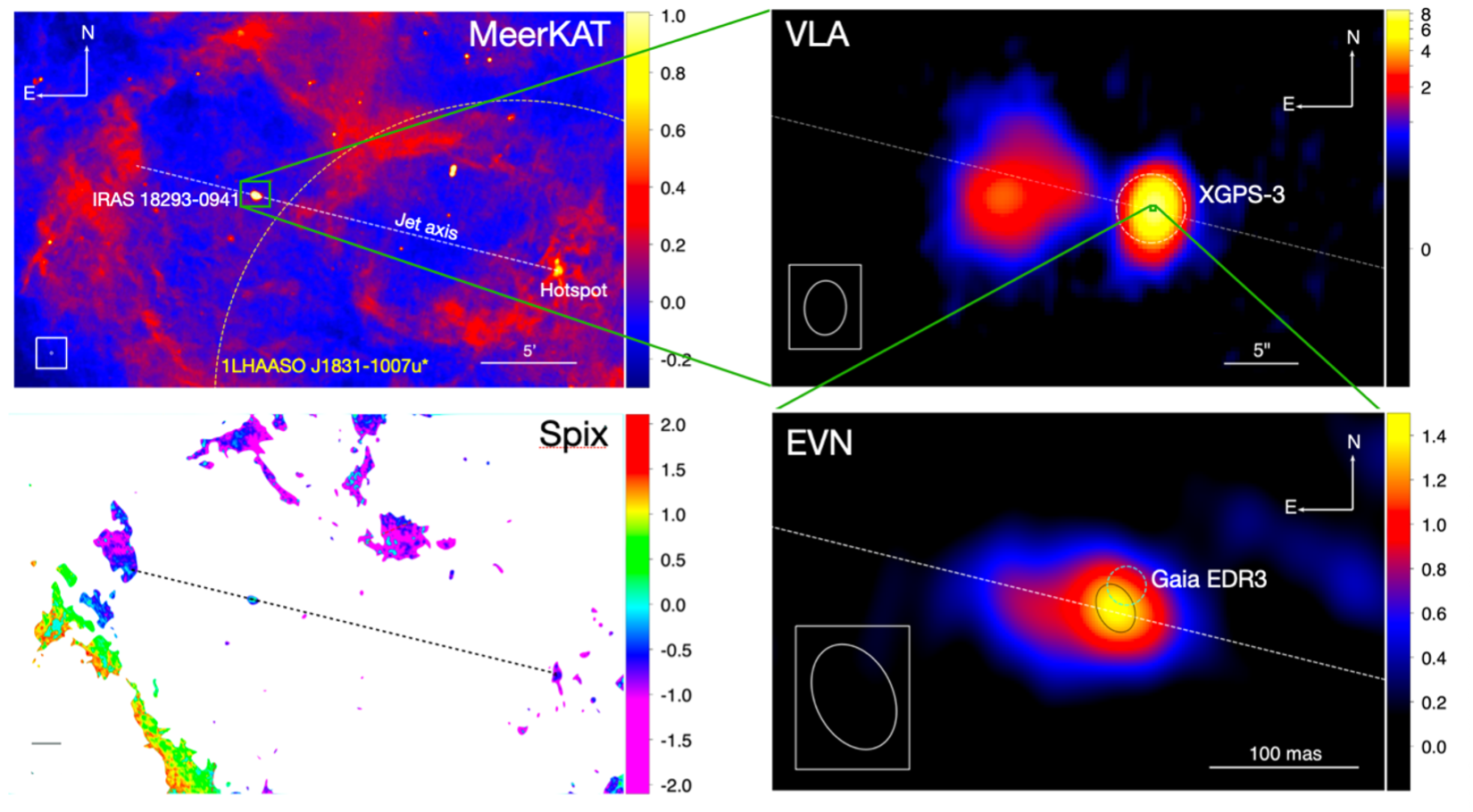
Radio views across scales show the compact core, one-sided jet, larger structures, and hotspot. Credit: Martí et al. 2026, CC BY 4.0, from the authors’ arXiv paper.
Does a jet aimed toward Earth pose any danger?
No. “Aimed toward Earth” describes a viewing geometry that makes the approaching jet easier to measure; it is not evidence of a new threat. At about 12,000 light-years away, IRAS 18293−0941 is a research opportunity, not a hazard. The favorable alignment lets scientists inspect jet physics in far greater detail than they can for distant blazars.
Think of a flashlight: it appears brightest when pointed at you. Here, special relativity magnifies that effect. The phrase tells us why the source is conspicuous, not that Earth is in harm’s way.
What does the jet–cloud interaction show?
The study also finds large structures aligned with the jet. On the proposed receding side, the jet seems to end at a compact radio hotspot after crossing a roughly 100-light-year bubble and meeting a dense molecular cloud. The hotspot coincides with signatures of shocked gas and warmed dust.
That makes this more than a striking perspective effect. Jets can transfer energy to the interstellar environment—carving cavities, compressing material, and heating gas. It gives astronomers a nearby laboratory for studying a process that is much harder to disentangle in faraway galaxies.

Model diagram of the proposed binary, jets, cavity, and cloud interaction. Credit: Martí et al. 2026, CC BY 4.0, from the authors’ arXiv paper.
Is it really a PeV particle accelerator?
Potentially—but that part is not proven. The hotspot lies in the region of the ultra-high-energy gamma-ray source LHAASO J1831−1007u*. The authors model a scenario in which particles accelerated near the jet termination hit the dense cloud and produce gamma rays. If right, the system could be a Galactic PeVatron, capable of accelerating particles toward peta-electronvolt energies.
There is compelling geometry and an energetically consistent model, but neither spatial coincidence nor a viable model uniquely proves the origin of every gamma ray in the field. The paper uses calibrated language: IRAS 18293−0941 is a potential accelerator and a plausible contributor. Further high-resolution observations of the impact site will test that idea.
Why this matters even if you don’t own a telescope
You cannot point binoculars at IRAS 18293−0941 and see its jet. Dust obscures the system, and the evidence came from radio, optical, infrared, X-ray, and gamma-ray instruments working together. Still, it is a vivid reminder that the Milky Way is not a static backdrop: it contains local versions of some of the universe’s most powerful engines.
For more discoveries explained without assuming a physics degree, browse our Space Science & Cosmology collection. See how another team communicates uncertainty in LZ’s dark-matter hint, or explore the evidence behind Hubble and Webb’s tiny worlds beyond Neptune. For a related story from another cluster, read how Henrietta Leavitt made cosmic distance measurable.
Want a place to swap “wait, how does that work?” questions with other space fans? Join the Cosmic Match astronomy community or meet local stargazing people in Austin. No telescope required—just curiosity.
Sources
- Martí et al., “A Galactic microblazar as a potential accelerator of ultra-high-energy particles” (accepted in Astronomy & Astrophysics; preprint, CC BY 4.0).
- South African Radio Astronomy Observatory release, September 22, 2026.
- University of Amsterdam / Anton Pannekoek Institute release, September 22, 2026.
For another look at how astronomers use non-light messengers to study extreme cosmic sources, read how IceCube turned Antarctic ice into a neutrino observatory.